

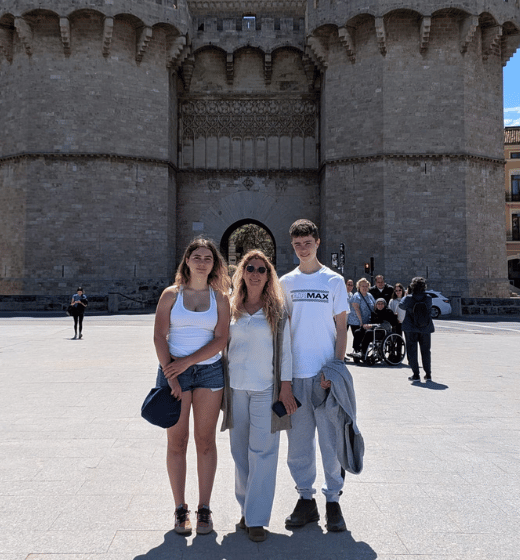
In shortRichard, a British secondary-school student from Hertfordshire training to be a pilot, spent two weeks in April living with host teacher Pilar in Gilet, just outside Valencia. He arrived at A1 with GCSE grammar and no confidence to speak. He left holding conversations across present, past and future tenses, having ordered, shopped, cycled and shared paella entirely in Spanish.
StudentTeenager, UK
Length2 weeks
WhereGilet, Valencia
LevelA1 → conversational
P
¡Hola! I'm Pilar Martínez, a host teacher with the Spanish Homestay Immersion Programme (SHIP) in the quiet town of Gilet, twenty minutes north of Valencia. Students live in my home, share my table, and learn Spanish the way it is actually used. This April I welcomed Richard. This is his story, from his evening landing to his final sunset.
Long before a pilot is allowed to fly, he has to learn to speak. The instruments matter, but the words exchanged with the ground are what keep everyone safe and moving. Language, then, is not really a school subject. It is equipment. Some of my students understand that instinctively, and those are the ones who make the fastest progress.
Why Richard came to Gilet

Richard is a British secondary-school student from Hertfordshire, and he brought more energy into my house than almost anyone before him. He grew up speaking English and Russian and has been studying Spanish since Year 7. He is training to become a pilot. He also codes, has recently taken up CrossFit, plays several sports and cycles regularly.
He came to us at A1, following his GCSE Spanish path and thinking ahead to an official Spanish exam. School had given him grammar and vocabulary, but not enough chances to actually speak. That was his goal: fluency, and the confidence to hold a conversation in everyday situations without freezing. Two weeks of living in Spanish, rather than studying it from a distance, was exactly the missing piece.

Week one: building the language piece by piece
Our mornings followed a clear structure. We began with breakfast in Spanish, then moved into formal class using the Spanish Express verb workbook, which gave Richard a solid framework to build on. Each new tense arrived only when he was ready to use it.
Week 1
- Present tense, regular and irregular verbs
- Reflexive verbs
- Verbs like gustar
- The near future
Week 2
- Present perfect
- Past simple
- Moving between tenses in one conversation
Every grammar point was immediately put to work. Richard wrote a personal presentation, described his daily routine, planned his summer, and later recounted his Easter holidays and his last trip. Each written task was followed by a conversation on the same theme, so the vocabulary moved from the page into his mouth. By the final Friday he was holding a full conversation moving between present, past and future. For a student who started at A1, that was a real achievement.
Valencia on foot: towers, Romans and a supermarket queue
207 steps up the Miguelete
Richard had never set foot in Valencia before, and the historic centre made an immediate impression on him: the architecture, the narrow streets, the layers of history. The highlight was the bell tower of the Cathedral, known as the Miguelete. He took on all 207 steps with real enthusiasm, no complaints on the way up. The panoramic view from the top left him amazed, and it gave us plenty to talk about afterwards.

Underground at the Almoina
The same afternoon we visited the Basilica and then went underground into the Almoina Archaeological Museum, where the Roman, Muslim and Iberian remains of the city are on display. Richard has a naturally analytical mind, and this suited him perfectly. He wanted to understand how one civilisation had built directly on top of another. We described what we could see in simple Spanish, which turned a museum visit into a very effective vocabulary lesson.
Spanish where it actually happens
The supermarket is one of my favourite classrooms, and Richard understood why within ten minutes. Shelves, labels, prices, weights, and a real cashier waiting for a real answer. He handled food vocabulary, quantities and polite phrases, and he learned to read packaging carefully, which mattered for him given the products he avoids. Nobody slows down for you in a supermarket queue. That small pressure is exactly what builds listening skills and confidence in a foreign country.

Valencia by bike: the day he had been waiting for
This was the day Richard had been waiting for, although he did not know it yet. Cycling is one of his great passions, and the Turia Gardens are the perfect place for it. We rode through the old riverbed, now a long green park running through the heart of Valencia, with bridges passing overhead. He was completely in his element. Talking while cycling turned out to be one of the most natural speaking practices of his whole programme.


Our route carried us to the City of Arts and Sciences, where the white futuristic structures rise out of the water at the end of the gardens. Richard, with his interest in engineering and flying, was fascinated by the shapes and the way the buildings are constructed. Conversations about design and architecture pushed his vocabulary well beyond the usual beginner topics, which is exactly what he needed.
From the gardens we continued all the way to Malvarrosa Beach and stopped for a relaxed lunch beside the sea. Meals like this are where the real learning quietly happens. There is no lesson plan, no correction sheet, just conversation over food. Richard talked about flying, about his training, and about home. Relaxed, unhurried Spanish, spoken because he wanted to say something.
We finished the way Valencians do, with a cold horchata at Horchatería Daniel, one of the most popular spots in the city for the traditional drink. For Richard it was something completely new, sweet and refreshing after hours on the bicycle. Ordering it himself was part of the experience. Small transactions like these, repeated across two weeks, are what turn a hesitant student into a confident speaker.
Talking while cycling turned out to be one of the most natural speaking practices of his whole programme.Pilar, host teacher
Tables, markets and a house shaped like a dragon
The Science Museum, hands on
Given his love of programming and machines, the Science Museum was always going to be a success. It is built around interactive exhibits, so nothing is behind glass. Richard pressed, pulled, tested and read his way through it, asking questions constantly. Because the explanations were in Spanish, he was reading and processing the language without noticing he was working.
Sunday paella
Sunday brought one of the warmest days of his stay. We gathered family and friends around a proper Valencian paella. Richard found himself at a table full of native speakers, all talking at once, as Spanish tables tend to do. He listened, joined in, and laughed along. Sharing food with real people did more for his confidence than any exercise I could have set.


Central Market, La Lonja and the Serranos Towers
Back in the centre, we explored the Central Market with its enormous domed hall and endless stalls, then the Silk Exchange and the Serranos Towers. Richard was interested in the history behind each one, and the market gave him a chance to shop in Spanish. He bought gifts for his family, including traditional turrón and magnets of Valencia's landmarks. Asking, choosing and paying entirely in Spanish was a proud moment for him.

Hiking to the Dragon House
Close to my home in Gilet stands the Dragon House, a strange and wonderful building covered in decoration that looks like something from a story. Richard explored it with Fleur, another of my students that fortnight, and the two of them climbed the mountain behind it, almost reaching the summit. For a student who loves the outdoors, this was unforgettable. It also showed him a quieter, greener side of life in Spain.
The last days: Bioparc and a golden Albufera
Richard enjoyed the first cycling day so much that he asked for another one, which tells you everything about how the fortnight was going. This time we rode from the city centre through the Turia Gardens all the way to Bioparc, the Valencia zoo at the far end of the park. The route gave us hours of natural conversation, moving between present, past and future tenses without a single grammar drill.

We closed his programme at the Albufera, the lagoon just south of the city, aboard a traditional boat as the light began to fade. Water, forest and birds rising in every direction, with the sky turning gold above the reeds. Richard, who loves nature, hardly spoke for a while. It was a peaceful and beautiful ending, and a final memory of Valencia to take back to Hertfordshire.

What changed for Richard
Arrived with
- A1, GCSE-path Spanish
- Grammar and vocabulary from school
- Few chances to speak, froze in conversation
→
Left with
- Seven grammar areas used in real conversation
- Present, past and future in one exchange
- Noticeably sharper listening around native speakers
- Ordering, shopping and paying without help
Most of all, his attitude carried him. Enthusiastic, curious and always ready to participate, he made his own progress possible, both academically and personally. He arrived with school Spanish and left with something far more useful: the willingness to speak.
If you're a teenager thinking about this
- A1 is enough to start. Richard had GCSE grammar and little speaking practice. Two weeks was enough to connect the two.
- Tell your teacher what you love. Richard's fortnight was built around bikes, machines and the outdoors. Yours can be built around whatever gets you talking.
- Two weeks beats one if you want to reach past tenses. Week one builds the present; week two is where the stories start.
- April is a good month for Valencia. Warm enough for the beach and the Albufera, cool enough to climb 207 steps.
Frequently asked questions
Can a GCSE student join a Spanish immersion programme at A1?
Yes. Most teenagers arrive between A1 and A2 with school grammar and little speaking experience. Lessons are one to one, so the pace is set by the student, and daily life with the host teacher provides the conversation practice school cannot.
Is Gilet a good base for exploring Valencia?
Gilet is a quiet town about twenty minutes north of Valencia by car or train. Students get a calm home environment and easy day trips into the city, the beaches and the Albufera, as well as walks in the hills behind the town.
How much grammar can a teenager realistically cover in two weeks?
Richard covered the present tense, reflexive verbs, gustar, the near future, the present perfect and the past simple, and used all of them in conversation. Progress depends on the starting level, but two weeks is typically enough to move from single sentences to short exchanges across tenses.
More student stories
Richard shared his fortnight in Gilet with Fleur. Read her story and others from Pilar's home, or browse more student stories from across Spain.
Same fortnight207 Steps to DELE A2: Fleur's Three Weeks in Valencia
Same destinationTraining Spanish Like an Athlete: Zachary's Two Weeks in Gilet
Same destinationWhen the Teacher Becomes the Student: Yvonne in Gilet
Ready to find your voice in Valencia?
Richard's fortnight shows what happens when Spanish stops being homework and becomes the language you cycle, eat, climb and laugh in every day. Programmes run from one to four weeks with a dedicated host teacher.
Talk to our founder and host teacher in Menorca, Mónica Romero · WhatsApp +44 7903 867 894 · monicaromero@spanishexpress.co.uk
