

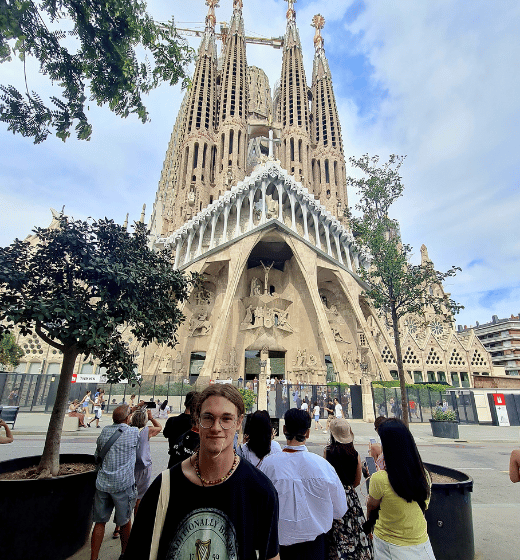
On a clear Thursday morning in late October 2025, a quiet milestone unfolded in Barcelona. A crane carefully hoisted a final piece atop the central tower of La Sagrada Família, Antoni Gaudí’s unfinished basilica, nudging its height to an astounding 162.91 meters. According to the Associated Press, this new height marks an official record.
In that moment, this beloved church officially became the world’s tallest church, surpassing the long-reigning Ulm Minster in Germany (161.53 m). The Sagrada Família now holds the title of the world’s tallest church, a remarkable achievement that places it as the world’s tallest among its peers.
It represents over 140 years of perseverance, artistry, and faith – a dream begun in 1882 that is still rising today. The Sagrada Família (which translates to “Holy Family”) stands not just as the tallest church now, but as a living symbol of devotion and collective effort spanning generations. The world enthralled by Gaudí’s masterpiece has watched this historic milestone unfold.
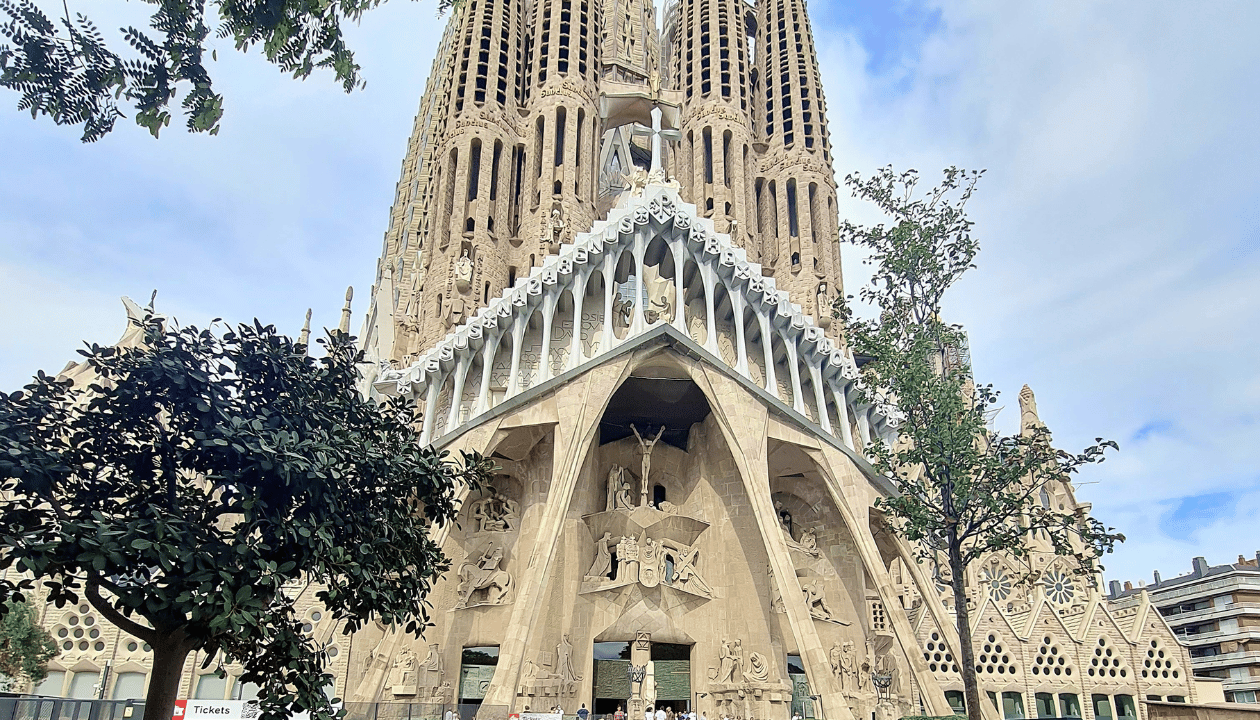
Record-Breaking Height of Barcelona’s Sagrada Familia
In October 2025, the Sagrada Família earned a place in history by reaching 162.91 m in height, edging out Germany’s Ulm Minster by just over a meter. Ulm’s towering spire, part of a Gothic Lutheran church built between 1543 and 1890, had held the “tallest church” title for over a century. The new record came as workers lifted a section of the central tower into place, a key step that put Barcelona’s basilica’s central structure slightly above its southern Germany rival.
And Sagrada Família is still growing – the central Tower of Jesus Christ isn’t even finished yet. When the final piece, a great four-armed cross, is mounted atop this central tower of Jesus in the coming months, the basilica will reach its full height of 172 meters, firmly securing its rank as the tallest church in the world.
For context, that will make it taller than any church ever built, a true “sky-scraping” cathedral of modern times. It was the placement of the first part of that cross tower – lifted into position Thursday morning, October 30, 2025 – that allowed Sagrada Família to claim the height record.
Surprisingly, church officials in Barcelona have been modest about the achievement. The Sagrada Família hasn’t formally proclaimed itself the world’s tallest, but the numbers speak for themselves. From its perch in the heart of Barcelona, the basilica’s status as a minor basilica now rises above the city skyline as an architectural marvel, its tallest point brushing the sky and symbolizing a new chapter in an extraordinary construction story.
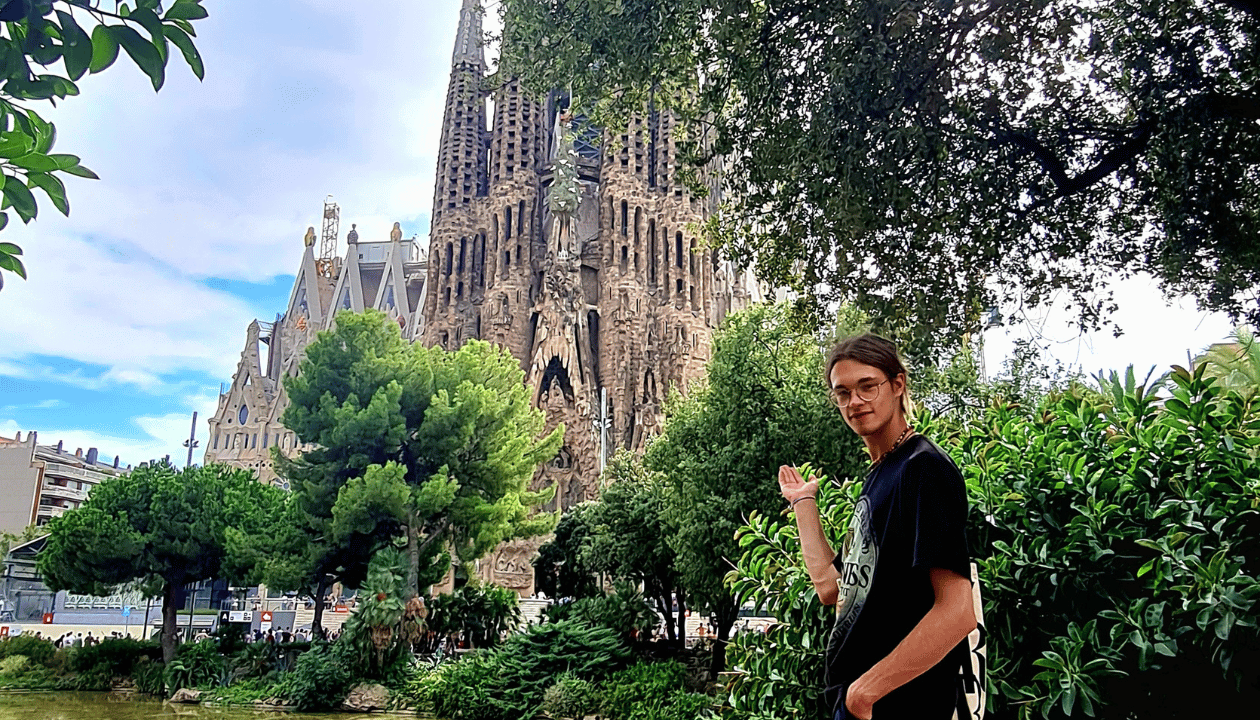
A Long Journey Through Time
Breaking a world record was never the primary goal of this project – in fact, the Sagrada Família’s story is one of patience, creativity, and unwavering faith.
The journey began with the placement of the first stone in 1882, marking the symbolic start of the basilica’s long and remarkable development.
For more than a century, this extraordinary basilica has risen slowly but purposefully, shaped by visionaries who refused to let time or tragedy defeat their dream.
Here’s how this architectural masterpiece evolved, step by step, through history.
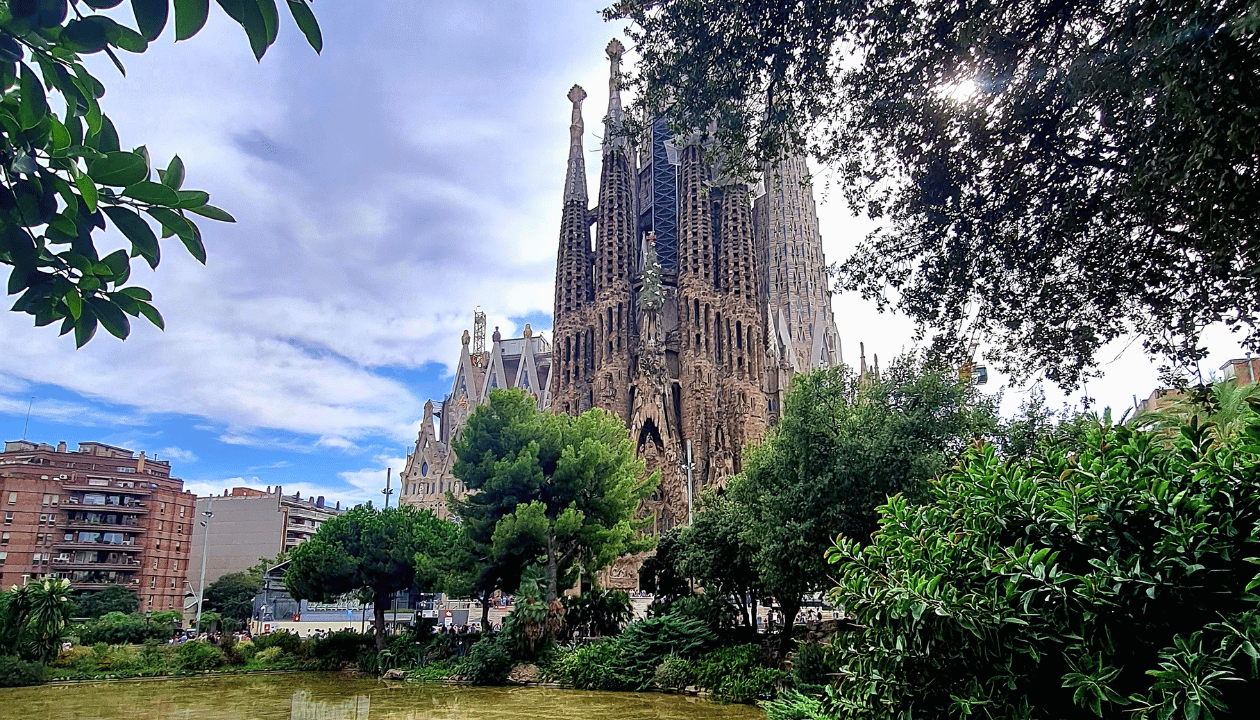
The Vision Begins: Gaudí’s Lifelong Devotion (1882–1926)
Construction of the Sagrada Família began in 1882 under architect Francisco de Paula del Villar. A year later, a 31-year-old Antoni Gaudí took over, reimagining the project as a monumental expression of faith. Gaudí’s ambitious proposal transformed the original plans, setting the stage for the basilica to become a renowned architectural masterpiece. For the next 43 years, Gaudí dedicated his life entirely to this sacred work, blending architecture, nature, and theology into a singular vision.
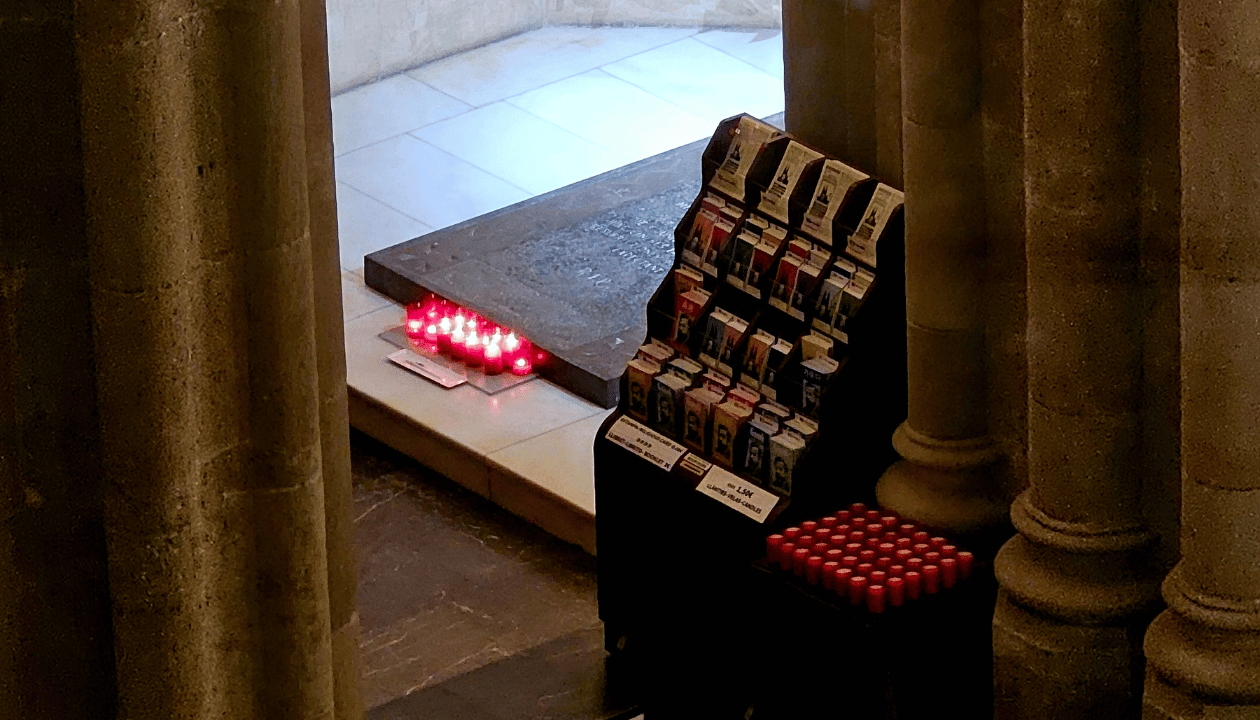
He eventually made the basilica his home, so entwined was his life with the church. Gaudí’s unique aesthetic, characterized by organic forms, Catholic symbolism, and innovative design, left a lasting impact on the basilica’s appearance. Fittingly, Gaudí rests in its crypt, forever part of his creation. By the time of his death in 1926, only one tower stood completed. When asked about the slow pace, he famously replied, “My client (God) is not in a hurry.”
War and Destruction: The Spanish Civil War (1936–1939)
The 20th century brought devastation. During the Spanish Civil War in July 1936, anti-religious militias stormed Gaudí’s workshop, which was destroyed along with many of his original drawings, blueprints, and plaster models. The church’s crypt was also targeted and suffered significant damage during the conflict.
This catastrophe destroyed most of the original plans and models. What survived of Gaudí’s vision became a puzzle of ashes and memory, forcing the next generation to work from scarce notes and damaged models.
Reconstruction and Renewal (1939–1970s)
After the war, architect Francesc de Paula Quintana took charge in 1939 and led efforts to reconstruct Gaudí’s plans from what remained. It took 16 years of meticulous work just to reassemble the designs. The published plans, reconstructed from surviving documents and drawings, served as the foundation for ongoing construction, ensuring that the work stayed true to Gaudí’s original vision. Despite limited resources, teams of artisans and engineers pressed on, breathing life back into the half-ruined structure.
Though progress was slow, every stone set during this period represented resilience and faith in the impossible dream Gaudí had begun.
Modern Innovations and Global Support (1980s–2000s)
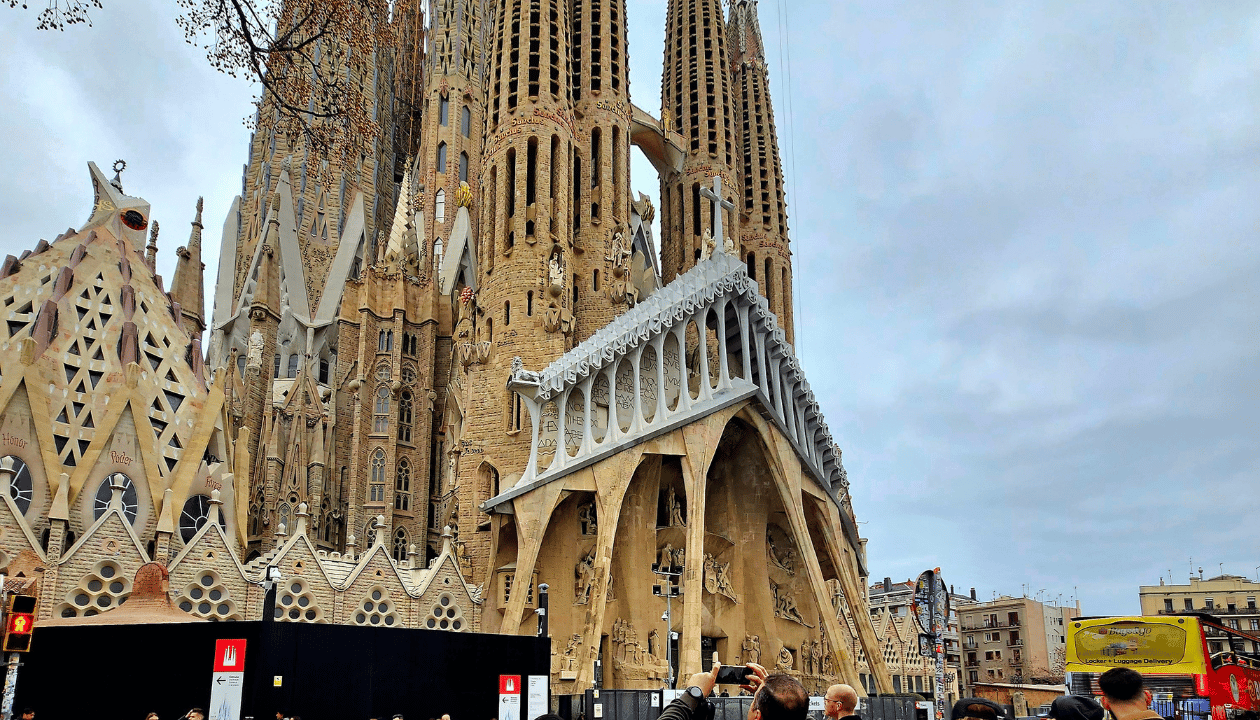
By the late 20th century, the project had gathered renewed momentum. Successive architects adopted emerging technologies to preserve Gaudí’s artistic intent while modernizing construction methods.
The arrival of computer-aided design, 3D modeling, and robotic stone-cutting transformed the process. Improved site management enabled better coordination of construction and preservation efforts, ensuring that builders could interpret Gaudí’s complex geometries with the precision he could only imagine. This technological leap turned the Sagrada Família from a languishing site into a rapidly progressing architectural marvel.
Setbacks and Perseverance in the 21st Century
Even in modern times, the basilica faced new trials. The COVID-19 pandemic of 2020 brought construction to a complete stop for the first time since the Civil War. With tourism halted and funds depleted, the long-held goal of completion by 2026 was delayed.
Yet, once the world began to heal, the workers returned with renewed commitment. Each setback—from war to pandemic—has strengthened the project’s identity as a symbol of endurance and human faith.
A Testament to Time
Over 143 years later, the Sagrada Família stands as a living chronicle of devotion and determination. Generations of architects, artisans, and laborers have contributed to its ascent, building stone by stone so that Gaudí’s vision could transcend time.
Through patience, perseverance, and passion, what began as one man’s dream has become one of the world’s most profound architectural legacies—a monument not only to God, but to the enduring spirit of creation itself.
The Genius of Gaudí’s Architecture
The Sagrada Família is far more than a church — it’s a spiritual symphony carved in stone. Every column, color, and curve speaks of Gaudí’s desire to unite faith, nature, and geometry into one living form. Beyond the Sagrada Família, Gaudí’s other notable buildings in Barcelona, such as Casa Batlló and Casa Milà, have also left a lasting mark on the city’s architectural heritage, celebrated for their historical and cultural significance. To understand its power, let’s explore how Gaudí turned sacred architecture into an enduring work of art.
A Living Vision of Faith and Nature
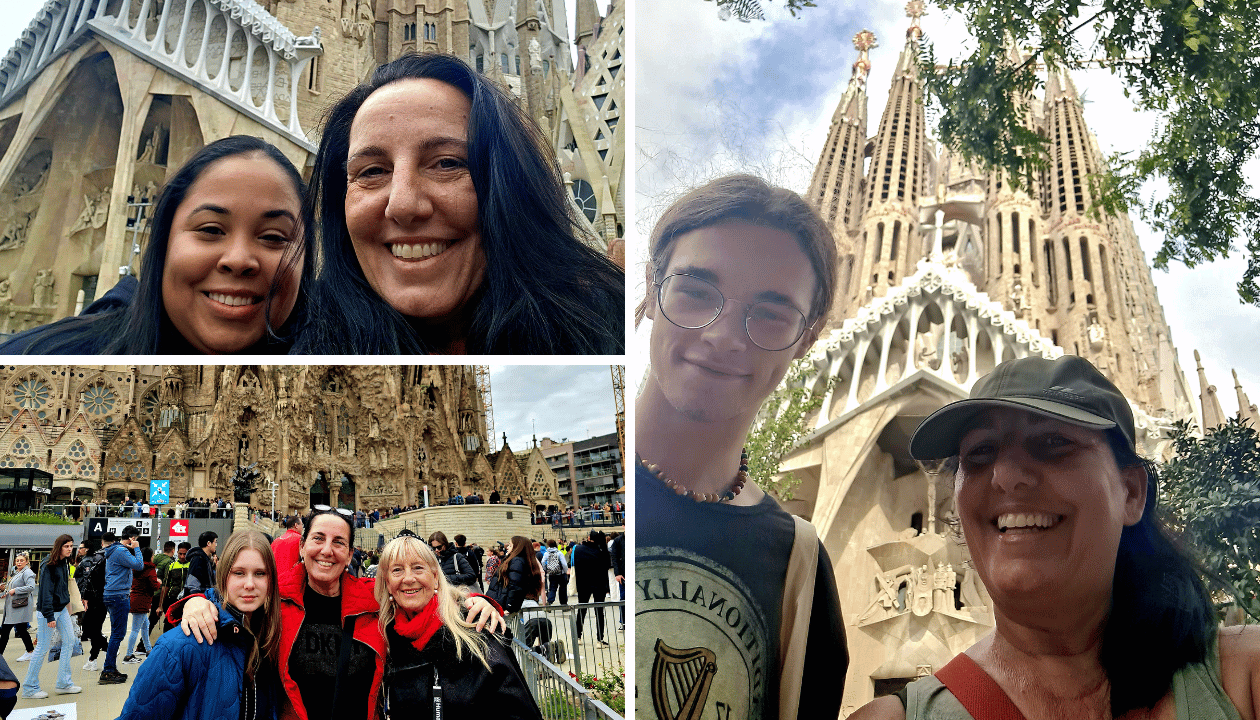
From first glance, it’s clear that this is no ordinary basilica. Gaudí’s design combines Catholic symbolism and organic forms, geometric intricacy into a cohesive masterpiece. Critics have hailed it as “the most extraordinary personal interpretation of Gothic architecture since the Middle Ages.”
Unlike the solemn Gothic cathedrals of centuries past, Gaudí’s creation feels alive — its shapes resemble natural growth, as if the building itself were breathing. Every structural curve mirrors God’s creation, transforming faith into form.
Inside the Stone Forest
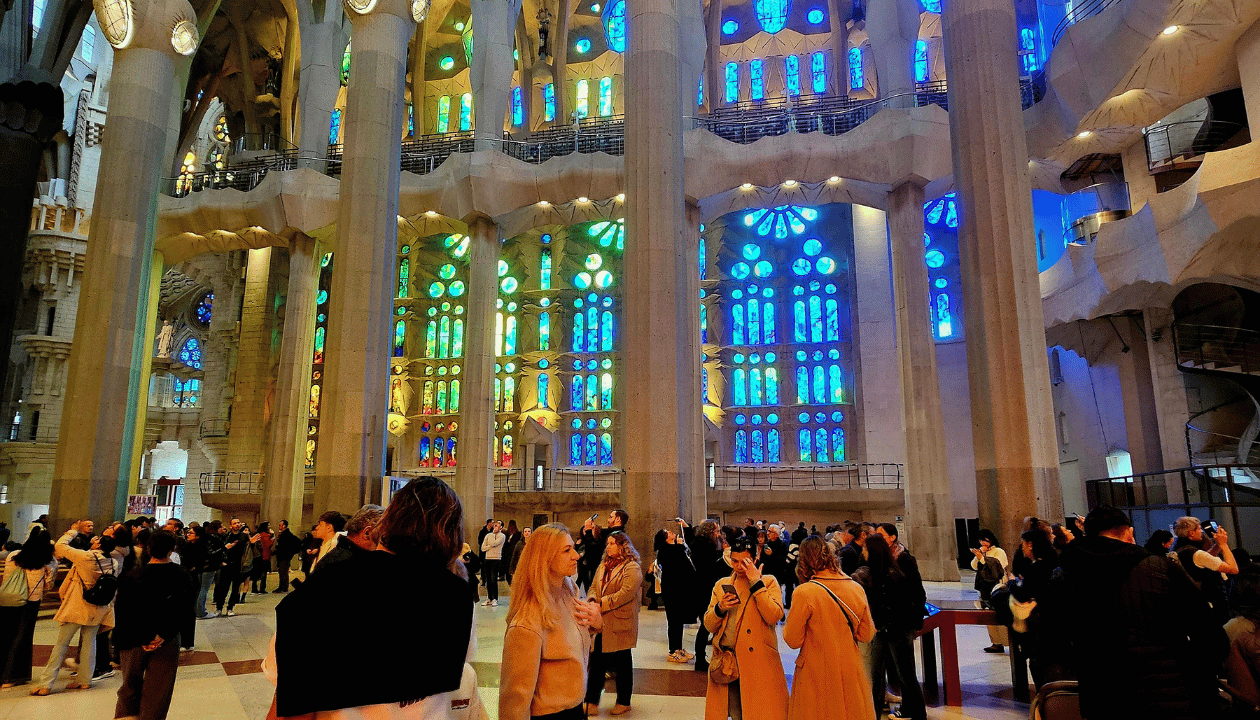
Stepping inside, visitors are enveloped by an ethereal sense of wonder. Towering columns branch like trees, forming a forest canopy that filters light through vibrant stained glass. The arrangement of the naves, with their grand scale and symbolic significance as the central pathway of the basilica, draws the eye forward and emphasizes the spiritual journey toward the altar. The colors shift throughout the day, casting kaleidoscopic reflections across the floor.
Everywhere, natural motifs abound: sculpted fruit, flowers, and animals, each symbolizing the beauty of divine creation. Gaudí wanted visitors to feel as though they were walking through a “stone Bible,” where nature and scripture coexist in harmony. The result is a sacred space that feels both mystical and profoundly human.
Three Façades, One Story of Faith
The basilica’s exterior unfolds like a visual gospel, with the church’s elaborate facades—three grand façades—each narrating a part of Jesus’s life.
The Nativity Façade, the only one completed under Gaudí’s direct supervision, bursts with vitality. Its joyful carvings of plants, animals, and Biblical figures celebrate the birth of Christ in exuberant detail. The decorative details on this façade, from intricate sculptures to ornate embellishments, showcase the extraordinary craftsmanship that defines the Sagrada Família.
In contrast, the Passion Façade, finished in the late 20th century by sculptor Josep Subirachs, offers a stark, angular interpretation of Christ’s suffering. Its sharp lines and shadowed forms evoke the pain of crucifixion.
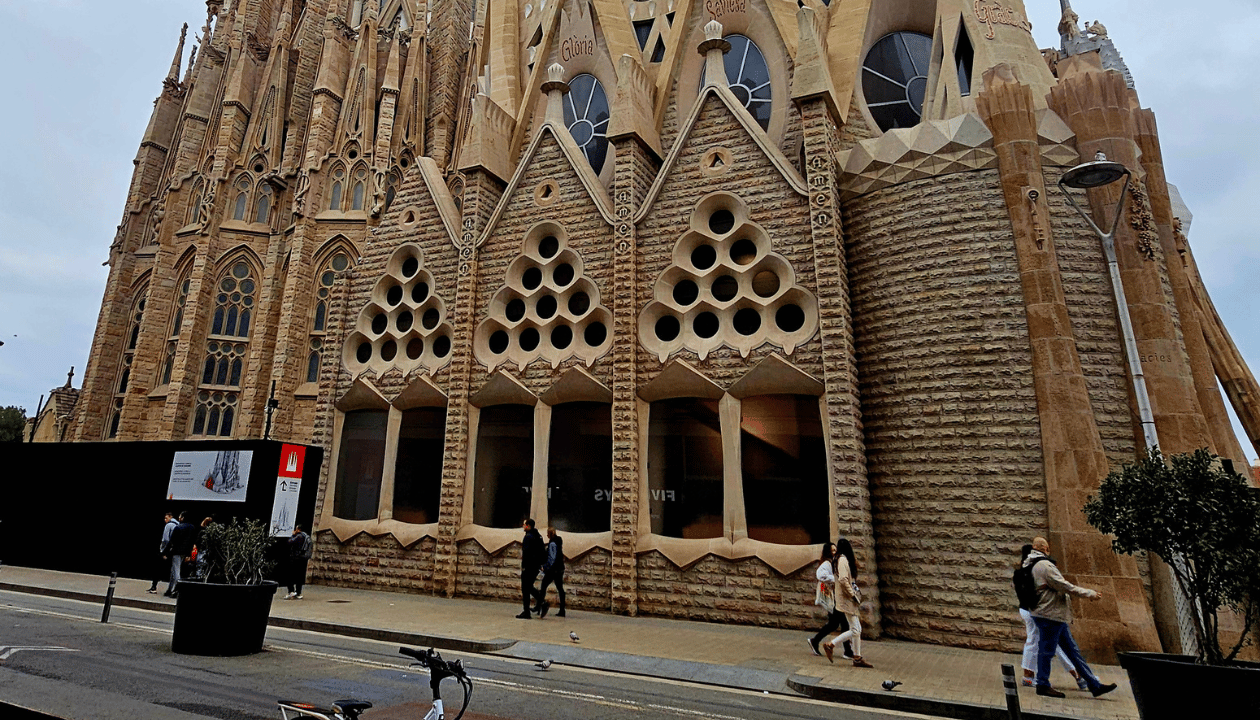
The final Glory Façade, still under construction, represents resurrection and eternal life — the heavenly triumph of Christ. Together, these façades form a chronological journey from birth to sacrifice to salvation, a storytelling technique rendered entirely in stone.
The Towers that Touch the Sky
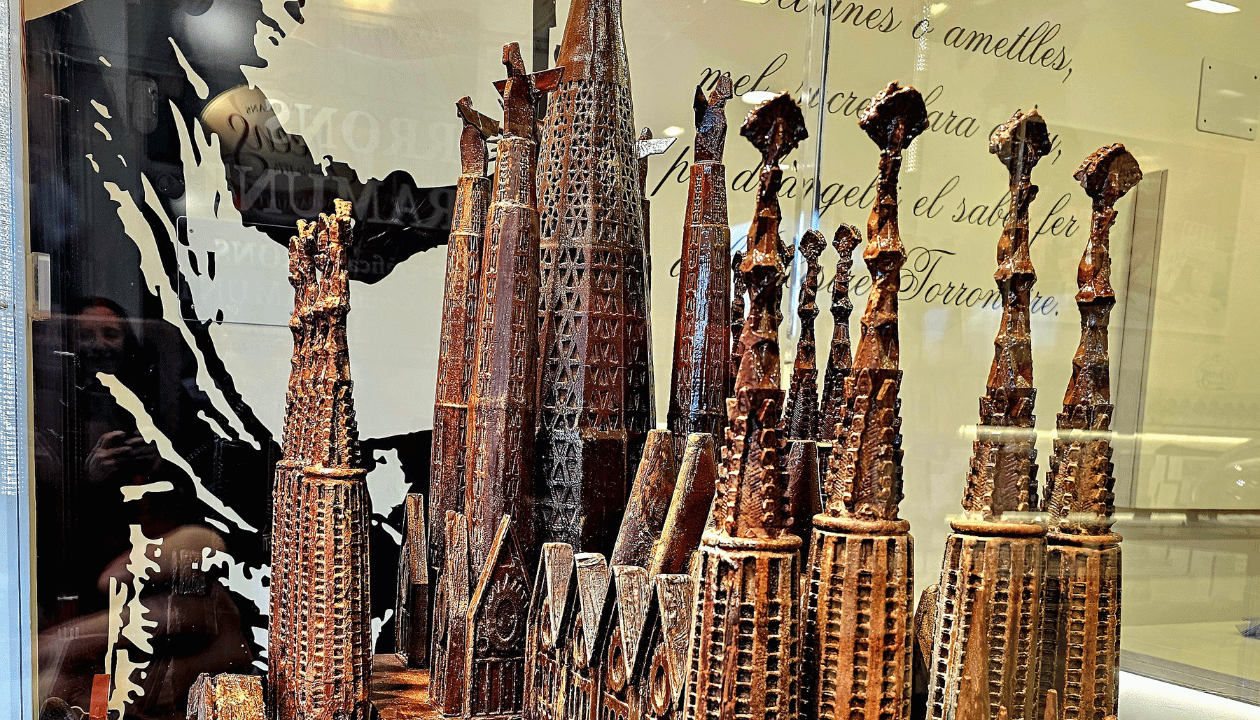
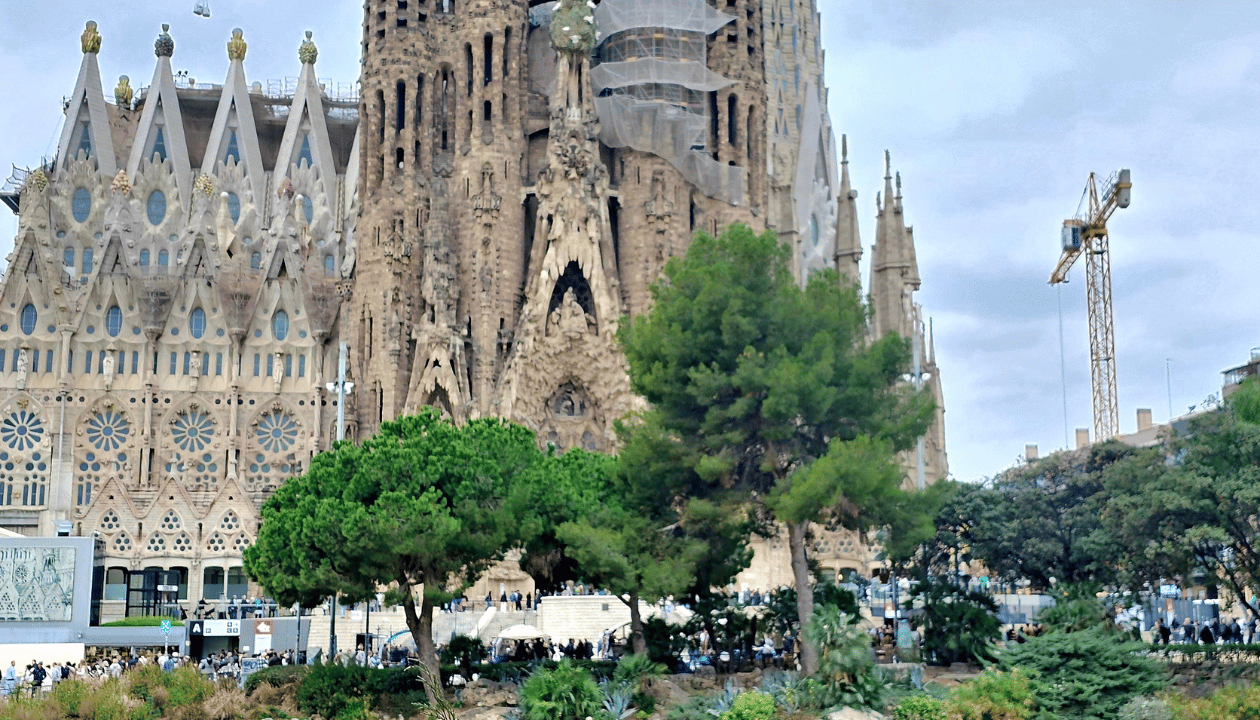
Rising above the façades is one of the most distinctive features of the Sagrada Família: its towers. Eighteen in total are planned, each bearing deep theological meaning.
Twelve slender spires represent the Apostles, while four taller ones honor the Evangelists — Matthew, Mark, Luke, and John, each topped with a symbolic figure: an angel, lion, ox, and eagle. Above them soars the elegant Tower of the Virgin Mary, crowned in 2021 with a 12-pointed illuminated star.
At the center, still under construction, stands the Tower of Jesus Christ, destined to reach 172 meters, making it the tallest church spire in the world. It symbolizes Christ as the link between heaven and earth, the ultimate expression of faith reaching upward.
Engineering Innovation and Artistic Genius
Gaudí’s brilliance extended beyond art into science and engineering. He revolutionized Gothic structure by using inclined columns, catenary arches, and hyperboloid vaults that eliminated the need for traditional buttresses.
To perfect his forms, he built intricate hanging models using strings and weights, studying how gravity shaped natural curves. These experiments allowed him to calculate flawless load distribution long before computer modeling existed.
This blend of creativity and precision made the Sagrada Família a bridge between eras — medieval in inspiration yet futuristic in design. Its architecture continues to astonish engineers, artists, and pilgrims alike, standing as proof that faith and innovation can coexist in one transcendent masterpiece.
Religious Significance: A Sacred Symbol for the Ages
Rising above the Barcelona skyline, the Sagrada Familia’s central tower—dedicated to Jesus Christ—now claims its place as the world’s tallest church, a beacon of faith and inspiration for generations. This monumental achievement is more than a feat of engineering; it is a profound testament to the enduring power of belief and the vision of Antoni Gaudí, the head architect whose devotion shaped every stone.
Unlike any other church in the world, the Sagrada Familia combines Catholic symbolism with the flowing, organic forms that define Gaudí’s unique aesthetic. The basilica’s elaborate facades, from the joyful Nativity Façade to the stark Passion Façade, narrate the life of Jesus Christ in sculpted stone, inviting visitors to reflect on the mysteries of faith. Each detail, from the intricate carvings to the soaring vaults of the main nave, is imbued with spiritual meaning, transforming the basilica into a living expression of devotion.
The central Tower of Jesus Christ, expected to reach 172 meters upon completion, will not only surpass the Ulm Minster—a Gothic Lutheran church built in southern Germany—but also stand as a symbol of hope and unity for the city of Barcelona and the world. The Sagrada Familia’s construction, which began in 1882 and survived the destruction of Gaudí’s workshop and the church’s crypt during the Spanish Civil War, is a story of resilience. Church officials, artisans, and the faithful have persevered through every challenge, determined to see Gaudí’s vision completely finished within the next decade.
Inside the basilica, the main nave welcomes worshippers and visitors alike into a sacred space where light, color, and stone converge in a celebration of the Holy Family. The church’s organic forms and Catholic symbolism invite contemplation, making the Sagrada Familia not just an architectural marvel, but a place of profound spiritual expression.
Beyond its religious role, the Sagrada Familia has become a cultural icon, inspiring artists such as Claude Monet and captivating millions from around the globe. Its influence extends far beyond Barcelona, serving as a symbol of national pride and a reminder of the importance of preserving cultural heritage. In recent decades, entrance fees from the steady stream of tourists have played a crucial role in funding the ongoing construction, ensuring that Gaudí’s dream will be realized for future generations.
As the world’s tallest church, the Sagrada Familia stands as a sacred symbol for the ages—a fusion of faith, art, and human perseverance. Its story, carved in stone and illuminated by the spirit of those who built it, will continue to inspire awe and reverence for centuries to come.
Tourism and the Power of the People
Unlike many of Europe’s great cathedrals, the Sagrada Família was never a royal project or a government commission. It was born — and continues to rise — through the commitment of ordinary people. Every year, there are large numbers of tourists coming from around the world to see the basilica, contributing to its international appeal and ongoing construction. This singular model of collective effort has made the basilica not only a masterpiece of architecture, but also a monument to human cooperation.
A Temple Funded by Faith
From the beginning, the Sagrada Família was intended as an expiatory temple, built entirely from private donations. Gaudí rejected state or church sponsorship, believing the project should be sustained by the devotion of believers. For decades, funding arrived in small sums from individuals who wanted to see his vision realized — a literal act of faith cast in stone.
Tourism Becomes the Lifeline
In the modern era, visitor revenue replaced donations as the project’s economic heart. Entrance fees from millions of travelers now finance nearly every stage of construction. In 2024 alone, 4.9 million people visited the basilica, with about 15 percent arriving from the United States. Each ticket sold directly supports new stonework, salaries for artisans, and maintenance of Gaudí’s fragile models — turning visitors into active participants in the building’s story.
A Transparent, Self-Sustaining Model
All income is managed by the Junta Constructora, a nonprofit foundation that oversees every euro spent on the site. The organization receives no direct funding from Barcelona’s city government or the Spanish state, keeping Gaudí’s principle of independence intact. This structure allows complete transparency: what the basilica earns through tourism immediately goes back into its towers, façades, and restoration.
Resilience in the Face of Crisis
When the COVID-19 pandemic halted global travel, construction slowed to a crawl. The sudden loss of visitors in 2020–2021 exposed how closely the basilica’s progress depends on people’s presence. Yet as soon as tourism returned, cranes began to move again. The restart underscored a powerful truth — that the world’s admiration is not only emotional but also material, literally fueling the completion of Gaudí’s work.
A Global Collaboration in Stone
Today, the Sagrada Família stands as a shared creation of millions. Every tourist, donor, and craftsman has contributed a fragment of its walls. The basilica’s continuing rise demonstrates how art, faith, and civic pride can unite across borders. When it finally reaches completion, it will not belong to kings or governments, but to humanity itself — the cathedral built by the people and for the people.
Looking Toward Completion
After more than 140 years, the Sagrada Família is entering its final phase. The central Tower of Jesus Christ is nearing completion, and its illuminated cross will soon crown the basilica at 172 meters—the highest church spire in the world. This milestone will coincide with the centenary of Antoni Gaudí’s death in 2026, the date Barcelona hopes to mark as the official completion of the main structure. To commemorate Gaudí’s death, several events and commemorative events are planned, including architectural and cultural events that will honor his legacy and the ongoing significance of the Sagrada Família.
Most towers are already finished; the focus now is on the church’s elaborate facades and interior. Sculptures, mosaics, and reliefs will continue to evolve for several years, with final artistic detailing likely extending into the 2030s. While the structure will stand complete around 2026, artisans will keep refining its surfaces and spaces well beyond that date.
Modern technology drives these last stages. Architect Jordi Faulí’s team combines digital modeling, CNC stone-cutting, and laser scanning to achieve precision Gaudí could only imagine. Craftsmen still carve and polish each piece by hand, guided by 3D-printed templates derived from his surviving models.
When the final crane is removed, the basilica will represent three centuries of work a fusion of faith, patience, and innovation. Gaudí’s vision will at last become reality, a monument uniting history and modern engineering.
Experience the Sagrada Família as a Living Classroom with SHIP
Standing under the towers of the world’s tallest church is not just sightseeing it’s a cultural and emotional experience that brings Spanish history, art, and language together in one powerful place. This is exactly how we design learning in our Spanish Homestay Immersion Program (SHIP).
With SHIP, you don’t just visit landmarks like the Sagrada Família. You live with your teacher, practise Spanish in real conversations, and connect language to daily life, culture, and meaning.

You can explore more immersive learning experiences here:
👉 Spanish Culture & Language Immersion Stories
For personalised guidance and programme details, you can contact our founder directly:
Mónica Romero
Founder and Director, Spanish Express
📞 Phone / WhatsApp: +44 7903 867894
📧 Email: monicaromero@spanishexpress.co.uk
Frequently Asked Facts
Q1. How tall is the Sagrada Família right now?
As of 2025, the Sagrada Família stands 162.91 meters tall, officially making it the world’s tallest church. It surpassed Ulm Minster in Germany (161.5 m) after the addition of a new section of the central tower in October 2025.
Q2. What will be the final height when it’s finished?
When complete, the Tower of Jesus Christ will reach 172 meters, crowned by a four-armed illuminated cross. This will confirm the Sagrada Família as the tallest church ever built, about 10.5 meters taller than Ulm Minster.
Q3. How has the Sagrada Família been funded?
Construction began in 1882 and has continued for over 143 years without government funding. The basilica relies entirely on private donations and tourism revenue. In 2024 alone, 4.9 million visitors helped finance the project through entrance fees, carrying forward Gaudí’s tradition of public devotion sustaining the build.
Q4. When will the Sagrada Família be completed?
The main structure is projected for completion in 2026, coinciding with the 100th anniversary of Gaudí’s death. Final decorative and landscaping work may extend into the early 2030s, but by the late 2020s, the world will finally see Gaudí’s masterpiece complete—a triumph nearly 150 years in the making.
