

Walking through Barcelona’s Gothic Quarter (Barri Gòtic) feels like stepping back in time while still being in the vibrant heart of the city.
Narrow cobbled lanes open onto sunny plazas, medieval stonework stands alongside lively cafés, and around every corner lies a piece of the city’s rich history.
This informative guide will delve into the neighborhood’s past, its architectural and cultural treasures, practical travel tips, local legends, and a suggested walking tour through its most iconic spots.
Historical Background and Key Events
The Gothic Quarter is the oldest part of Barcelona, with origins dating back over 2,000 years to the Roman colony of Barcino. Founded around 15 BC, Barcino’s grid-like forum and defensive walls occupied what is now the Gothic Quarter. You can still see segments of the ancient Roman walls incorporated into later structures, and even a cluster of Roman tombs unearthed at Plaça Vila de Madrid – reminders of the quarter’s classical roots.
During the Middle Ages
During the Middle Ages, Barcelona grew into a bustling port and capital of the Crown of Aragon. The Barri Gòtic took on its characteristic Gothic style as grand churches, palaces, and plazas were built atop the Roman foundations. Medieval Barcelona’s most important civic and religious institutions all centered here: the Cathedral of Santa Eulàlia (Barcelona’s Cathedral) was begun in the 13th century, and nearby the Plaça Sant Jaume area housed the city’s government.
Roman Times
In fact, Plaça Sant Jaume has been the political heart of Barcelona since Roman times (it was the site of Barcino’s forum). A darker chapter came in 1391, when anti-Jewish riots devastated the El Call (Jewish Quarter), leading to the destruction of that thriving community. The medieval fabric of the Gothic Quarter endured through the centuries, even as the city expanded beyond its walls in the 19th century.
Late 19th and Early 20th Century
By the late 19th and early 20th centuries, parts of the Gothic Quarter had fallen into disrepair. In a push to beautify the city for the 1929 International Exhibition, a massive restoration project transformed the Barri Gòtic. Many structures were refurbished or even rebuilt with Neo-Gothic additions to evoke a romantic medieval atmosphere. For example, the Barcelona Cathedral’s imposing neo-Gothic façade, which today looks authentically medieval, was actually completed in 1913. Likewise, the picturesque Bishop’s Bridge (Pont del Bisbe) over Carrer del Bisbe was added in 1928, connecting the Catalan government palace to a canonical house.
The effort was so extensive that much of the quarter’s present appearance dates from the late 19th–20th century renovations, layered on top of genuine Middle Ages structures. Despite (or because of) these changes, the Barri Gòtic emerged as a kind of open-air museum of Barcelona’s heritage – a transformation from a somber old district into a charming “Gothic” showcase for locals and visitors. In the 1930s, the quarter witnessed tragedy during the Spanish Civil War; an infamous aerial bombing in 1938 struck Plaça Sant Felip Neri, killing dozens of civilians (mainly children) and leaving the church’s facade pockmarked with shrapnel damage that is still visible today.
Through all these eras, the Gothic Quarter has remained the historic and spiritual core of Barcelona. Today it is part of the Ciutat Vella (Old City) district, preserving a labyrinthine street plan from medieval times – a maze of pedestrian lanes opening onto plazas. Cars are largely barred from these ancient streets, making it easy to imagine an earlier Barcelona as you wander. Each stone here could tell a story: of Roman merchants, Gothic guilds, noble families, or modern revolutionaries. The Gothic Quarter truly is a living palimpsest of Barcelona’s history, shaped by Roman founders, medieval kings and artisans, urban planners of the 19th century, and everyone since who has fallen under its spis truly a living palimpsest of Barcelona’s history, shaped by Roman founders, medieval kings and artisans, 19th-century urban plannersell.
Architectural Highlights and Notable Landmarks
One of the joys of the Barri Gòtic is the sheer concentration of historic landmarks in such a walkable area. Medieval churches, government palaces, and even remnants of ancient temples are tucked within a few blocks. Here are some architectural highlights and must-see landmarks in the Gothic Quarter:
Barcelona Cathedral (Catedral de Santa Eulàlia)
The centerpiece of the Gothic Quarter, this 13th–15th century cathedral (often called La Seu) is a masterpiece of Catalan Gothic architecture. Its soaring spires and intricate facade dominate Plaça de la Seu, while the interior features a lofty nave and beautiful side chapels.
Don’t miss the lovely cloister, home to 13 white geese honking around a medieval fountain – a tradition honoring the city’s co-patron Saint Eulàlia, who was only 13 when martyred. (Legend says the geese also alerted citizens to invaders in one tale, but primarily they symbolize the young saint’s purity and age.)
Visitors can take an elevator to the rooftop for panoramic views over the Gothic Quarter’s rooftops. The cathedral’s facade may look ancient but, as noted, it was actually completed in 1913 in neo-Gothic style, blending seamlessly with the medieval core.
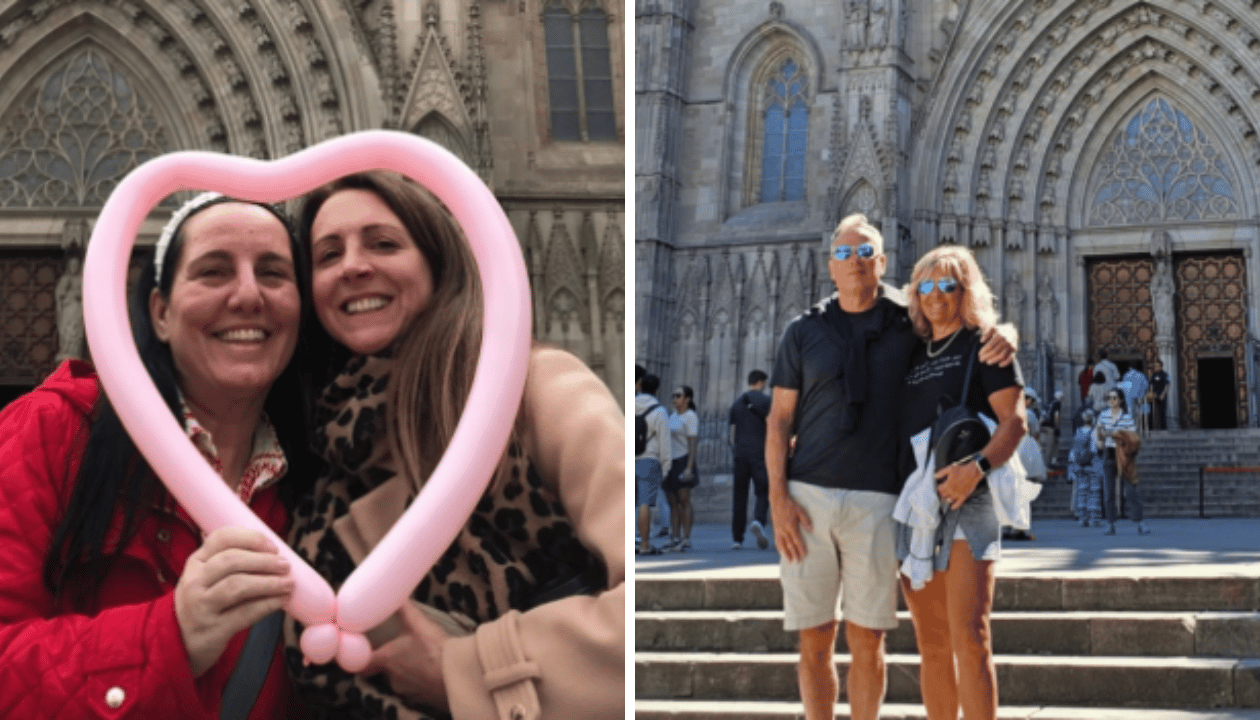
During our visit to the Cathedral, SHIP students Laura and Christine engaged deeply with the surroundings, practising Spanish while reading historical plaques and discussing the Gothic architecture around them. The cloister, with its peaceful ambiance, provided the perfect setting for real-time language application.
Plaça Sant Jaume (City Hall and Palau de la Generalitat)
A broad square that has been the center of Barcelona’s civic life for two millennia. Here, the Barcelona City Hall (Casa de la Ciutat) faces the Palau de la Generalitat de Catalunya (seat of the Catalan regional government). The City Hall’s current Neoclassical façade hides Gothic interiors from the 14th century, while across the plaza, the Palau de la Generalitat boasts a grand Renaissance porch and a beautiful Gothic courtyard within.
This plaza was the site of Barcino’s Roman forum, and it remains the gathering point for political events, festivals, and demonstrations. If you’re lucky, you might catch a traditional Catalan folk performance here. Many city festivals (like the La Mercè celebration) feature human towers (castellers) or folk dances in Plaça Sant Jaume.
At Plaça Sant Jaume, SHIP students Fallon and Christine explored civic life past and present. As they moved between the historic government buildings, they used this setting to reinforce vocabulary related to politics, history, and local customs.

Basilica of Santa Maria del Pi
A massive 15th-century Gothic church tucked in Plaça del Pi, a quaint square named for its historic pine tree. Santa Maria del Pi is known for its fortress-like, austere exterior and a gigantic rose window that floods the interior with colored light. The church’s bell tower is one of the highest medieval bell towers in the city, and you can sometimes climb it for great views.
Around the plaza and neighboring Plaça Sant Josep Oriol, you’ll often find artists’ stalls and weekend craft markets, adding to the local charm. The surrounding buildings also display beautiful sgraffito facades (decorative plaster etchings), some of the best examples in Barcelona.
Plaça del Rei (King’s Square)
Perhaps the Gothic Quarter’s most atmospheric square, seemingly unchanged since the 14th century. Stepping into this quiet plaza is like traveling back in time to the medieval kingdom. On one side is the Palau Reial Major, the former royal palace of the Counts of Barcelona (and later Kings of Aragon).
Its great hall, the Saló del Tinell, is where tradition holds that King Ferdinand and Queen Isabella received Christopher Columbus upon his return from the Americas. Adjacent to it is the Palau del Lloctinent (Lieutenant’s Palace), a 16th-century addition, and the Chapel of Santa Àgata (14th c.) perched above the Roman walls.
The arcaded building across the square, Casa Padellàs, was moved here stone by stone in 1931 and now hosts part of the Barcelona City History Museum (MUHBA). Tip: Visit the MUHBA entrance in this square to descend into fascinating excavated Roman ruins beneath the plaza, where you can walk the streets of Roman Barcino’s underground remains.
Roman Temple of Augustus
Tucked away in a narrow alley (Carrer Paradís, 10) is one of the quarter’s best hidden treasures: four towering columns from the Roman Temple of Augustus, nearly 2000 years old. These 9-meter-high Corinthian columns once formed part of a temple that stood at the forum of Barcino in the 1st century BC.
They were rediscovered and now stand inside a medieval building’s courtyard, astonishing visitors who stumble upon them. The juxtaposition of ancient Roman pillars enclosed by later walls perfectly encapsulates the layers of history in the Barri Gòtic. (Look for a small sign for “Temple d’August” to find the entry.)
El Call (Historic Jewish Quarter)
Between the Cathedral and Plaça Sant Jaume lies El Call, the old Jewish quarter, a labyrinth of tiny lanes that was home to Barcelona’s Jewish community until the 14th century. Carrer de Sant Domènec del Call and its offshoots retain a medieval layout – so narrow in spots that neighbors could shake hands between facing balconies. Here you can visit the Sinagoga Major, said to be one of the oldest synagogues in Europe.
It’s a small two-room museum now, partly underground, where you can learn about Jewish life in medieval Barcelona. Though much of El Call was destroyed after 1391, walking these quiet alleys (with names like Carrer de la Fruita and Carrer de Marlet) gives a sense of Barcelona’s diverse cultural roots. Keep an eye out for a little stone slab on a wall with Hebrew inscriptions – a medieval epitaph embedded as a reminder of this quarter’s past.
Elisha, one of our SHIP students, experienced a personal connection to Barcelona’s Jewish heritage while walking through El Call. Along the narrow alleys of Carrer de Sant Domènec del Call, he described his impressions in Spanish, blending cultural reflection with linguistic practice.

Pont del Bisbe (Bishop’s Bridge)
Perhaps the most photographed spot in the quarter, this ornate bridge stretches like something out of a fairy tale over Carrer del Bisbe. Despite its Gothic appearance, the bridge was built in 1928 as part of the Neo-Gothic renovations. It links the Palau de la Generalitat to the Casa dels Canonges (the adjunct residence of the regional president).
The Pont del Bisbe is adorned with a carved skull and dagger motif on its underside, which has spawned some eerie legends. (Many locals avoid walking directly under it) – more on those legends later! Still, the bridge adds undeniable charm to the streetscape, perfectly framing views of the Cathedral spires from afar.
Plaça Reial
A grand arcaded plaza just off La Rambla, technically at the edge of the Gothic Quarter, but an essential stop for its ambiance. Plaça Reial (Royal Square) was laid out in the 19th century on the site of an old convent and is lined with palm trees, elegant arches, and bustling restaurants and bars.
In the center is a fountain of the Three Graces, and the iron lamp posts designed by a young Antoni Gaudí stand at intervals. By day, you can browse coin and stamp collectors’ markets here on weekends; by night, the plaza comes alive with music and nightlife. It’s an ideal spot to rest at an outdoor café and soak up the atmosphere in the early evening, when the square glows under old-fashioned street lamps.
Surrounded by palm trees and lively street music, SHIP student Laura took the chance to relax and converse naturally in Spanish at Plaça Reial.

Basilica de la Mercè
A Baroque gem (unusual in a neighborhood dominated by Gothic style) dedicated to La Mercè, one of Barcelona’s patron saints. Tucked near the waterfront end of the Gothic Quarter, this 18th-century church features a majestic dome and a revered statue of La Mare de Déu de la Mercè (Our Lady of Mercy) on its rooftop.
Locals visit to pay respects to the city’s protector, especially around the Feast of La Mercè in September. If you wander down Carrer Ample to Plaça de la Mercè, step inside this serene basilica to admire its gilded Baroque interior – a sharp contrast to the austere Gothic churches nearby.
These are just a few highlights – the Barri Gòtic is full of additional points of interest, from the medieval Portal de l’Angel (now a shopping avenue that was once a city gate, to the modernista Els Quatre Gats café, to countless other nooks.) Each landmark is a stone witness to Barcelona’s layered history, and together they make the Gothic Quarter an open-air architectural museum.
Cultural Significance: Traditions, Festivals and Local Life
Beyond its historic buildings, the Gothic Quarter is alive with Catalan culture and traditions. As the historic center of Barcelona, it has long been the stage for civic celebrations, religious processions, and community gatherings. Here are some cultural aspects and events that highlight the significance of the Barri Gòtic:
Religious Traditions:
The quarter’s many churches still host age-old rituals. For instance, the Cathedral’s cloister is the site of the charming “Dancing Egg” (l’ou com balla) tradition each year during Corpus Christi. In this 600-year-old custom, an egg is set dancing on the water spout of a fountain adorned with flowers. This peculiar sight – an egg magically bobbing on a jet of water – has been observed in Barcelona since at least 1637 and is said to symbolize the cycle of life or the Eucharist, depending on who you ask.
The Cathedral also keeps alive the memory of Saint Eulàlia, co-patron of Barcelona, whose tomb lies in the crypt. Every February, around Santa Eulàlia’s feast day, the city holds a winter festival in her honor. During the Festes de Santa Eulàlia, the Gothic Quarter fills with giants (papier-mâché giant figures parading), traditional sardana dancing, and castellers (human tower teams) performing in front of the Cathedral and City Hall. It’s a family-friendly celebration that highlights Catalan folk culture and commemorates the young martyr saint who, according to legend, endured 13 tortures – hence the 13 geese kept in her memory.
Weekly Sardana Dances:
Speaking of sardanas – if you visit on a Sunday, you might stumble upon locals performing the Sardana, Catalonia’s national folk dance, right in the open square by the Cathedral. Around midday on Sundays (and some Saturday evenings), a cobla band strikes up sprightly music and people join hands in circles to dance the Sardana outside the Cathedral’s entrance. All are welcome to watch or even participate. This simple circle dance, with its precise steps, is a quietly powerful expression of Catalan identity and community, and the Gothic Quarter has been its traditional stage for decades.
Major Festivals:
The Barri Gòtic plays host to many events during Barcelona’s citywide festivals. In late September, Barcelona’s biggest festival, La Mercè, honors its patron saint. While activities span the whole city, the Gothic Quarter sees some of the most emblematic: casteller towers often rise in Plaça Sant Jaume, fire-breathing correfoc parades (with costumed devils and firecrackers) snake through the old streets, and concerts or traditional dances enliven plazas. Another beloved event is Sant Jordi’s Day (St. George’s Day) on April 23, when Barcelona swaps Valentine’s Day for a day of books and roses.
The Gothic Quarter’s streets, especially the Rambla and Portal de l’Angel, fill with stalls selling roses and books, as it’s customary for sweethearts to exchange them on this day. The atmosphere is joyous and literary; even the City Hall and Generalitat often open their courtyards to the public, decorated with roses for Sant Jordi. This celebration of Catalonia’s patron saint (who slew a dragon and gave a rose to the princess in legend) is one of the most romantic and culturally significant days of the year.
Local Life and Customs:
Despite being a huge tourist draw, the Gothic Quarter is home to a tight-knit community that maintains local traditions. Wander through in the early morning, and you’ll see residents shopping at small neighborhood markets and bakeries, or enjoying their daily cortado coffee. Many quarters of Barcelona have an annual Festa Major (neighborhood festival); the Barri Gòtic is part of the larger Ciutat Vella district’s festival, which typically occurs in late August.
During these festas, you might catch outdoor concerts in Plaça del Rei, community dinners in the squares, and children’s activities echoing in the alleys. Street names in the Gothic Quarter often hint at old trades (Carrer dels Sombrerers – hat makers; Carrer de la Llibreteria – book sellers) or legends (Carrer de la Pietat – street of Pity, etc.), reflecting the quarter’s social history.
Even the bohemian art scene has a foothold: streets like Carrer d’Avinyó (famously painted by Picasso) and Carrer Petritxol host art galleries and old-time cafés. In Petritxol, you’ll find the city’s traditional granjas (chocolate cafés) where locals indulge in thick hot chocolate with churros – a delicious ritual especially on cool afternoons.
In essence, the Gothic Quarter isn’t just an open-air museum of the past; it’s a living neighborhood where culture is actively practiced and reinvented. From religious celebrations to folk dances and everyday rituals, the Barri Gòtic remains at the heart of Barcelona’s Catalan identity and community life.
Travel Tips: Where to Eat and Drink
Visiting the Gothic Quarter can be a highlight of any Barcelona trip. Its mix of tourist attractions and local charm means a bit of savvy can enhance your experience. Here are some practical tips and recommendations to make the most of your time in Barri Gòtic:
The Gothic Quarter is filled with eateries, from traditional taverns to trendy cafés, but it also has its share of tourist traps, given the location. Venture a bit off the busiest streets (like off Las Ramblas or around the Cathedral) for more authentic finds. Here are some notable spots and local favorites:
Granja Dulcinea (Carrer de Petritxol, 2):
A historic chocolate café dating to 1941 that feels frozen in time. Locals come here for hot chocolate and churros or melindros (ladyfinger cakes) in the afternoon. The old-fashioned decor and friendly service make it a perfect place to experience the Catalan merienda (afternoon snack) tradition. Petritxol Street, only a few meters wide, is famous for its chocolate shops, and another popular one is Granja La Pallaresa. Duck in for a rest and a dose of sweetness, especially on a chilly day.
La Plata (Carrer de la Mercè, 28)
A tiny corner tapas bar that proudly calls itself “the last authentic bar in the Gothic Quarter.” Whether that claim is true or not, Bar La Plata has earned a cult following by doing just a few things very well. In fact, they serve only four types of tapas (including fresh fried sardines and tomato-onion salad) along with wine straight from the barrel. It’s standing-room only, usually packed with a mix of locals and adventurous tourists. Enjoy a glass of house vermouth or cava and soak up the old-school atmosphere – this place hasn’t changed much in decades and oozes authenticity.
Can Culleretes (Carrer d’en Quintana, 5)
If you’re looking to sample traditional Catalan cuisine in a historic setting, consider reserving a table at Can Culleretes. Opened in 1786, it’s reputedly the oldest restaurant in Barcelona (and the second-oldest in all of Spain). The dining rooms are adorned with 19th-century murals and photos of famous patrons. Their menu features classic Catalan dishes like canelons (cannelloni), roast suckling pig, and crema catalana. Even if the food is simple, the sense of history is palpable. Dinner here feels like dining in another era – and it’s firmly on the radar of locals celebrating special occasions, which is a good sign.
Els Quatre Gats (Carrer de Montsió, 3)
A café-restaurant with a special place in art history. Els Quatre Gats opened in 1897 in the Modernist Casa Martí and became a hangout for Catalonia’s leading artists and intellectuals in the early 20th century. Young Pablo Picasso was a patron here (he even held his first exhibition in one of the back rooms), and the cafe was modeled after Paris’s Le Chat Noir cabaret. Today it’s a restaurant (with a mix of tourists and locals) serving Catalan and French-inspired fare. Even if you don’t dine here, it’s worth popping in for a coffee or beer to admire the Modernista interior and imagine the bohemian gatherings of a century ago. The walls are covered with artwork and there’s often a pianist playing in the evenings.
La Alcoba Azul (Carrer de Salomó Ben Adret, 14)
A cozy tapas and wine bar in the heart of the old Jewish Quarter (Call). This candlelit tavern is literally a “Blue Alcove,” with rustic stone walls and an intimate atmosphere. It’s known for excellent charcuterie boards, tasty montaditos, and a good selection of local wines. La Alcoba Azul is slightly hidden away, making it feel like a secret discovered. Friendly service, fair prices, and a very local vibe despite being a stone’s throw from the busy Carrer Banys Nous. Great for a casual evening bite.
Satan’s Coffee Corner (Carrer de l’Arc de Sant Ramon del Call, 11)
Don’t be alarmed by the name; this is one of Barcelona’s most renowned specialty coffee shops. Tucked in a tiny plaza in El Call, Satan’s Coffee serves high-quality brews for those in need of a caffeine fix. It’s a hip spot where you can grab a cold brew or flat white along with a Japanese-inspired light breakfast or pastry. Given the sometimes overwhelming number of tourist-oriented eateries in the area, a place like this is a godsend (or perhaps devil-send?) for coffee lovers who want something beyond the standard fare.
Live the History: Stay in the Gothic Quarter with SHIP!
Experience the magic of Barri Gòtic not just as a visitor but as a local! Our Spanish Homestay Immersion Program (SHIP) invites you to spend 1 to 4 weeks living and learning Spanish in Barcelona, right in the heart of the city’s most historic center.
Stay with one of our warm, knowledgeable host teachers, just steps from cobblestone alleys, narrow streets, and world-famous landmarks like the Pont del Bisbe, Barcelona Cathedral, and Plaça Reial. Practice your Spanish while shopping at la Boqueria, enjoying live music on the Royal Square, or navigating the Gothic spires of this enchanting area.
Whether you’re tracing the path of the Spanish Civil War, exploring the Jewish Quarter, or relaxing near the palm trees of Plaça de Catalunya, every moment here is a language and culture lesson in one. Your host will guide you beyond the tourist traps to uncover secret squares, stories from Roman times, and favorite spots like a local pastrami shop or the best bar in town.
Ready to walk through centuries-old buildings, admire stained glass windows, and sip coffee near important political buildings? Join SHIP in the Gothic area—your immersive Spanish adventure begins now!

You can explore more real immersion experiences here:
👉 SHIP Stories of Our Previous Students
For personalised guidance and programme details, you can contact our founder directly:
Mónica Romero
Founder and Director, Spanish Express
📞 Phone / WhatsApp: +44 7903 867 894
📧 Email: monicaromero@spanishexpress.co.uk
What is special about the Gothic Quarter in Barcelona?
The Gothic Quarter is Barcelona’s historic heart, where Roman walls, Gothic architecture, and medieval legends come alive. Its blend of old city charm and vibrant culture makes it a timeless treasure.
Is the Gothic Quarter in Barcelona worth visiting?
Absolutely! With highlights like Santa Maria del Mar, Carrer Paradís, and Plaça Sant Jaume, the Gothic Quarter is a must-visit for history lovers, photographers, and foodies alike.
Is La Rambla the same as Gothic Quarter?
No, but they’re neighbors! Las Ramblas runs along the edge of the Gothic Quarter Barcelona, offering easy access to iconic streets like Carrer del Bisbe and El Call.
How long to spend at Gothic Quarter Barcelona?
We recommend at least a full day to wander through gothic district gems like city hall, the Roman temple, and boutique shops, though many travelers stay longer to truly explore the gothic area.
What are some nearby attractions or tools to help explore the Gothic Quarter?
Start your journey with Google Maps to navigate the maze-like lanes of the Gothic Quarter with ease. Just outside the district, you’ll find the vibrant Mercado de la Boqueria, perfect for sampling local flavors. Art lovers should also visit the nearby Picasso Museum, where you can trace the artist’s early connection to Barcelona’s historic core.
