

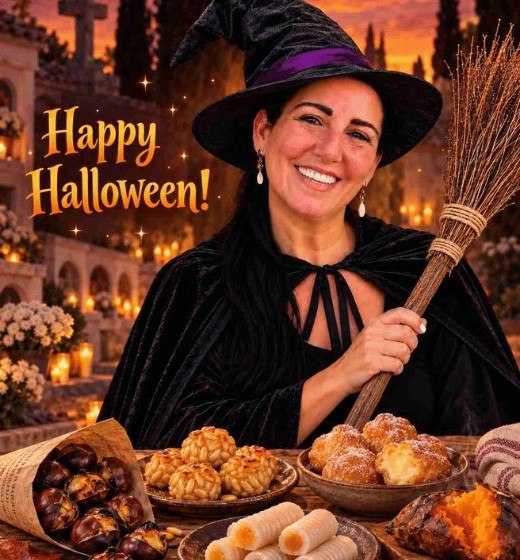
The first sign is the smell. Somewhere around 20 October a metal drum appears on a corner near my house in Ciutadella, and by that evening the whole street smells of chestnut smoke and burnt sugar. Nobody has put up a pumpkin yet. The castañera is always first.
That, in one image, is Halloween in Spain. We have borrowed the costumes and the plastic skeletons, and the children enjoy them enormously. But underneath the borrowed holiday there is an older one, with its own food, its own flowers and its own play, and it has not moved an inch to make room. Foreign visitors tend to notice the pumpkins. Spaniards are waiting for 1 November.
I have hosted students through more than twenty of these weeks, in Menorca Island and in Barcelona, and I have given up trying to explain the difference in a sentence. So here is the long version: what 31 October looks like now, what Todos los Santos has always looked like, the sweets you will be handed whether you want them or not, and how the week is kept in each of the places where our Spanish host teachers live.
🎨
A little note about our pictures
The images in this blog were created with AI, using photos of our own Spanish host teachers. We made them a bit playful on purpose, so you can enjoy reading the blog as much as we enjoyed making it. ¡Que lo disfrutes!
Halloween Has Arrived, but Todos los Santos Was Here First
When I was a child, nobody in Spain dressed up on 31 October. Halloween arrived with American films and television in the late 1990s, and it has grown every year since. Today you will see supermarkets full of plastic pumpkins, bars running themed nights, and children in the bigger cities and small towns going from door to door.
But Halloween is the guest. The host is Todos los Santos, All Saints' Day, on 1 November.
It is a public holiday across the whole of Spain, and it has been for centuries. The following day, 2 November, is El Día de los Difuntos (All Souls' Day), when families remember their dead.
This is why Halloween in Spain feels different from Halloween in the United Kingdom or the United States. The night of 31 October is really the eve of something. Even the people in witch hats are, in a way, warming up for a quieter and much older day. Trust me, you notice it in the air.
One thing I always clarify for students: this is not Mexico's Día de los Muertos. There are no sugar skulls or painted faces in Spain, however many shops try to sell them. Our version is simpler, more domestic and, I would say, more melancholic. It is living history, not a party.
Flowers, Cemeteries and a Long Lunch
If you are in Spain on 1 November, go and stand outside a cemetery for ten minutes. You will understand the whole festival.
From early morning, families arrive with armfuls of chrysanthemums. They clean the family niche, change the flowers, light a candle and stay for a while. Grandmothers introduce grandchildren to great-grandparents they never met. Florists do more business in the last week of October than at any other time of year, and in many towns the council lays on extra buses to the cemetery.

Then everyone goes home and eats. A lot. Todos los Santos is a family lunch day in the same way that Christmas is, with the whole family around one table and the afternoon disappearing into coffee, sweets and the same stories told every year. In my house in Menorca Island, lunch finishes when somebody finally brings out the bunyols, and not a minute before.
In the evening, many people watch or go to see a play. I will come back to that, because it is one of the strangest and loveliest Spanish traditions I know.
Sweets of the Season
Spain marks every festival with a specific sweet, and Todos los Santos has more than most. From the middle of October, the windows of every pastelería fill up with the same four things.
🦴
Huesos de santo
saint's bones
Little tubes of marzipan filled with sweet egg yolk and glazed with sugar. The name is macabre and the taste is pure almond.
👻
Buñuelos de viento
wind fritters
Light, hollow balls of fried dough, often filled with cream, chocolate or custard. The old saying is that every buñuelo you eat frees a soul from purgatory, which is as good an excuse as I have ever heard.
🟤
Panellets
little almond cakes
Small round cakes of ground almond and sweet potato, rolled in pine nuts. These belong to Catalonia, Valencia and the Balearic Islands, and in my experience children can eat twenty of them without stopping.
🌰
Castañas asadas
roast chestnuts
On almost every corner you will find a castañera with a metal drum, roasting chestnuts and selling them in a paper cone. The smell of chestnut smoke in the street is, for me, the real start of winter.
Some regions add their own: moniatos (roast sweet potatoes) in the east, quince jelly in the south, and in Extremadura, as you will see, half the countryside.
How Our Host Teachers Celebrate, Region by Region
Spain is a country of regions, and Todos los Santos proves it. Each of our SHIP homes does the week a little differently. Here is what my fellow Spanish host teachers and I would show you if you were sitting at our tables this week.
1
Menorca Island
At home in Ciutadella, 1 November means bunyols: ring-shaped fritters, fried in olive oil and rolled in sugar, made by hand and eaten warm. Students are never allowed to just watch. You will also see panellets and roast chestnuts, and the cemetery outside the old town is a sea of flowers for the whole weekend. There is something about the quiet of the island in November that makes this day feel especially gentle.

2
Barcelona
Catalonia does not really do Halloween. It does La Castanyada, and it does it with conviction. The castanyera, an old woman in a shawl roasting chestnuts, is the symbol of the day, and every school in the region has children dressed as her on 31 October. Families eat chestnuts, roast sweet potatoes and panellets, washed down with sweet moscatell wine. In our Dosrius home, the panellets are home-made and the students help.

3
Valencia
Valencia is the capital of the buñuelo de viento. The queues outside the best churrerías on 31 October are a sight in themselves. Valencians also make huesos de santo and, this being Valencia, there is usually music and a fair somewhere in the city. The cemetery in the city centre becomes one of the busiest places in town for two days.

4
Cádiz
Cádiz turns the day on its head, as it does with everything. The night of 31 October is Tosantos, when the city's market stalls dress up their produce: rabbits in costume, fish wearing hats, whole scenes built out of vegetables that poke fun at politicians and the year's news. It is Carnaval in miniature, a month early. Children parade with lanterns, and the whole thing is funny, irreverent and completely Gaditano.

5
Cáceres (Extremadura)
In Extremadura, 1 November is La Chaquetía (in some villages, la calbochada). Families and groups of friends walk out into the countryside, light a fire and eat what the season gives: roast chestnuts, figs, walnuts, pomegranates, quince and sweet wine. Our host teacher in Miajadas will take you with her. It is, to me, the most beautiful version of the day in all of Spain, because it happens outdoors and in company.

6
Burgos
Castilla is the heartland of the old traditions. In Burgos the chestnut sellers appear in the Plaza Mayor, the cathedral fills for the All Saints' mass, and in the evening families gather to watch Don Juan Tenorio (more on this below). The days are cold and clear, and the city's stone looks its best.
7
Sevilla
Sevilla keeps it elegant. The castañeras are set up on the corners of the old centre, the pastelerías fill with huesos de santo, and the big cemetery of San Fernando receives thousands of visitors. In the afternoon, the famous Sevillian habit of a long walk, a coffee and a chat with everyone you meet takes over.
8
Tarragona
Like Barcelona, Tarragona celebrates La Castanyada, and like Barcelona city center, with the Mediterranean right there. In our Torredembarra home, chestnuts are eaten by the sea, which is a sentence that makes no sense anywhere else in Europe.
Don Juan Tenorio: The Play Spain Watches Every Year
Here is the tradition that surprises my students most. Every 1 November, theatres across Spain stage the same play: Don Juan Tenorio, written by José Zorrilla in 1844. Television used to broadcast it too. Families go together, and many people can recite the famous lines by heart.
Why this play, on this day? Because the final act takes place in a cemetery on the night of the dead, with statues that come to life and a ghost who arrives for dinner. In the nineteenth century, it became the natural thing to perform on All Souls' Day, and the habit never went away. Alcalá de Henares, near Madrid, performs it outdoors in the streets of the old town, and in Burgos and Sevilla you will find it in the main theatres.

If your Spanish is at B1 or above, go. You will not understand every line (nobody does, it is in verse), but you will understand why a whole country still sits down for a 180-year-old ghost story once a year.
A Few Spanish Words for the Week
Todos los SantosAll Saints' Day, 1 November, a national holiday.
El Día de los DifuntosAll Souls' Day, 2 November.
Truco o tratoTrick or treat. Yes, Spanish children say it now.
CastañeraThe chestnut seller on the corner.
Castañada / CastanyadaThe chestnut celebration of 31 October in Catalonia and the east.
Hueso de santoSaint's bone, the marzipan sweet.
Buñuelo de vientoWind fritter.
PanelletThe little almond cake of Catalonia, Valencia and the islands.
ChaquetíaThe countryside picnic of Extremadura.
TosantosCádiz's dressed-up market night.
Feliz castañadaWhat we say to each other this week instead of Happy Halloween.
Want to Live Todos los Santos in Spanish?
You can read about bunyols and huesos de santo, or you can make them, in Spanish, in a Spanish kitchen, with someone correcting your subjunctive while you roll the marzipan. That is the whole idea of the Spanish Homestay Immersion Program (SHIP): you live in the home of a native Spanish host teacher, in Menorca Island, Barcelona, Valencia, Cádiz, Cáceres, Burgos, Sevilla or Tarragona, and the festival happens around you rather than in front of you.
Autumn and winter are our quiet months, which makes them the easiest time to come and, if I am honest, the time our Spanish host teachers enjoy most. Programs run Sunday to Saturday, from one to four weeks, with weekly start dates all year round.
If you would like to spend the next Todos los Santos at one of our tables, write to me and tell me roughly when and where. I will take care of the rest.
And if you are not sure of your level yet, take our free Spanish level test on the website first. It only takes a few minutes.
¡Feliz castañada! 🌰
