

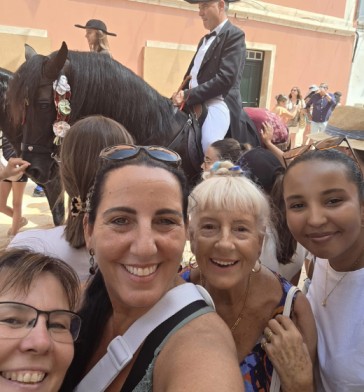
Ask anyone in Es Mercadal which weekend matters most, and you will get the same answer without hesitation. Sant Martí is Es Mercadal’s patron saint festival, celebrated on the third weekend of July in the centre of Menorca with horse parades, music, traditional ceremonies, and village-wide gatherings. For the rest of the year, Es Mercadal is a quiet town of white houses sitting beneath Monte Toro. However, when July arrives, the streets fill with horses, family celebrations, and visitors from every corner of the island. In fact, many locals plan their whole summer around these dates.
If you are visiting Menorca, learning Spanish, or simply interested in local culture, Sant Martí offers one of the clearest ways to experience the island’s traditions at street level. I’m Mónica, and through the Spanish Homestay Immersion Program (SHIP) at Spanish Express, I welcome students into real Menorcan life. Instead of studying Spanish only from a textbook, my students live with a local teacher, practice the language while shopping, cooking, and walking through town, and join guided cultural experiences like the Sant Martí festival. In the guide below, I explain the history and meaning of Sant Martí, the main events of the third weekend of July, key customs such as the qualcada and aigua-ros, and how to experience the fiesta through SHIP.

A Short History of the Sant Martí Festival
Although the summer fiestas of Menorca are famous for their energy, I always tell my students to look at the history first, because the celebration makes more sense that way. The Sant Martí festival honors the patron saint of Es Mercadal, and its origins date back to ancient traditions that have been passed carefully from one generation to the next. Like the better known Sant Joan in Ciutadella, this festival grew around the church and the community that surrounded it.
More importantly, the structure of the celebration still reflects old Menorcan society. The riders in the cavalcade are not chosen at random. Instead, they act as representatives of the traditional social classes of the island. There is a priest, a married man, a peasant, and other figures, each one riding in honor of the saint. Therefore, when you watch the procession, you are really watching centuries of local history move through the streets.

The Third Weekend of July in Es Mercadal
People often ask me for exact dates, so here is how the calendar works. The main days of Sant Martí are always held on the third weekend of July. In 2026, that means the festival is celebrated on July 18 and 19. Even so, the wider Es Mercadal festivities begin much earlier. The program of events actually starts at the end of June, marking the beginning of the broader celebrations, and continues until July 20, filling the village and surrounding area with concerts, games, and gatherings for weeks.
The heart of it all arrives with the Vigília de Sant Martí on July 18, the evening when the celebration truly takes off. After that, Sunday, July 19, becomes the most solemn and most joyful day at the same time. Then, on July 20, the final day closes everything with a children’s party and fireworks over the town. Visitors who plan their trip around this weekend discover Menorca at its warmest.
The Qualcada: Horses, Riders, and the Jaleo
If you have seen images of Menorcan fiestas, you already know the horses are the stars. During Sant Martí de Es Mercadal, the traditional horse parade is called the qualcada, and it follows customs that locals protect with real pride. Before anything can begin, the riders must ask permission from the mayor and the local authorities. Only then does the cavalcade start moving, with each rider representing his or her place in the old social order.
Meanwhile, the horses themselves are beautifully decorated with ribbons, and the crowd presses close as the jaleo music is played in the square. When the first notes sound, the horses rear up on their hind legs while people cheer and reach toward them. It is loud, emotional, and unforgettable. For example, my students often say that no photo prepared them for the feeling of standing in that crowd.

Sunday at the Town Hall: Reception and Aigua-ros
Sunday morning brings a quieter, more ceremonial side of the fiesta, and honestly, it is my favorite part to explain. First, a solemn mass is held in the church on July 19, and during the service, aigua-ros is distributed among the people. This scented rose water is a small gesture, yet it carries deep meaning, because it connects today’s celebration to the traditions of the past.
After the mass, there is an official reception at the Town Hall, where the riders, the authorities, and the community come together. As a result, the whole centre of the village feels like one extended family for a day. Then, in the evening, the horses return to the streets, the music rises again, and Es Mercadal enjoys the last hours of its most important weekend before daily work and routine slowly come back.
Living the Es Mercadal Festivities Through SHIP
For my students, Sant Martí is never just something to watch. Because they stay with me and share daily life on the island, the festival becomes something to live in Spanish. We talk with neighbors about the riders, order local pastries in the village bakeries, and follow the events side by side with people who have celebrated this fiesta their entire lives. At the same time, every conversation, every question, and every shared meal quietly builds their confidence in the language. That is the real difference between visiting a festival and belonging to it, even for a week.

A Weekend That Stays With You
By the time the last fireworks fade on July 20, my students usually realize they have learned far more than vocabulary. They remember the sound of the jaleo, the ribbons on the horses, the taste of a shared meal, and the pride of a small village honoring its saint. That is why I love teaching here in Menorca. The island becomes the classroom, and Spanish becomes something my students have truly lived.
So, Come Live Sant Martí With Us
If you want to experience the Sant Martí festival the way locals do, the best way is through the Spanish Homestay Immersion Program (SHIP). You will stay with a local teacher in Menorca, practice Spanish through real daily life, and join the Es Mercadal festivities with someone who can explain every tradition as it happens around you. Instead of watching from the outside, you will celebrate from within, and your Spanish will grow with every conversation.

You can also explore more cultural immersion stories here:
👉 Read Stories of Our Past Visitors Here
For personalised guidance and programme details, you can contact our founder directly:
Mónica Romero
Founder & Director, Spanish Express
📞 Phone / WhatsApp: +44 7903 867 894
📧 Email: monicaromero@spanishexpress.co.uk
