

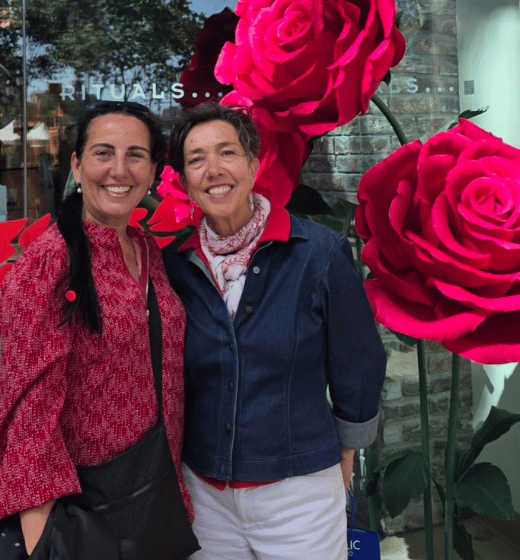
She stood on Passeig de Gràcia with her mouth half-open, a copy of García Márquez tucked under one arm, and said the thing I hear from almost every student who walks into Sant Jordi for the first time.
“Wait, this is all for a saint?”
I laughed. Because yes, technically, Sant Jordi is the patron saint of Catalonia. He has been since the 15th century. But calling April 23rd a religious holiday is like calling Carnival a church service. It misses the entire point.
Sant Jordi’s Day is a Catalan festival held on April 23rd that combines culture, romance, and history.
My name is Mónica. I’m the founder, director, and one of the host teachers at Spanish Express. Every year, I welcome hundreds of students into my home in Barcelona and Menorca through our Spanish Homestay Immersion Program (SHIP). Students don’t just study Spanish with us. They live it. They eat it. They walk through it on streets that smell like fresh bread and old stone.
And if they’re lucky enough to arrive in April, they walk straight into the most romantic, chaotic, book-obsessed festival this city has ever invented.
Jane was one of the lucky ones!
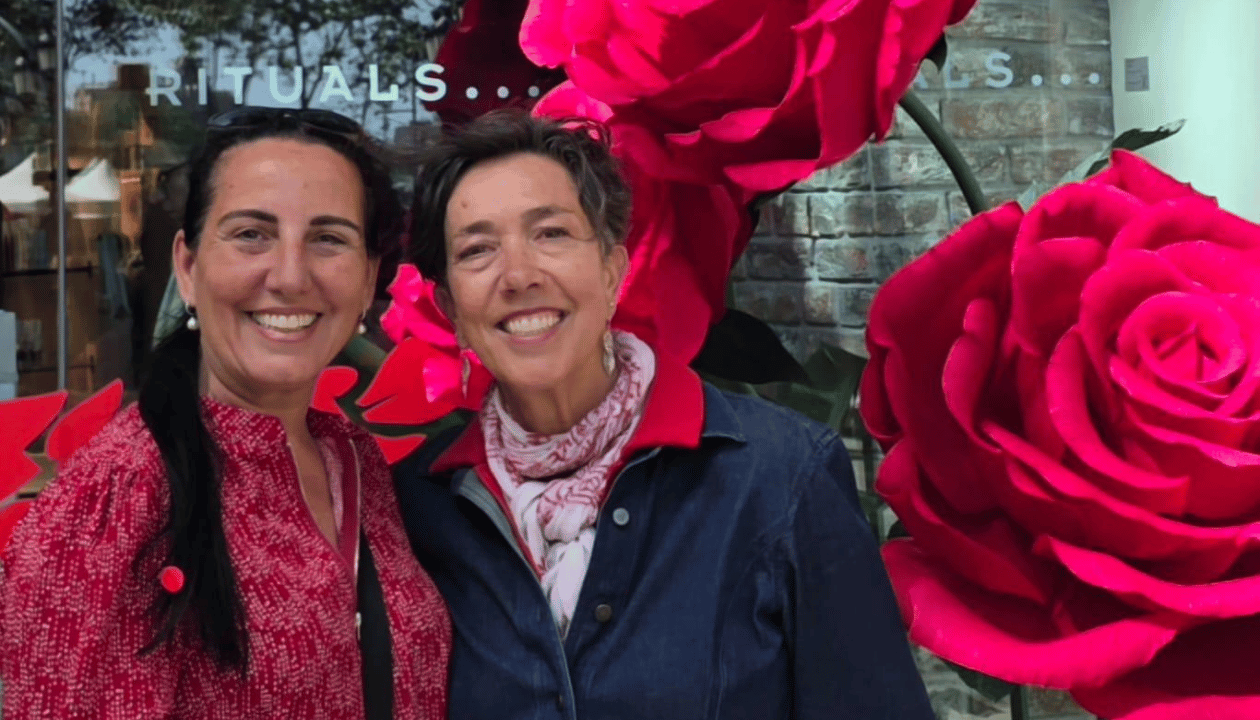
How Jane Turned Barcelona into Her Playground
She flew in from North Carolina just one week before Sant Jordi’s Day—confident, curious, and already working comfortably at a high B1 level of Spanish. She wasn’t the kind of student who waited on the sidelines; she stepped straight into conversations.
From day one, Jane was fully engaged—asking questions, reacting naturally, and making every interaction count. Her Spanish wasn’t perfect, but it was expressive, fluid, and confident.
A few days into her stay, as the city began preparing for La Diada de Sant Jordi, I watched her lean into a conversation with a local bookseller. She wasn’t just buying something—she was asking about the tradition itself.
Why do people exchange roses? Is it true that on April 23, men traditionally give roses and women give books—sometimes called the ‘men books’ tradition? Do people still follow this, or has it changed? What’s the story behind it all?
She listened carefully, nodded, and followed up with more questions—connecting ideas, building the conversation, and genuinely engaging with the culture. The bookseller explained that while it was once traditional for men to give roses and women to give books, nowadays anyone can exchange gifts regardless of gender, reflecting the changing social customs and festive atmosphere of Sant Jordi.
It wasn’t rehearsed Spanish; it was real communication with purpose.
So when I told her we had something special planned—that we were heading to Casa Batlló on April 23rd—she didn’t hesitate.
She grabbed her bag, smiled, and said, “Vamos.”
She had no idea what she was about to walk into.
When Barcelona Becomes the Festival
Here’s the thing about Diada de Sant Jordi that no travel blog quite captures: Barcelona doesn’t celebrate it. Barcelona becomes it.
Over the course of Sant Jordi, the city bursts into a vibrant celebration filled with symbolism, tradition, and a wide range of activities. The festival is often considered the Catalan Valentine’s Day, featuring the cherished tradition of exchanging books and roses.
By the time Jane and I stepped off the train that morning, La Rambla and Passeig de Gràcia had already transformed into open-air markets. Stalls selling books stretched for blocks, their tables sagging under the weight of poetry collections and thrillers and children’s stories in Catalan. Other stalls overflowed with red roses, tied with ribbon, wrapped in cellophane, some still wet from the morning’s misting. The streets were thick with people. Couples, families, friends walking arm-in-arm, everyone carrying either a book, a rose, or both.
“There are flowers everywhere,” Jane kept saying.
She wasn’t exaggerating. Approximately four million roses are sold across Catalonia on this single day. Four million. Alongside roughly 500,000 books. It is, by any measure, a staggering act of collective devotion to two simple things: love and literature.
And that devotion has a story behind it.
The Legend That Started It All
I told Jane the legend as we walked. Every Catalan child grows up hearing it the way American children grow up with George Washington and the cherry tree, except this one has a dragon.
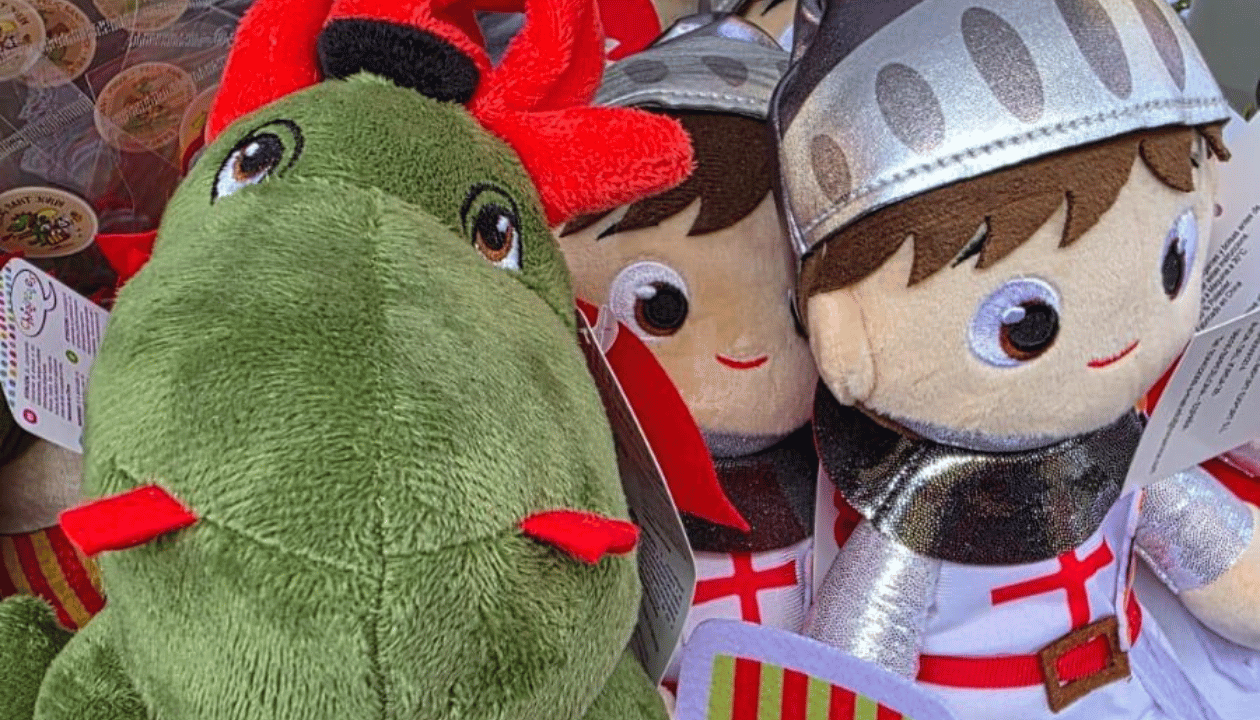
Long ago, in the medieval village of Montblanc, a terrible dragon terrorized the townspeople. It devoured their animals, poisoned their water, and demanded a daily human sacrifice. The villagers chose their victims by drawing lots, and one day the lot fell on the king’s daughter, the beautiful princess, whom no one could spare.
Just as the dragon prepared to take her, a brave knight arrived on a white horse. This was Sant Jordi, also known as Saint George, and he drove his lance into the beast. From the dragon’s blood, a rose bush sprang from the earth, blooming with the reddest roses anyone had ever seen. Sant Jordi picked a red rose and offered it to the princess.
That story, with its roots in the historical figure of Saint George, a Roman soldier martyred for his Christian beliefs around 303 AD, has echoed through the Middle Ages and across centuries of Catalan culture. It has been adapted and retold in Greece, England, and a dozen other countries, each with its own version of the tale.
But nowhere has it sunk so deeply into a people’s identity as it has here. The legend isn’t just a story in Catalonia. It is the story. The tale of the king’s daughter and Sant Jordi is central to George’s Day and Saint George’s Day celebrations in Catalonia, explaining why, every April 23rd, the tradition calls for an exchange of books and roses between loved ones.
A Rose for Love, a Book Forever
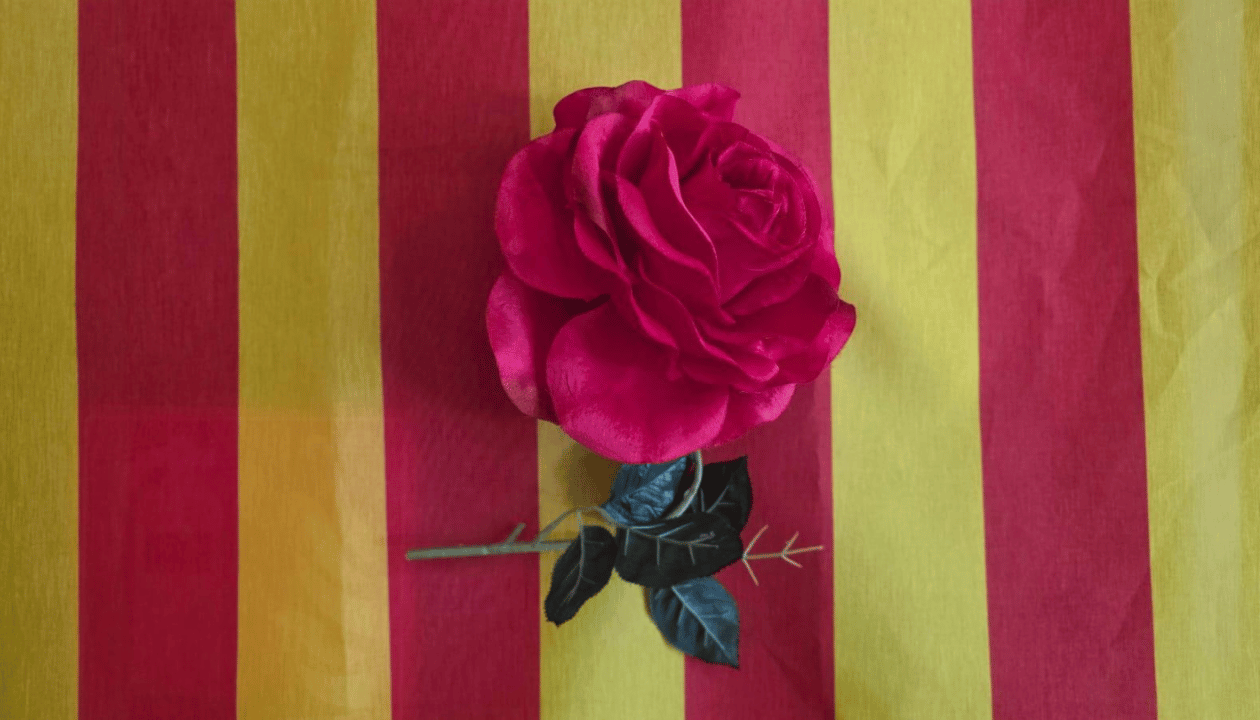
On Sant Jordi’s Day, it is traditional for men to give roses and women to give books, though in recent years these roles have become far more flexible. Now anyone exchanges gifts regardless of gender. The tradition of giving roses on Sant Jordi’s Day dates back to the 15th century, with men traditionally giving roses to women. The rose has become a symbol of love and Catalan identity, representing both affection and cultural pride. The official slogan since 1997 says it plainly: a rose for a love, and a book forever.
Jane thought about that for a second. “So it’s like Valentine’s Day but with better gifts?”
Close enough. The festival is often called the Catalan equivalent of Valentine’s Day, though locals might bristle at the comparison. Valentine’s Day sells greeting cards. Saint George’s Day in Catalonia sells poetry in the Catalan language.
But we hadn’t come just for the stalls. We’d come for the dragon.

Standing Inside the Dragon: Our Casa Batlló Experience
Casa Batlló sits on Passeig de Gràcia like a building that dreamed itself into existence. Antoni Gaudí redesigned it in the early 1900s, and everything about it bends and breathes. The façade ripples with colored tiles. The balconies look like the jawbones of some enormous creature. The rooftop arches upward in a ridge of ceramic scales that, depending on who you ask, represents either the back of a dragon or the spine of a dinosaur.
During Sant Jordi celebrations, the building leans fully into the legend. Casa Batlló is decorated with roses along its facade, thousands of them cascading down the front of the structure until the whole building seems to blush. The cross-shaped chimney on the roof becomes Sant Jordi’s lance, plunged into the dragon’s spine. The entire building transforms into a living monument to the story.
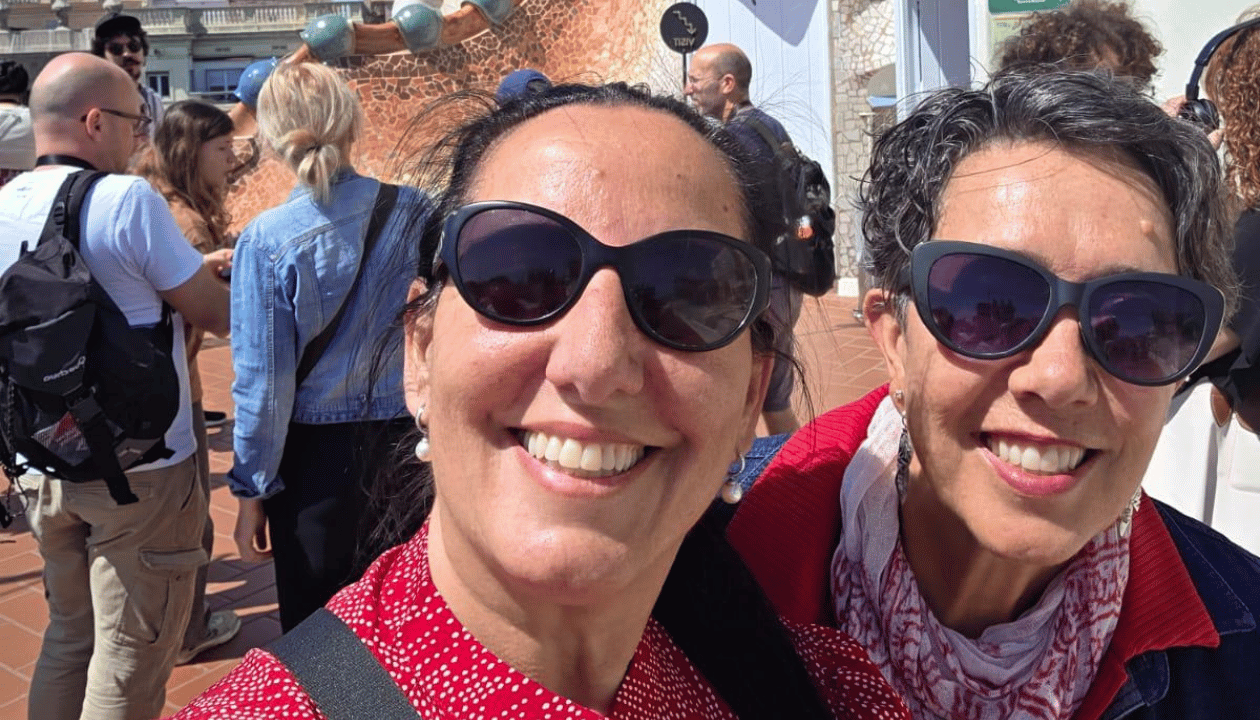
Jane stared up at it. Then she took a photo. Then she put her phone away and just stared again.
“The building is the dragon,” she said.
“Now you’re getting it.”
What It Feels Like Inside Gaudí’s Masterpiece
Inside, it only deepens. The stairwells curve like the interior of a ribcage. Light filters through stained glass that shifts from blue to green depending on where you stand. Everything is organic, with no straight lines and no sharp edges, just the fluid architecture of something alive. Gaudí didn’t design rooms. He designed ecosystems.
We climbed to the rooftop. From up there, you can see across the city. The spires of the Sagrada Família in one direction, the shimmer of the Mediterranean in another, and below, the city centre is packed with the celebration in full motion. I watched Jane lean against the railing, looking down at the crowds flowing along the boulevards, at the scattered color of book covers and rose petals, at the Catalan flag hanging from balconies.
“Do people here know how special this is?” she asked.
I told her what I always tell my students. The people of Catalonia don’t just know. They insist on it. Sant Jordi is woven into Catalan identity like thread into fabric. It is a day dedicated to everything they value most: their language, their literature, their history, their sense of who they are. When you see someone reading aloud at a stall near Plaça Sant Jaume, or lining up outside the Palau de la Generalitat to see the rose display, or buying a book from a small Catalan publisher they’ve never heard of, that’s not performance. That’s inheritance.
Why April 23rd Matters to the Whole World
What makes this special day even more layered is that April 23rd also happens to be UNESCO World Book Day, or more formally, World Book and Copyright Day. The date marks the death anniversary of both Miguel de Cervantes and William Shakespeare. When UNESCO declared it in 1995, they chose a date that already belonged to Catalonia’s deepest tradition. It was no coincidence that Cervantes Publishing House and Catalan publishers had long championed the day as a celebration of literature. The overlap only amplified what the festival already was.
On this single day in 2016, more than 1.58 million copies of over 45,000 book titles were sold in Catalonia, with 54 percent published in Catalan. Annually, roughly eight percent of all books sold in the region, around 1.5 million copies, move on Sant Jordi’s Day alone, along with a third of all roses sold throughout the year. The celebration generates enormous economic energy for authors, publishers, and booksellers. It is, without exaggeration, one of the most significant cultural events in all of Spain.
A Long Stroll Through the Heart of the Celebration
We spent the rest of the afternoon wandering through the celebrated streets. Past author signings and Sardanes dancing in the squares. Past restaurants with special de Sant Jordi menus, which often feature Sant Jordi Bread (Pa de Sant Jordi), a traditional savory bread made with cured sausage and cheese to represent the colors of the Catalan flag, and shops with dragon-themed window displays. Past buskers and performers and a man in full knight armor riding, I am not kidding, an actual horse through a pedestrian town street while tourists and locals cheered.
The festive atmosphere was everywhere. Castells performers building human towers, musicians playing in doorways, people laughing and reading and handing roses to strangers. The whole centre of Barcelona felt like it had agreed, just for today, to be its best and most generous self.
At one point, we stopped at a stall and Jane bought a book, a slim volume of poetry by a Catalan writer she’d never heard of. She bought it because the bookseller told her it was about “the distance between languages,” and something about that phrase landed.
She also bought a rose for my mum, my dad and for me. She wanted to belong here and it felt wrong to walk through George’s Day without buying roses.
What Jane Said That I Haven’t Forgotten
As we left Casa Batlló and took a long stroll back toward the metro, the afternoon light turning everything amber, Jane said something I’ve been thinking about ever since.
“I thought I came here to learn Spanish. But I think what I’m actually learning is how to pay attention.”
That’s what Sant Jordi in Barcelona does, if you let it. It doesn’t just celebrate a legend or mark a feast on the calendar. It asks you to stop and notice what matters. A rose, a story, a person standing next to you, the city you’re walking through. It asks you to hold a book in your hands and remember that someone sat alone in a room for years to write it. It asks you to give a flower to a loved one and not be embarrassed about it.
Why I Keep Bringing My Students Back
Every April, I take my Spanish Homestay Immersion Program (SHIP) students to this celebrated festival. I walk them through the many attractions of Barcelona that become, for one special day, something more than tourist sites. I watch the city reveal itself to them in stalls and songs and the smell of roses drying in the sun.

And every year, at least one student, standing on the rooftop of Casa Batlló with dragon scales under their feet and a whole Catalan tradition swirling below, turns to me and says something that tells me they finally get it.
Paying attention. Giving something beautiful to someone. And letting a very old story remind you that the dragon doesn’t always win.
If you’d like to experience Sant Jordi in Barcelona the way Jane did, living it from the inside rather than watching from the outside, I’d love to welcome you into my home.
You can explore more cultural immersion stories here:
👉 Read Stories of Our Past Visitors Here
For personalized guidance and program details, feel free to contact me directly:
Mónica Romero, Founder & Director, Spanish Express
📞 Phone / WhatsApp: +44 7903 867 894
📧 Email: monicaromero@spanishexpress.co.uk
