

For 121 years, no one standing on Spanish soil has watched the Moon swallow the Sun whole. On August 12, 2026, that long wait ends, and five of our own homes sit directly in the shadow’s path.
I am Mónica, founder and director of Spanish Express and a host teacher in Menorca, where I run our Spanish Homestay Immersion Program (SHIP). I have spent years welcoming learners into my home, and this summer I get to share something far rarer than a lesson.
This guide walks you through the total solar eclipse on August 12 and the five SHIP destinations where you can learn Spanish by day and stand beneath totality by evening.
What Makes This Eclipse So Special
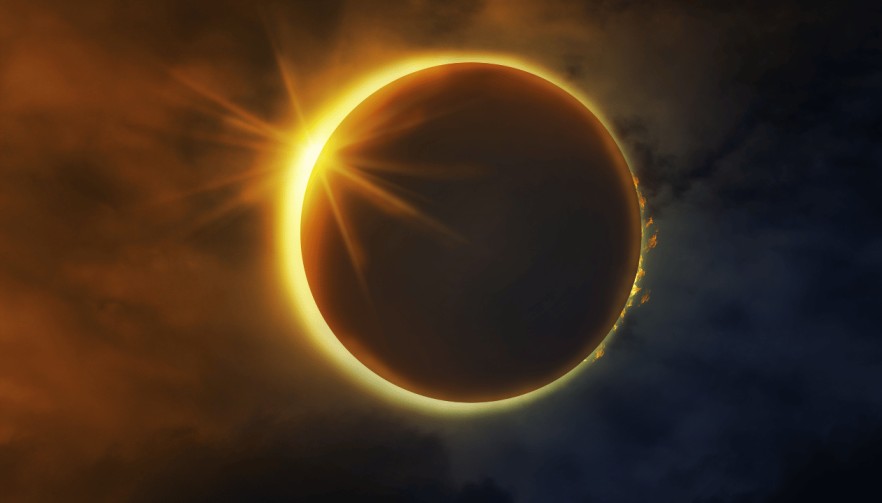
A total solar eclipse occurs when the Moon passes directly between the Earth and the Sun and completely covers the Sun’s bright face. Only then, during the total phase, does the Sun’s corona blaze into view as the sky darkens.
This is the first total solar eclipse visible from mainland Europe since 1999, and the first in Spain since 1905. The Moon’s shadow sweeps from the Arctic Ocean across Greenland, Iceland and the North Atlantic before reaching northern Spain.
How the Eclipse Unfolds Across Spain
The eclipse begins in northern Russia at sunrise, with totality occurring between roughly 17:02 and 18:30 UTC along its full track. The path of totality also clips a small corner of Portugal before crossing the Iberian Peninsula.
In Spain, it arrives near sunset, low on the western horizon. Observers outside the narrow path see only a partial eclipse, where the Moon never completely blocks the Sun, and the corona stays hidden.
A Coruña: First to Catch the Shadow in Spain
Our Galician destination is where mainland Spain first meets totality. In A Coruña the eclipse begins around 19:31 local time, reaches maximum near 20:28, and totality lasts about 76 seconds.
The Sun sits roughly 12 degrees above the horizon here, higher than anywhere else on our list. That extra altitude gives A Coruña one of the clearer sightlines among the Spanish viewing spots.
Burgos: The Longest Totality of Our Five
Burgos rewards patience with the longest darkness of any Spanish Express destination. Totality here runs about 104 seconds, with maximum eclipse near 20:29 and the Sun around 8 degrees above the horizon.
Sitting close to the eclipse centerline, this historic Castilian city is among the prime mainland spots. Pair its French Gothic cathedral by day with nearly two minutes of daytime night, and the experience becomes unforgettable.
Tarragona: Catalonia’s Only Window to Totality
Of the four Catalan provinces, only Tarragona falls fully inside the path of totality. In Tarragona city, maximum eclipse comes near 20:30 with about a minute of totality, the Sun just 4 degrees high.
Head south toward the Ebro Delta and totality stretches to roughly 1 minute 34 seconds. A clear, unobstructed view to the west-northwest matters greatly here, since the Sun hangs so low.
Valencia: Totality Over the Mediterranean City
Valencia is the third largest city in Spain to sit within the path. The eclipse begins around 19:38, with the total phase falling near 20:33 and lasting roughly one minute, the Sun only about 4 degrees up.
For that brief minute the light dims, the temperature drops slightly, and the twilight sounds of birds and insects emerge. A high spot with a clear western horizon gives the best view.
Menorca: A Sunset Eclipse Over the Sea
My own island sits near the very end of the path, where the eclipse becomes a true sunset spectacle. Near Cap d’Artrutx, totality lasts about 1 minute 16 seconds, with the Sun barely 2 degrees above the horizon.
Watching the darkened Sun hover over the Mediterranean before sinking is rare and dramatic. Because the Sun is so low, a west-facing coastline with nothing blocking the horizon is essential.
Seeing It Safely
Looking directly at the Sun can cause severe and permanent eye damage. Regular sunglasses, homemade filters and X-rays are never safe for observing any of the partial phases.
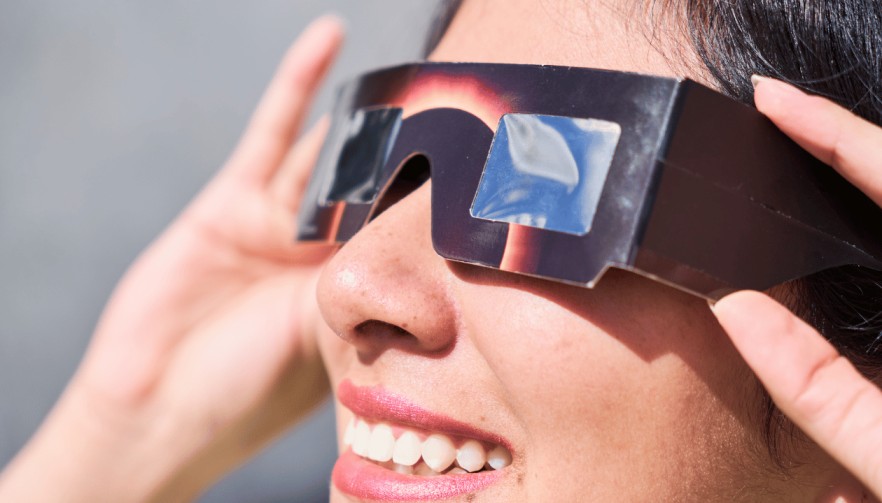
Use only eclipse glasses that comply with the ISO 12312-2 standard, and inspect them for damage before use. Telescopes, binoculars and cameras need certified solar filters fitted to the front, or you can try a pinhole projector for indirect viewing.
When It Is Safe to Look
There is one exception to the rule. It is safe to remove your solar glasses only during totality, the brief moment when the Moon completely blocks the Sun, and the corona appears.
The instant totality ends, and the Sun’s disk reappears, the glasses must go straight back on. During every partial phase, before and after, proper eye protection is essential.
Why Combine the Eclipse With a SHIP Stay
A total solar eclipse offers a rare scientific and educational opportunity, and it pairs naturally with learning a language in the place it is spoken. Imagine practising Spanish all day, then sharing this celestial moment with your host family at sunset.
During totality, bright planets such as Mercury and Jupiter may even appear in the darkened sky. It is the kind of shared experience that turns vocabulary into lasting memory.
FAQs
Where in Spain will the total eclipse be visible?
Totality crosses the northern half of the country from Galicia to the Balearic Islands. Among our destinations, A Coruña, Burgos, Tarragona, Valencia and Menorca all sit inside the path.
Where is the best place to see the 2026 total solar eclipse?
The best spot is anywhere inside the path of totality with a clear western horizon, since the Sun sets low. Iceland and Spain are considered the most accessible options, with Spain offering more reliable August weather.
Where is the path of totality for the 2026 solar eclipse?
It runs from northern Russia across the Arctic, Greenland, Iceland and the North Atlantic, then over a small corner of Portugal and northern Spain, ending in the western Mediterranean.
How long does totality last?
For most observers it lasts less than two and a half minutes, and at our Spanish destinations it ranges from about one minute to roughly one minute 45 seconds.
Will the total solar eclipse be visible in the USA?
Only as a partial eclipse, seen across the northern United States. The total phase is reserved for the narrow path crossing the Arctic, Iceland and Spain.
Where is the total eclipse in Spain in 2027?
On August 2, 2027, a second total solar eclipse crosses southern Spain near the Strait of Gibraltar, including much of Cádiz province, with far longer totality than 2026.
When is the next total solar eclipse after these?
After 2026 and 2027, an annular solar eclipse follows over Spain in January 2028. Spain will then wait until 2053 for its next total solar eclipse.
Past Visitors’ Stories
This guide is just one window into the experiences our SHIP visitors enjoy across Spain. Our host teachers welcome students of every age, profession and goal into their homes.
If you would like to read real stories from learners who have lived and studied Spanish with us, our diary blogs share their full journeys, from arrival to departure.
Come and witness a once-in-a-lifetime eclipse and learn Spanish in a whole new way with Spanish Express.
You can explore more real immersion experiences here:
 SHIP Stories of Our Previous Students
Get in Touch
To learn more about our Spanish Homestay Immersion Program (SHIP) and plan your own eclipse adventure, reach out to our founder, director and host teacher in Menorca, Mónica Romero.

Phone / WhatsApp: +44 7903 867 894
Email: monicaromero@spanishexpress.co.uk
You can become the protagonist of our next story. At Spanish Express, you will learn Spanish in a different way.
