

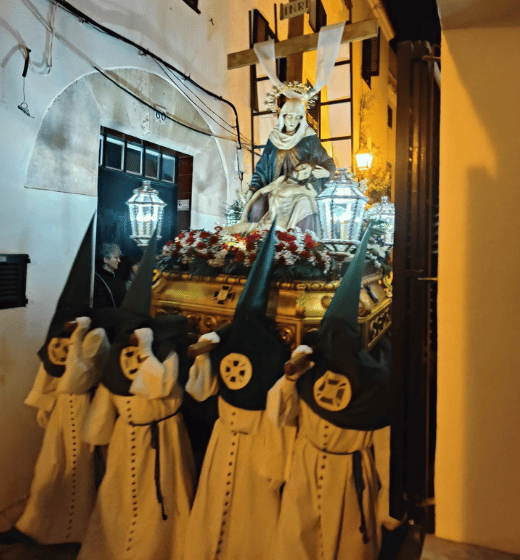
When people think of Semana Santa in Spain, they often imagine the huge and dramatic processions of Andalusia, with great crowds, heavy floats, and intense music filling the streets deep into the nights. But Semana Santa processions in Menorca offer something different, and in my opinion, something just as moving. Here on our island, Holy Week has a quieter soul. It feels more intimate, more reflective, and more connected to local culture and family life.
I say this not as a visitor, but as someone who has lived it year after year and shared it firsthand with students and tourists who come to stay in my home through our Spanish Homestay Immersion Program (SHIP).
I am Mónica, founder and director of Spanish Express, and a host teacher in Barcelona and Menorca. For me, Easter week is one of the most meaningful times to welcome guests, because they do not just see Semana Santa from the outside. They live it with us. They walk through the towns, hear the church bells, taste the traditional Easter treats, and understand why this international Catholic tradition still has such a strong place in everyday life on the island.
A Gentler Holy Week with Deep Feeling
Semana Santa is one of the grandest annual church celebrations in Spain, but in Menorca, it has its own style. The processions are highly anticipated, emotional, and beautiful, yet the atmosphere is more austere than in many cities on the mainland. That is one of the first things I explain to visitors. Here, there is reverence and silence. There is devotion without excess. The result is a unique experience that many guests remember even more strongly because it feels sincere and close.
From Palm Sunday to Easter Sunday, local churches around the island hold masses, prayers, and processions. In Mahón and Ciutadella de Menorca, people gather in the streets not only to watch but also to take part in a tradition that many families maintain year-round in their hearts, even if the public celebrations take place only during this week.
Palm Sunday Traditions that Still Feel Alive
Palm Sunday marks the true beginning of Holy Week, and it is one of the sweetest days to experience with children. On that morning, all the local churches celebrate a special mass. Families arrive carrying palm leaves and olive branches.
There is an old belief that olive branches bring luck, so many people take them home and place them near or above the front door. Some keep them hung close to the entrance as a blessing for the home.
One of my favourite Palm Sunday traditions in Menorca is palm weaving. This is something visitors are often fascinated by. Palm leaves are worked into different designs, sometimes simple and sometimes very detailed, with intricate formations that children proudly carry to church. It is a custom that has lasted for decades and is one of those beautiful details that connects easter to memory, family, and craftsmanship.
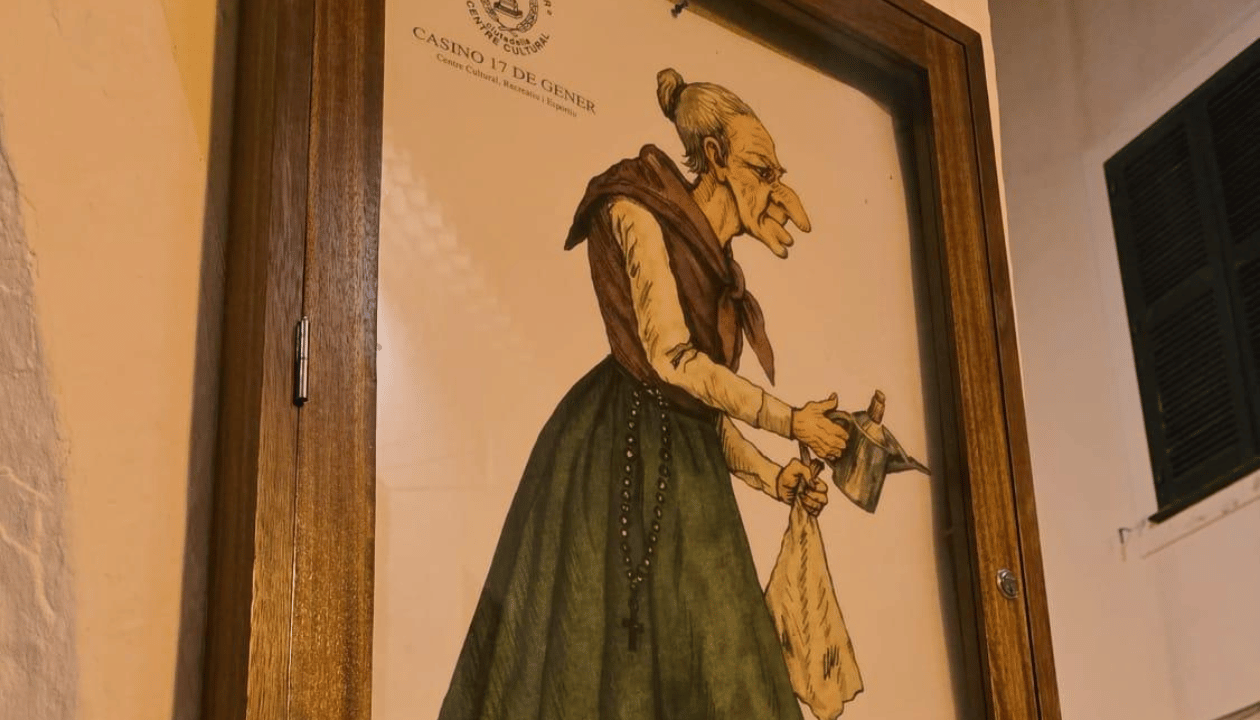
Another Lenten tradition that many local families know well is S’Avia Corema, the old woman with seven legs. Each week during Lent, one leg is removed until Easter arrives and the fasting season ends. When I explain this to students staying with us, they love how traditions here speak both to children and adults at the same time.
The Silence of the Processions Says Everything
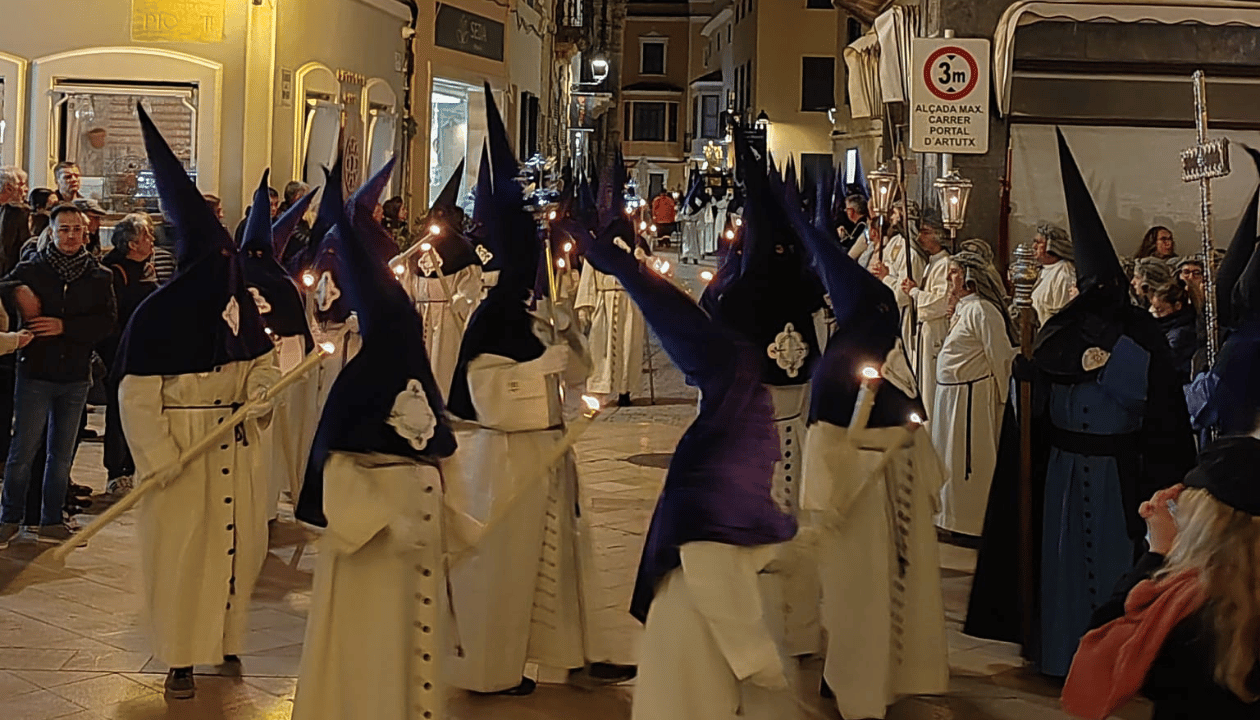
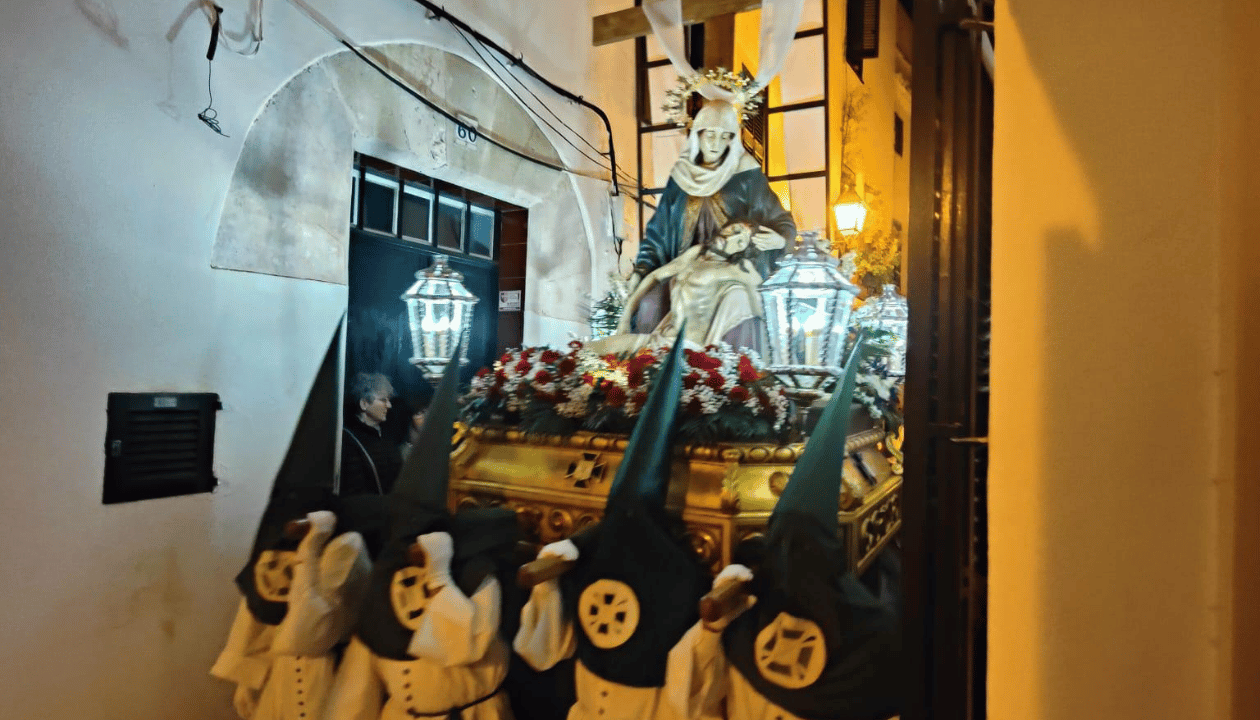
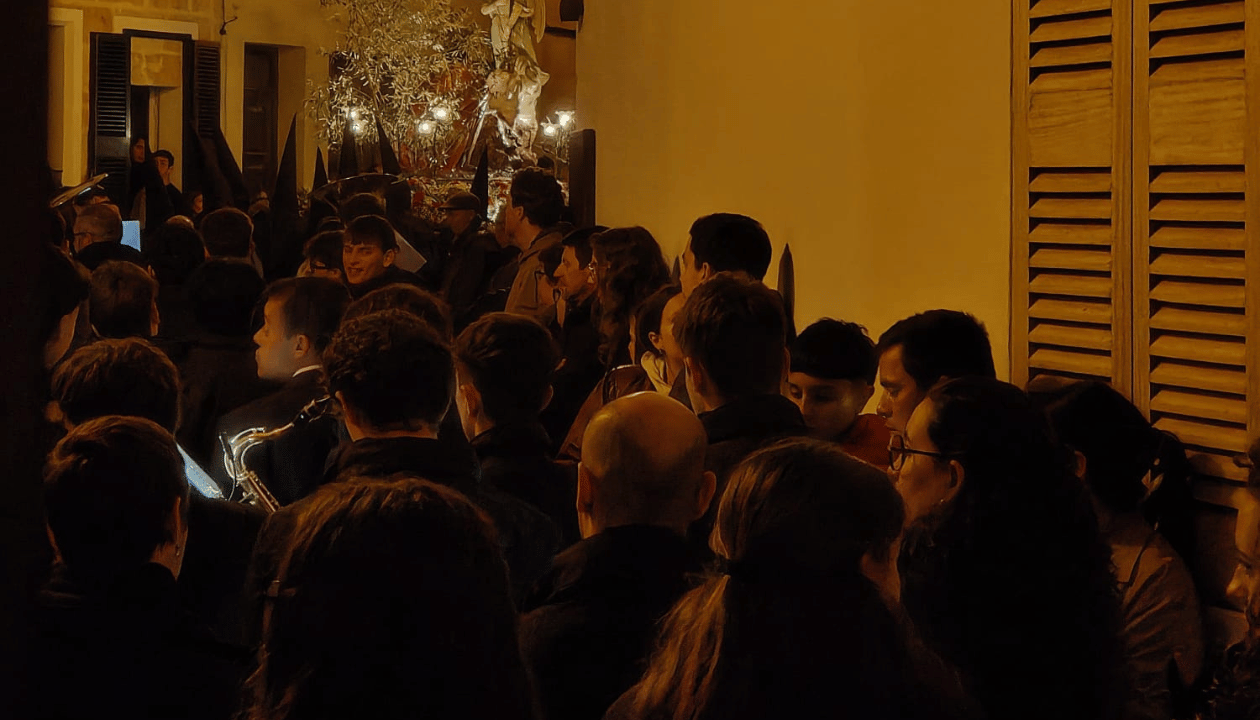
As the week continues, the processions become more solemn. In Mahón, Holy Thursday is marked by the Procesión del Silencio, the Procession of Silence. This is one of the most powerful moments of the Semana Santa processions Menorca offers. The streets grow still, the crowds lower their voices, and all attention turns to the slow movement of the brotherhoods.
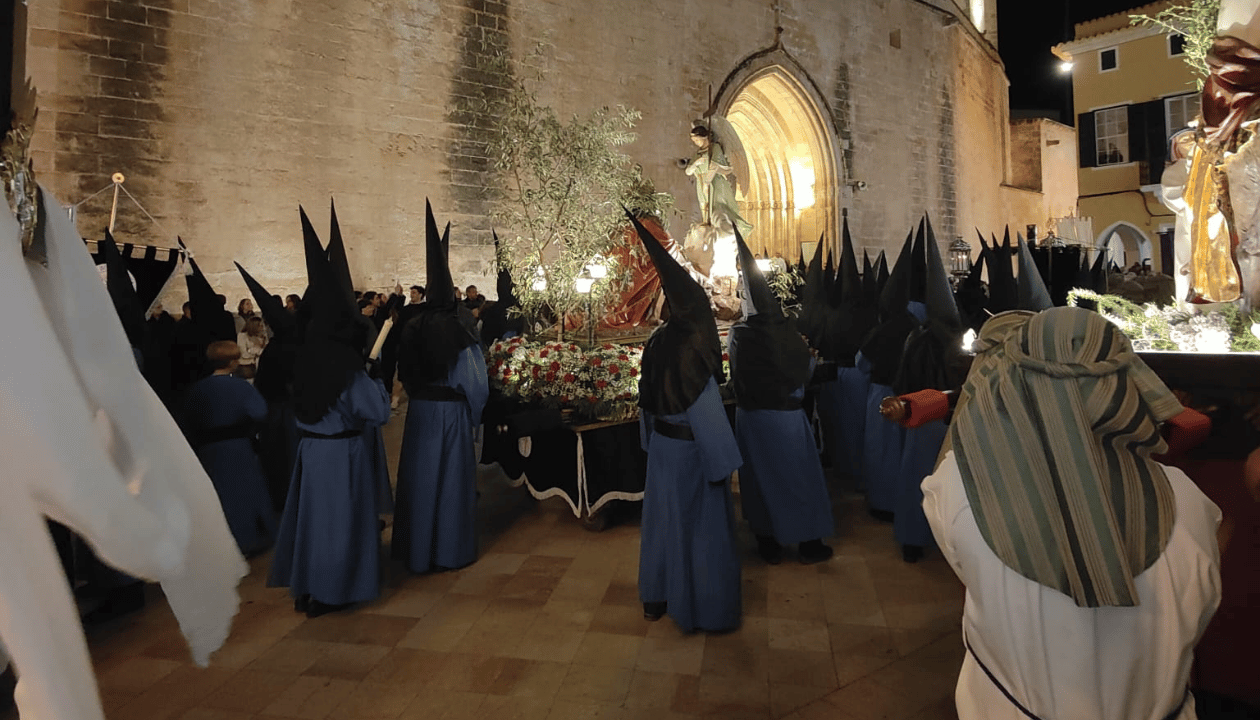
The participants wear traditional robes, long tunics, contrasting sashes, and pointed hoods. These nazarenos are part of the Cofradías, the religious brotherhoods connected to local churches.
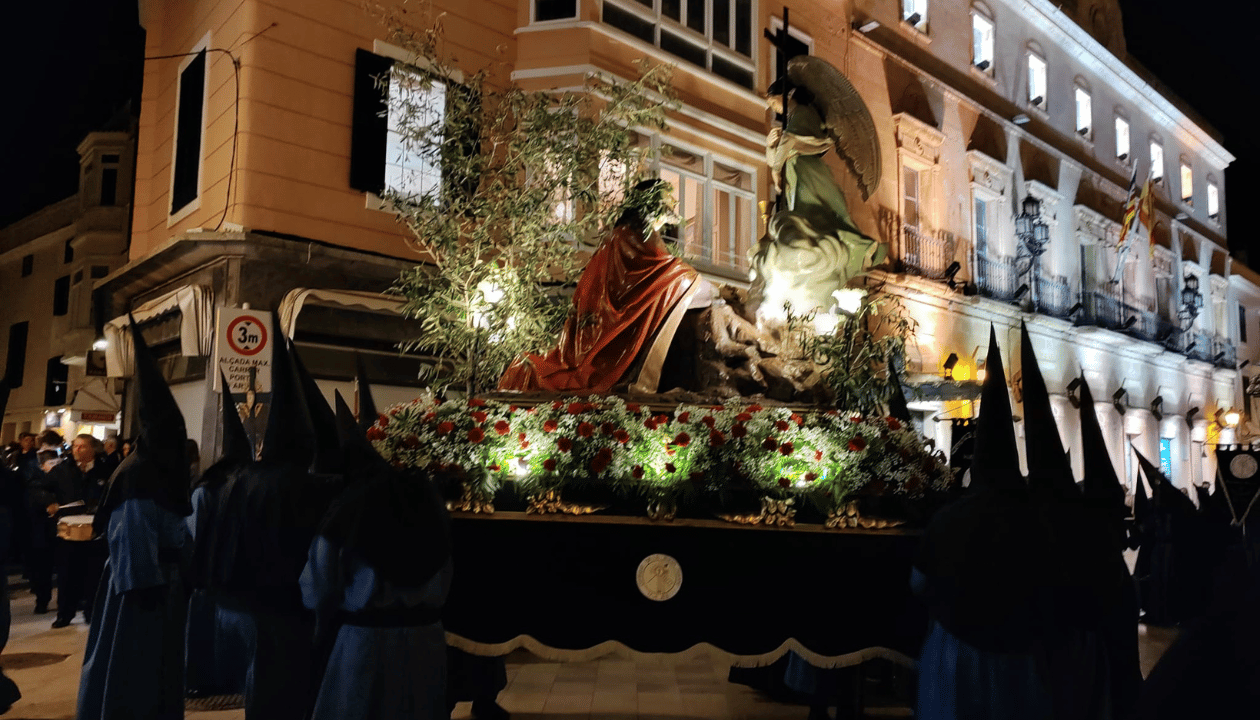
Each Cofradía has the responsibility of carrying an adorned statue or float, often representing Christ, the Virgin, or scenes from the Passion. Watching them move through the narrow streets is one of those spectacular events that does not need noise to leave a mark on you.
For guests who stay in my home, this is often the moment when Easter in Menorca becomes real. Until then, it may feel like a cultural holiday. But once you stand in silence as a simple procession passes by, lit softly and carried with devotion, you understand that this is more than something to visit. It is something deeply felt.
Good Friday in Ciutadella and Mahón
Good Friday is the most significant day of Semana Santa across the island. In both Mahón and Ciutadella de Menorca, the Processó del Sant Enterrament takes place, and in Ciutadella, the Processó dels Dolors is especially important and is often considered the largest on the island.
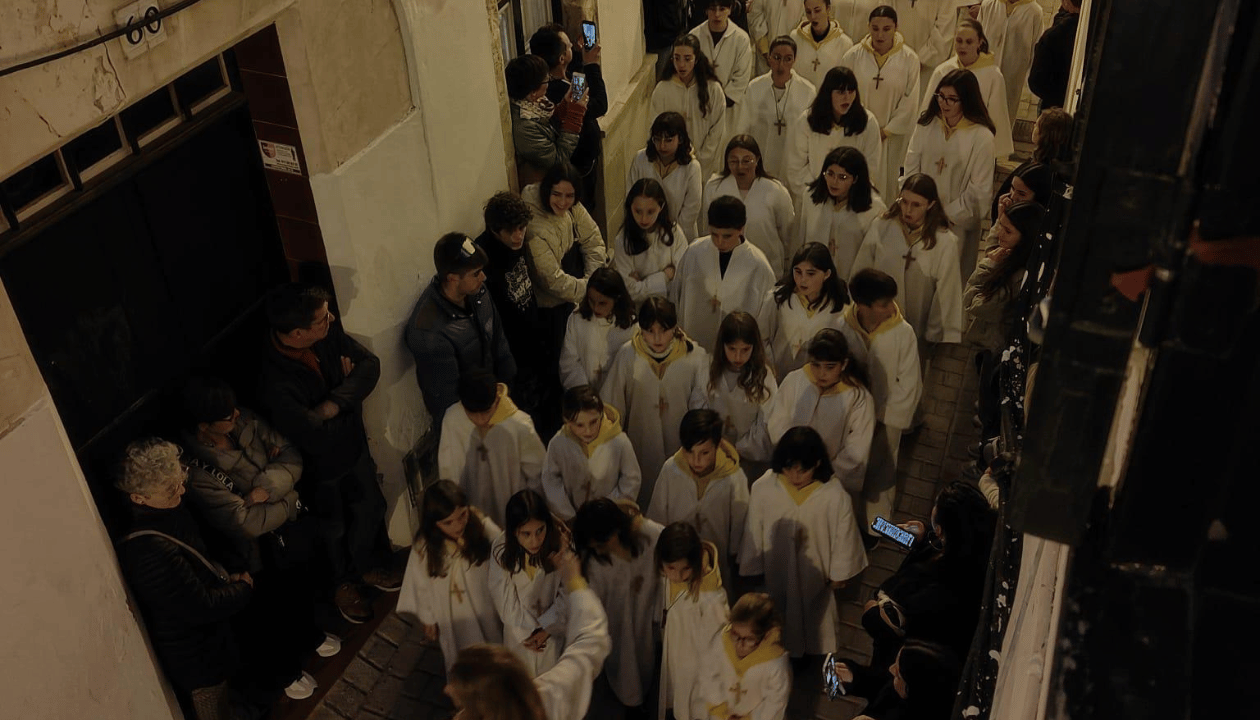
I always tell visitors to arrive early, because the towns fill gradually and the streets take on a very special mood. There are flowers, candles, quiet music, and the slow rhythm of the floats moving forward. The processions are solemn and traditional, but they are also full of emotion. You can see grandparents, parents, children, and visitors all standing side by side.
One detail many people do not expect is that some processions also include food collections for charity. I find this very touching. It reminds us that Holy Week is not only about ceremony, but also about care for others.
Easter Sunday Brings Joy After Reflection
After the seriousness of Good Friday, easter sunday changes the feeling completely. Morning services are held in all the local churches, usually between 9:00 am and 11:30 am, depending on the town. Then comes one of the most symbolic and joyful moments of the week: the meeting of two processions, one carrying the Risen Christ and the other the Virgin Mary.
When they meet, there is celebration, relief, and happiness. In some places, this encounter is accompanied by fireworks, which adds such a bright and moving contrast after the silence of the previous days. It is one of those moments that stays with people long after their trip is over.
And yes, easter monday also matters here. Even when the major religious events are over, the island still holds that holiday feeling. Families go for walks, share food, visit relatives, and enjoy the spring weather. It is often the perfect time for guests to simply relax and reflect on everything they have seen during the week.
Els Bujots and other Customs You Do Not Forget
Ciutadella also has one of the most curious customs of the season: Els Bujots. These are life-sized figures stuffed with straw and hung in the streets. They often represent unpopular figures or people who are the subject of social criticism. Traditionally, they were shot or burned on easter sunday.
This custom always surprises visitors because it feels so different from the solemn church processions. But that is exactly why it is so interesting. Semana Santa in Menorca is not only about religion inside churches. It also reflects humour, opinion, community memory, and old island ways of expressing public feeling.
Another local point of interest that people sometimes connect with this season is Santa Clara, especially when talking about convent life, sweets, and religious tradition in older parts of town. These details help visitors see how deeply easter is woven into the life of Menorca.
Traditional Easter Treats that Tell Their Own Story
For me, one of the most personal parts of easter week is the food we share at home. Menorca’s local gastronomy is part of the celebration, and guests remember it just as much as the processions.
Traditional foods during Semana Santa include formatjades, those wonderful pastry pies that are a real symbol of Menorcan easter. Some are filled with meat, especially formatjada de carn, with pork or lamb, spices, sobrasada, and lard. Others are filled with cheese, like formatjada de formatge, and are best eaten warm from the oven. These were traditionally eaten on Holy Saturday after Lent, which gives them even more meaning.
Then there are crespellets, delicate pastries with aniseed and sugar, and Caramelos de Pascua, the easter sweets children especially enjoy. There are also egg yolk candies, a traditional Holy Week treat that, in the past, were even thrown to the crowds during processions. Menorcan confectionery is full of these small treasures, and tasting them is one of the loveliest ways to understand the island.
Why Easter Is the Perfect Time to Visit Menorca
I always tell people that spring is a perfect time to visit Menorca. The weather is usually mild, with sunny days and cooler evenings, so light layers are a good idea. It is not the heat of summer, and that makes it ideal for exploring.
The island is quieter than in high season, which means the coves, coast, restaurants, and walking routes are far less crowded. You can enjoy the sea, take a walk on the beach, or start a journey along the Camí de Cavalls, the famous trail that circles the island. If you love nature, Camí de Cavalls is one of the best walks. Everything feels fresh, green, and alive.
This is also a wonderful time to discover Menorca’s megalithic monuments, fortresses, and charming towns. That’s because this time Menorca is opening earlier than ever for the tourists. You can move around by car and explore at your own pace, stopping wherever you like.
Some visitors choose a hotel, others book accommodation in rural areas, but for those who stay in a homestay, the experience has another layer. You do not only see the island. You eat with a local family, hear the stories, learn the tradition, and understand how easter is really lived.
A Local Experience from My Home in Menorca
What I love most is watching how this week changes people. At the start of the trip, they may come for the holiday, the scenery, or the idea of Spain in spring.
But after sharing meals, visiting local churches, seeing the processions, tasting sweets, walking through Ciutadella de Menorca, and talking late into the week at home, they leave with something deeper.

Semana Santa processions Menorca are not the loudest in Spain. They are not the biggest. But they are full of feeling, tradition, and truth. They are a reminder that faith and culture can still shape daily life in a quiet and beautiful way.
For anyone looking for an unforgettable experience, Menorca at Easter offers exactly that: Holy Week processions, traditional easter treats, local culture, mild weather, peaceful towns, and the chance to simply relax while discovering the island from the inside.
You can also explore more cultural immersion stories here:
👉 Spanish Culture & Festival Experiences – SHIP Stories
For personalised guidance and programme details, you can contact me directly:
Mónica Romero
Founder & Director, Spanish Express
📞 Phone / WhatsApp: +44 7903 867 894
📧 Email: monicaromero@spanishexpress.co.uk
