
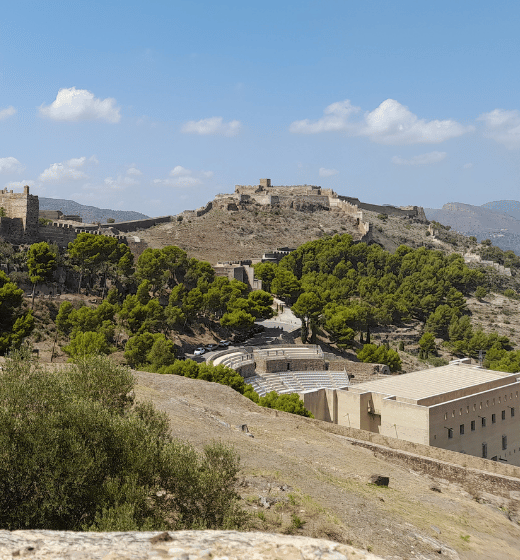
Sagunto is one of those places that quietly rewrites everything you thought you knew about Spain. Most visitors come for the beaches, but once they climb the hillside toward the ancient fortress and look out over the Mediterranean Sea, they realize this town holds something far more powerful than sunshine and sand.
The layers of history here are not just visible, they are walkable. You move from Roman ruins to Moorish arches to medieval streets within a single afternoon, and every step forward feels like a step deeper into a story that never fully ended.
I am Pilar, a Spanish teacher based in Valencia, and I bring students to Sagunto as part of the Spanish Homestay Immersion Program (SHIP) offered through Spanish Express. SHIP is not a classroom experience. It places students directly inside local life, learning Spanish through daily interaction, cultural exploration, and guided visits to places like this one.
Sagunto is not a stop on a tour. For our students, it becomes a living classroom where history and language come together in the most natural way.
A City That Refused to Be Forgotten
Sagunto’s story begins long before the Romans arrived. The city was originally settled during the early Iron Age as the Iberian city of Arse, a major trading post that commanded the surrounding landscape from its elevated hilltop.
The Romans later called it Saguntum, and it was this prosperous town that famously sided with Rome against Carthage. In 219 BC, the Carthaginian general Hannibal laid siege to Saguntum, and after eight months of fierce resistance, the city fell. That siege became the trigger for the Second Punic War, one of the most consequential conflicts in ancient history.
When the Romans retook the city in 214 BC, Saguntum was granted the status of municipium, receiving Roman citizenship and entering a long era of architectural and cultural growth. During the Middle Ages, the city was known as Murviedro and was held under Muslim rule from the 8th century until 1238, when it was reclaimed and began its next chapter. Each of these periods left marks on the stones still standing today.
Sagunto Castle: The Heart of the Hilltop
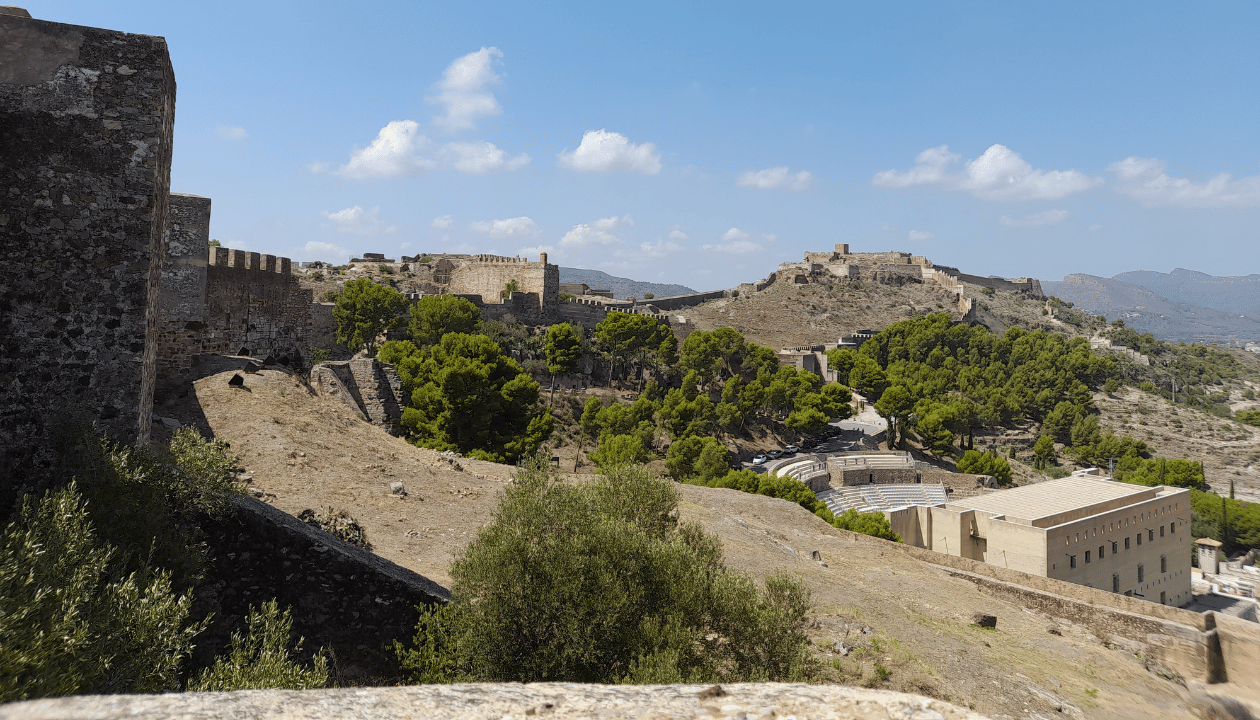
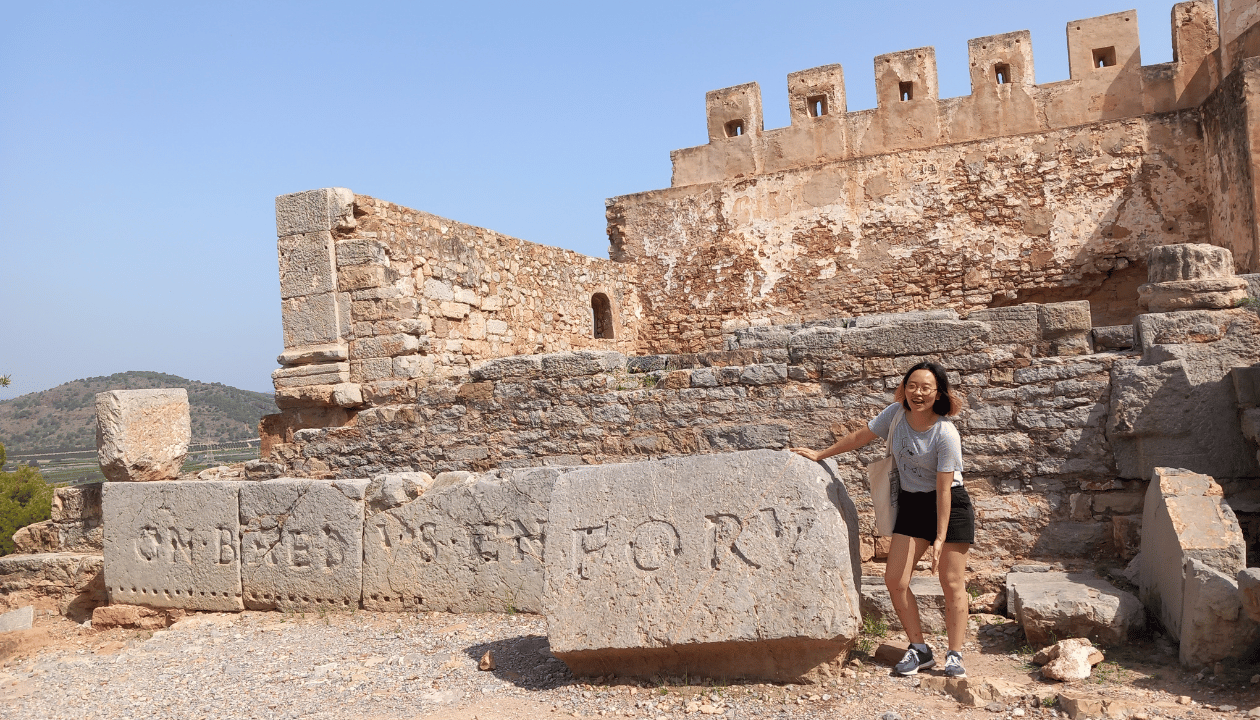
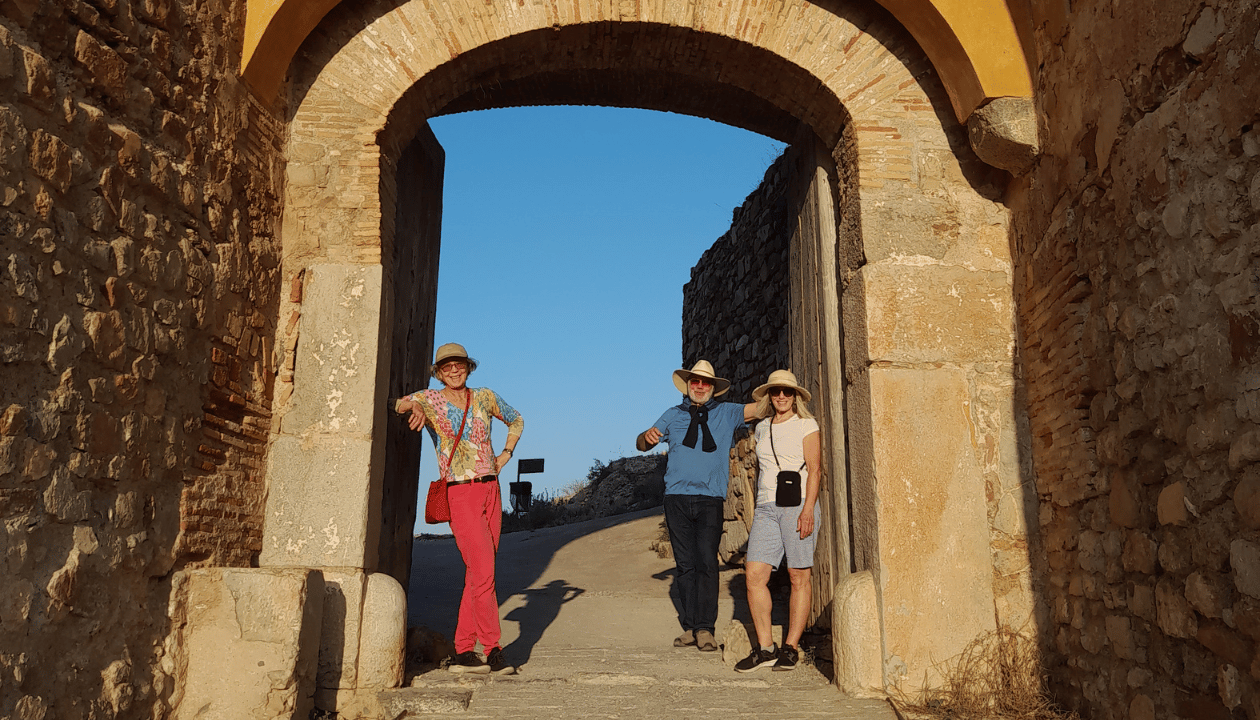
The castle is the first thing most visitors notice, and it earns every glance. Sagunto Castle sprawls across the hilltop, feeling less like a single structure and more like an entire civilization laid out in stone. The remains reflect Iberian, Roman, and Moorish periods, with the most impressive sections tracing back to the 8th century.
As you walk along the castle walls, the views stretch south toward Valencia and west across the Valencian community, with the Mediterranean Sea glinting in the distance on clear days. The Plaza de Armas sits at the heart of the fortress complex and gives a strong sense of how this space once functioned as a military and civic center.
The old walls here are thick and weathered, and standing inside them makes the ancient world feel genuinely close. I always bring students here early in the visit so that everything else in Sagunto can be understood in context.
The Roman Theatre and the Forum Below
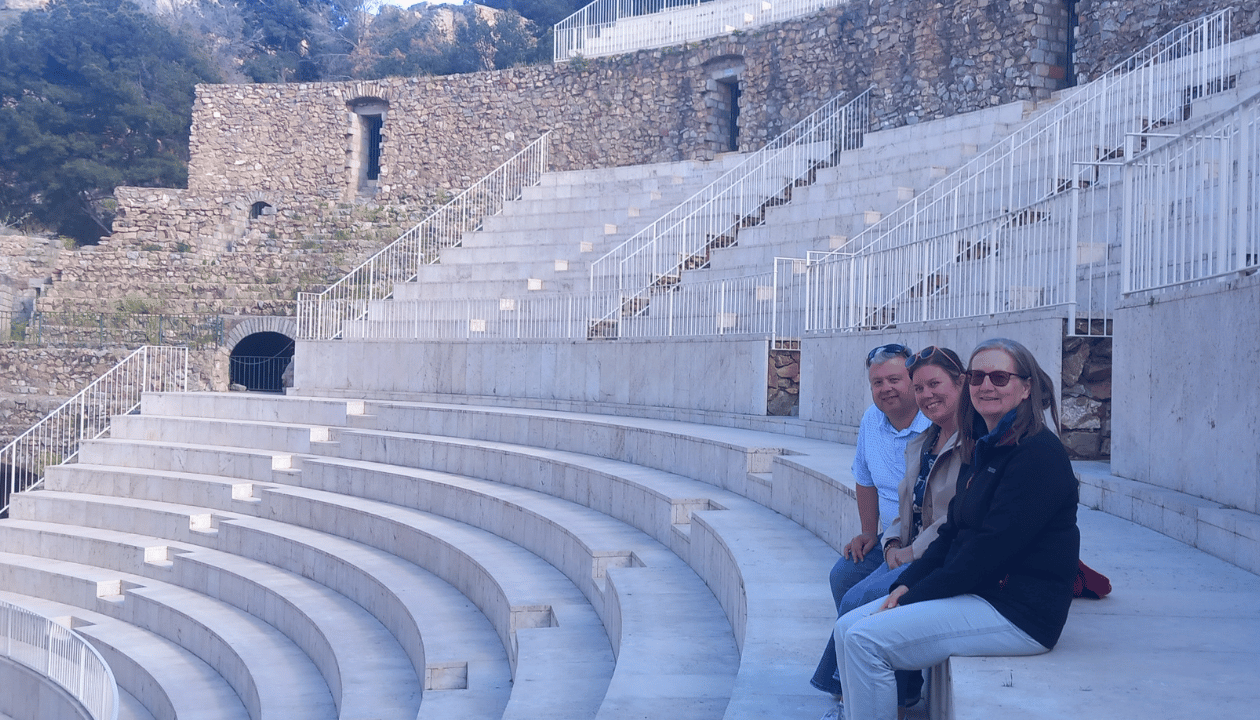
Few things in Spain prepare you for the Roman theatre of Sagunto. Built in the 1st century and declared a National Monument in 1896, this theatre could once seat 8,000 spectators and is still used for performances today.
The Roman theatre built into the natural slope of the hill is an extraordinary piece of engineering, and walking into it for the first time tends to silence even the most talkative group. Nearby, the Roman forum and other ruins from Roman times offer a broader picture of what Saguntum looked like at its peak.
The Roman city that once spread across this hillside and down into the valley below was a place of real ambition, shaped by the logic and scale of the Roman Empire. For students focused on Latin epigraphy or Roman history, this area alone could fill an entire day of guided exploration.
Narrow Streets, the Jewish Quarter, and Puerto de Sagunto
Coming down from the castle and into the city center, the rhythm of the place changes completely. The narrow streets of the old town wind past stone buildings that carry the architectural memory of the fourteenth and fifteenth centuries, and the Jewish quarter here is considered one of the best preserved in Spain.
The historical core of Sagunto holds over 2,000 years of layered occupation in a remarkably compact space, and walking it slowly is the only way to absorb what it contains. The Sagunto Archaeology Museum, housed in a building that once served as an exchange market in the 14th century, offers free admission and displays sculptures and artifacts from ancient Sagunto that put everything you have seen outside into sharper focus.
Further north, Puerto de Sagunto offers a completely different atmosphere. The beach there is sheltered from the wind, with safety surveillance, cleaning services, showers, and full access for people with limited mobility.
Canet beach, just to the north, separated by the mouth of the River Palancia, is widely regarded as one of the most beautiful beaches in the entire Valencia Autonomous Region. Sagunto’s coastline runs for 13 kilometers in total, all of it holding Blue Flag status for environmental quality.
Ready to Experience Sagunto Yourself?
The Spanish Homestay Immersion Program (SHIP) through Spanish Express places you inside this culture rather than outside it. Students live with local teachers, practice Spanish through real daily interaction, and visit places like Sagunto not as tourists but as participants in the life of the region.

This is language learning the way it was always meant to work, through experience, connection, and genuine immersion in a community that welcomes you in.
You can also explore more cultural immersion stories here:
👉 Read Stories of Our Past Visitors Here
For personalized guidance and programme details, you can contact our founder directly:
Mónica Romero, Founder & Director, Spanish Express
📞 Phone / WhatsApp: +44 7903 867 894
📧 Email: monicaromero@spanishexpress.co.uk