If you have never heard of Cáceres, you are not alone, and that is exactly why it is worth visiting. Tucked into the west of Spain in the Extremadura region, Cáceres holds one of the best-preserved medieval old towns in Europe.
Its walled historic centre, the Ciudad Monumental, has been a UNESCO World Heritage Site since 1986, and walking into it feels less like sightseeing and more like stepping back six hundred years. There are no cables, no neon, almost nothing to remind you of the present century. Just stone, silence, and storks circling the towers.
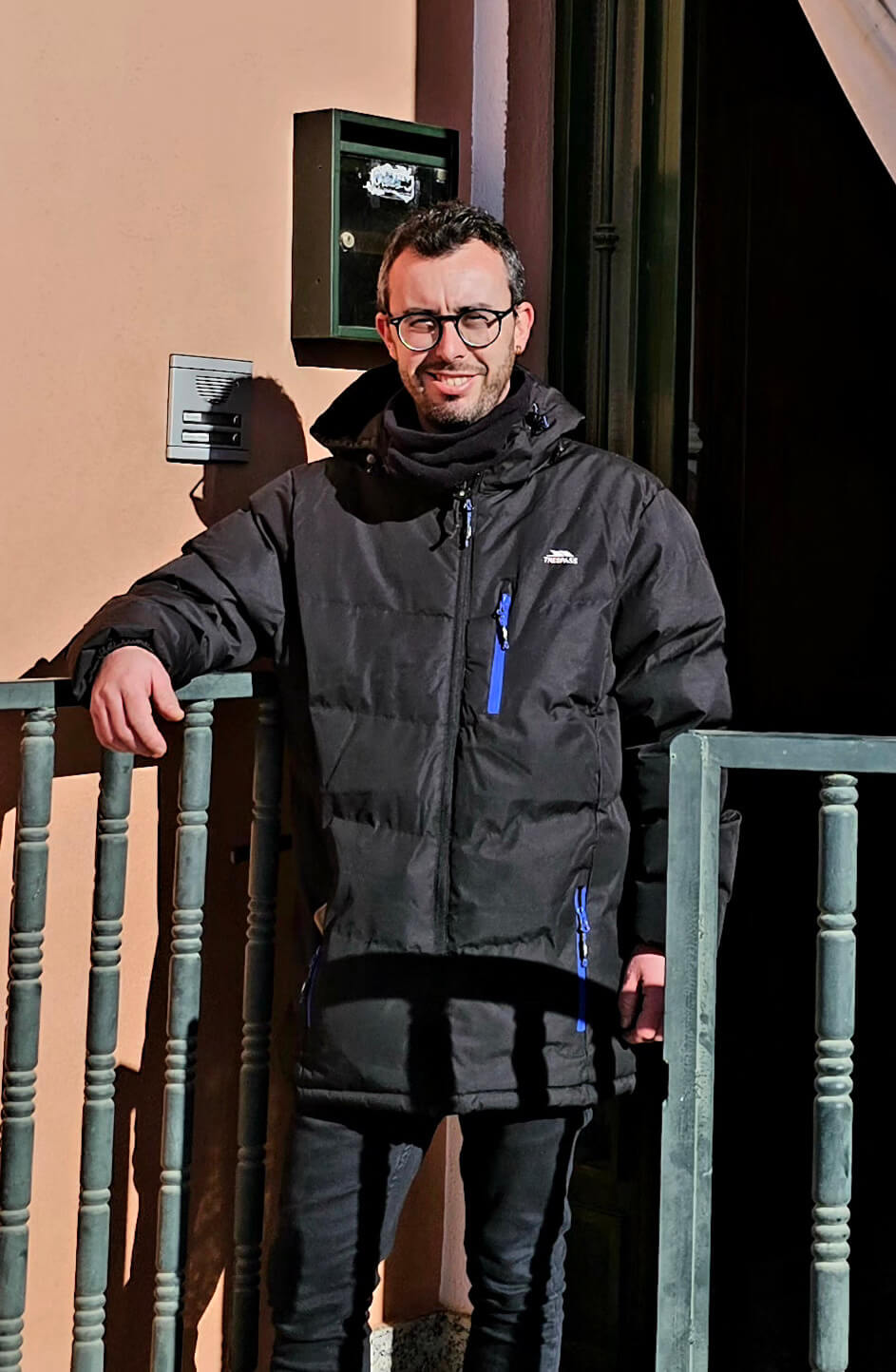
I am Richard, a host teacher with Spanish Express, and I welcome students from all over the world into my home here in Cáceres province, with this old city right on my doorstep. I am writing this guide rather than handing you another travel listicle for one simple reason: I live here. I have walked these streets in every season, eaten in the bars locals actually use, and learned the stories the guidebooks tend to flatten.
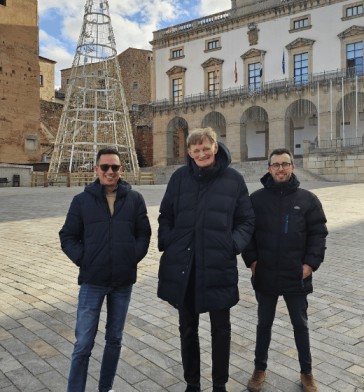
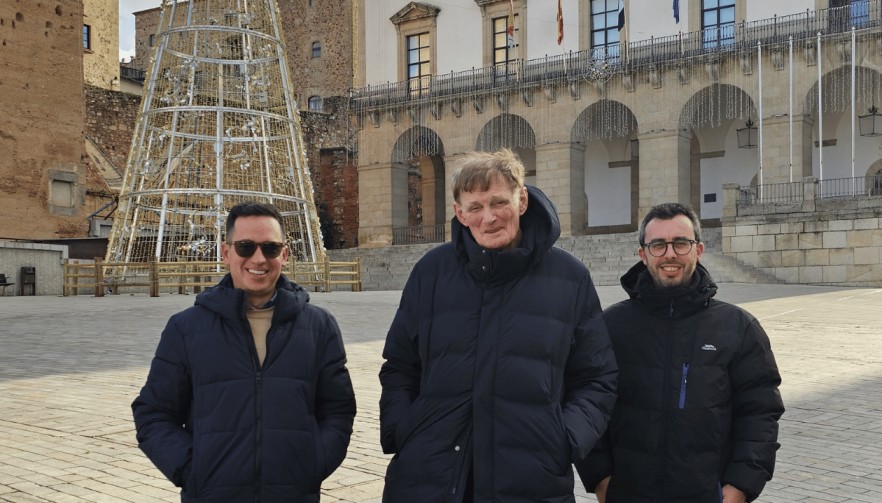
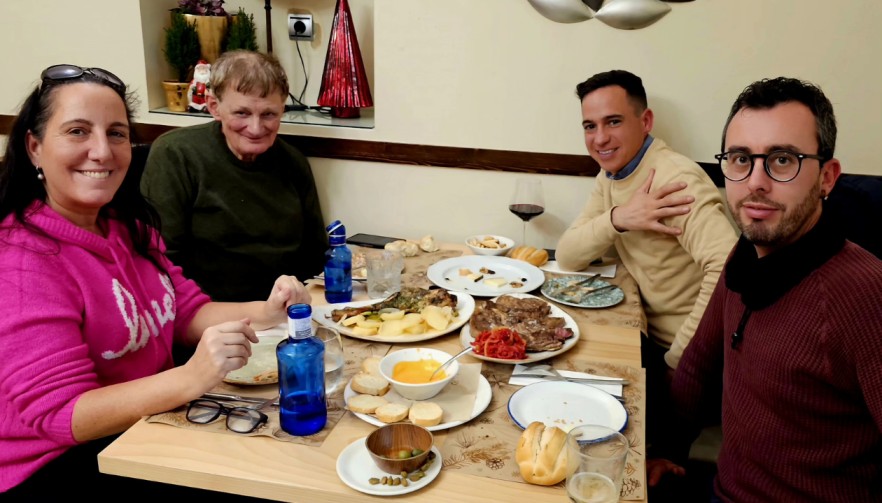
I recently spent a few days exploring the city again with Mónica, our founder and director and a host teacher herself, and it reminded me how much there is to say about this place once you get past the postcard view. So let me show you the Cáceres I show my students.
What most people get wrong about Cáceres
Before we explore, let me clear up two things I hear all the time from people visiting Cáceres for the first time, because getting them right changes how much you discover here.
The first is geography. People sometimes assume the city of Cáceres sits in Castilla-La Mancha or Castilla y León, the regions that border it to the east and north. It does not. Cáceres is the capital of Cáceres province, one of the two provinces that make up Extremadura, the other being Badajoz. This matters more than it sounds, because Extremadura has its own food, its own pace, and far less mass tourism than the famous cities further east.
The second mistake is treating Cáceres as a quick day trip. Plenty of visitors arrive from Madrid in the morning, walk the old town in two hours, and leave by mid-afternoon convinced they have seen it. They have not. The Ciudad Monumental rewards a slower visit, ideally with two nights, so you can see how the light changes the stone through the day and how the squares empty out once the coach groups leave. The city does not perform for visitors. It reveals itself to people who stay.
Walking into the Ciudad Monumental
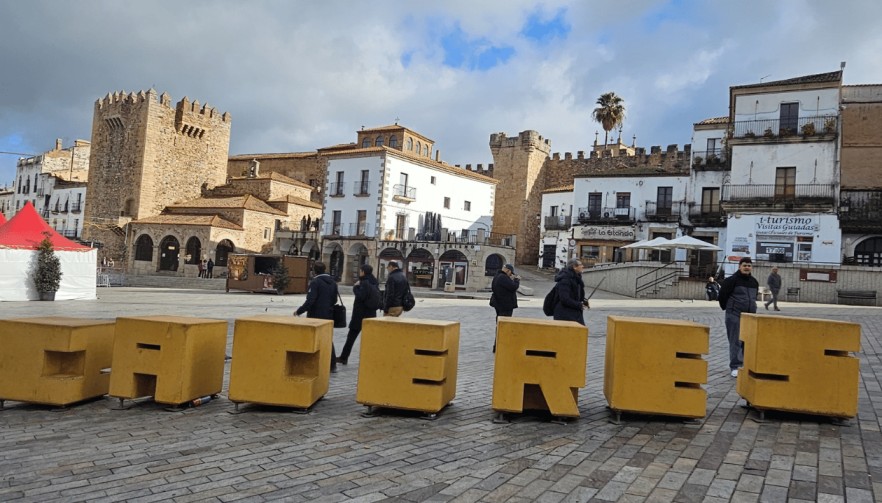
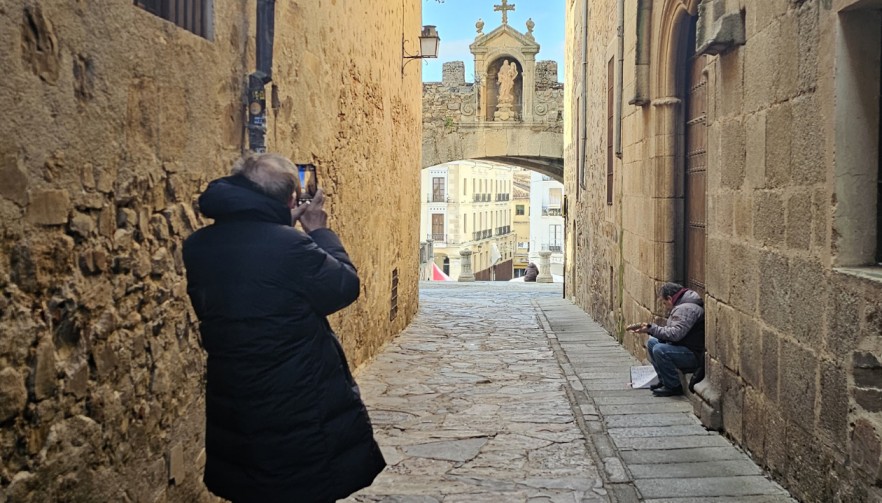
Most people enter the old town through the Arco de la Estrella, the curved baroque gateway carved into the city walls beside the Plaza Mayor. The Plaza Mayor is the great open square where life in Cáceres gathers, lined with cafés and watched over by the Bujaco Tower, a twelfth-century Moorish tower you can climb for one of the best views over the rooftops.
Step through the arch and the modern world drops away. The historic centre is a compact maze of narrow cobbled streets, climbing past fortified houses, palaces, several churches, and more than thirty medieval towers that still stand from the city’s Moorish past. These historic buildings span centuries: Cáceres was founded by the Romans around 25 BC along the Vía de la Plata, the old Silver Route that ran north to south across the Roman Empire and later became a pilgrimage road. Over the centuries, Roman, Moorish, Jewish, and Christian communities all left their mark, which is why the architecture inside the walls shifts from Almohad fortifications to Gothic palaces to Renaissance doorways within a few steep streets.
A few corners worth slowing down for:
Plaza de Santa María
The quiet heart of the old town, framed by the cathedral of Santa María and grand stone palaces. This is where I tend to start with students, because it gives them a feel for the scale of the place before the narrow streets swallow them.
Plaza de los Golfines
It’s home to the Palacio de los Golfines de Abajo, one of the most elegant noble houses in the city.
Plaza de las Veletas
Here, in the Palacio de las Veletas, is the Museo de Cáceres. Do not miss the aljibe, a remarkably preserved Moorish water cistern hidden beneath the building. Check the opening hours before you go, as the museum closes on certain days.
The Jewish quarter (Barrio de San Antonio)
The old Jewish district of whitewashed houses tumbling down the hillside, a softer, more domestic contrast to the lordly palaces above.
One detail people always notice: the facades are studded with carved heraldic shields. Cáceres has more than forty noble palaces and well over a thousand coats of arms cut into its stone, a record of the rival families who once ran the city from these fortified houses. Look up as you walk. The whole place is a stone family tree.
The stories hidden in the stone
This is where Cáceres stops being a pretty old town and starts being a strange and brilliant one.
Tucked into the north of the walled city is the Palacio de Toledo-Moctezuma, a domed Renaissance palace named after Isabel de Moctezuma, daughter of the Aztec emperor Moctezuma II. After the Spanish conquest of Mexico, her line married into Extremaduran nobility, and her descendants built this palace in Cáceres. Inside, frescoes show Roman and Aztec rulers side by side. It is now the provincial historical archive, and it is one of those facts that makes students stop and stare: an emperor from Tenochtitlan, remembered in stone in a quiet corner of western Spain.
The same lack of modern clutter that makes Cáceres feel frozen in time is exactly why film crews love it. The Ciudad Monumental stood in for King’s Landing in Game of Thrones, and once you have seen the show, you cannot un-see it in the streets around the concathedral. When Mónica and I last walked this part of the old town together, we spent half the time pointing out corners we recognised, and I enjoy watching my students do the same halfway through a walk.
Where Cáceres turns unexpectedly modern
For a medieval city, Cáceres has a surprisingly bold contemporary side, and this is the part most quick visitors miss entirely.
The Museo de Arte Contemporáneo Helga de Alvear, run by the Fundación Helga de Alvear, opened its striking new building in February 2021 and holds one of the most important private collections of contemporary art in Europe. Inside you will find work by international artists including Ai Weiwei, Olafur Eliasson, Picasso, and Kandinsky. Entry is free, the architecture alone is worth the visit, and it sits a short walk from the medieval walls, which is a jarring and wonderful contrast.
Then there is WOMAD, the World of Music, Arts and Dance festival, which Cáceres has hosted every May since 1992. For a few days the old town squares, including the Plaza Mayor and Plaza de San Jorge, fill with free outdoor concerts and workshops from international artists across every continent. It is completely free to attend and it is one of the best times to feel the city fully alive. If you can plan a trip around it, do.
What to eat in Cáceres
Extremadura is one of Spain’s great underrated food regions, and reason enough on its own to visit Extremadura. Cáceres is the place to taste it.
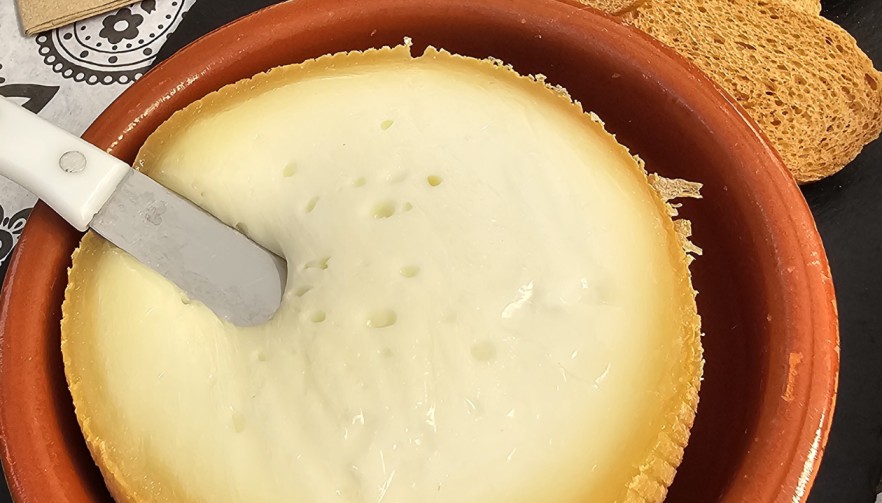
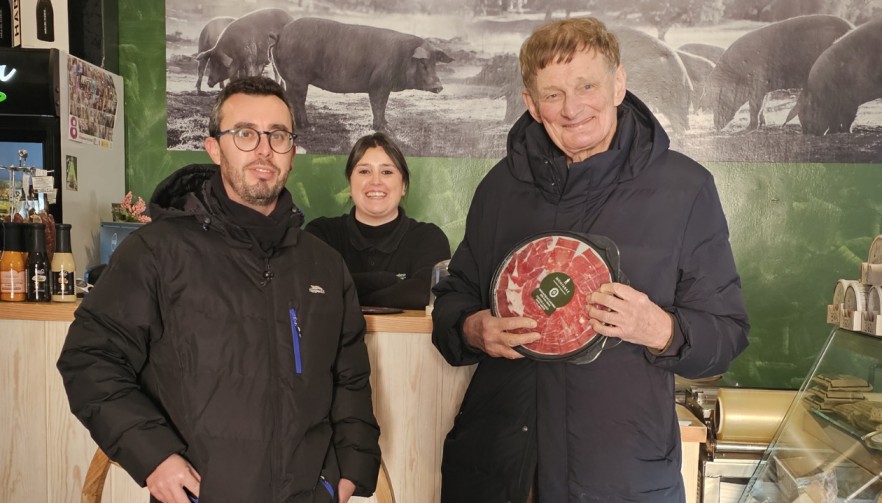
Start with the local stars. Torta del Casar is a soft, creamy sheep’s cheese so ripe you eat it with a spoon, made just outside the city. Jamón Ibérico, the cured ham from acorn-fed Iberian pigs that roam the surrounding dehesa woodlands, is some of the finest in Spain. For tapas, locals head to Calle Pizarro, a street of busy bars where a glass of Ribera del Guadiana wine, the local Extremadura denomination, costs very little and usually comes with something to nibble.
At the other extreme sits Atrio, a three Michelin star restaurant in the heart of the old town, run for more than three decades by chef Toño Pérez. It earned its third star in 2023 and is regularly called one of the best restaurants in Europe, with a wine cellar to match. It is a special occasion in every sense, but it tells you something that a city this small and this quiet quietly produces cooking at that level.
Beyond the walls: storks, granite, and Roman ghosts
One of the joys of staying in Cáceres is how easily you can step out of the medieval city and into wild Extremadura. These are the day trips I take my students on when they want a change of pace.
Los Barruecos, a natural monument located less than sixteen kilometres from the city near Malpartida de Cáceres, is an other-worldly landscape of giant granite boulders sculpted by erosion. It is home to one of the largest colonies of wild white storks in Europe, who nest right on top of the rocks during the season. There is an easy walking loop of around seven kilometres with barely any climbing, an interpretation centre, and, for the fans, more Game of Thrones filming locations. It is a great place for birdwatching and a slow afternoon walk.
About an hour’s drive away is Monfragüe National Park, one of the finest places for birdwatching in Europe. This protected nature reserve is built around the rock of Peña Falcón, where you can watch griffon, black, and Egyptian vultures wheel overhead, along with black storks and, if you are very lucky, signs of the Iberian lynx. Bring binoculars and patience.
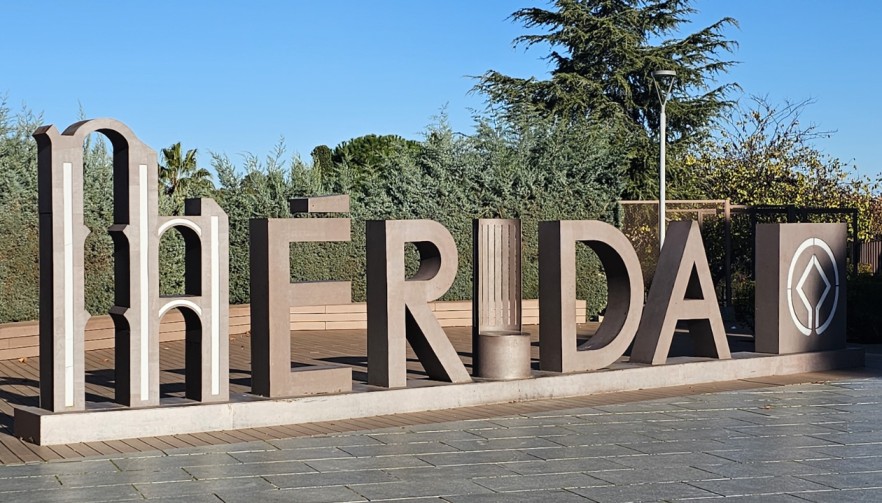
If you want more history, the Roman ruins of Mérida, over in Badajoz province, are an easy excursion and among the best preserved in the Roman Empire, with a theatre still used for performances today. And for another UNESCO gem, the Royal Monastery of Santa María de Guadalupe, also in Cáceres province, is worth the drive into the mountains. The areas surrounding the city, in other words, are as rewarding as the city itself.
When is the best time to visit Cáceres?
Honestly, the season makes or breaks this trip. Cáceres sits in one of the hottest parts of Spain, and in summer temperatures regularly climb above forty degrees Celsius. Wandering uphill through stone streets in that heat is nobody’s idea of a holiday.
My advice is to come in spring or autumn. October typically brings pleasant highs of around twenty to twenty-five degrees and crisp, clear light that suits the old stone. Spring is lovely too, and mid-spring gives you the WOMAD festival. January is the quietest month if you want the streets almost to yourself, though it can be cold. Be aware that Easter, in mid-April, is a busy and atmospheric time, with processions filling the historic centre.
How to get to Cáceres, and how to get around
Cáceres is well connected for somewhere that feels so off the beaten track.
By train, regular services link Cáceres with Madrid and with nearby Mérida, arriving at the city’s train station. The Cáceres bus station sits right beside it, with coach connections across the region and to major cities. By car, the city is an easy run from Madrid and from Seville to the south.
A practical tip that catches people out: local buses and public transport do not enter the historic city centre, and you would not want to drive into that maze of narrow streets anyway. If you arrive by car, leave it outside the walls. Párking Obispo Galarza is a handy car park near the old town. Once you are inside the Ciudad Monumental, everything worth seeing is within a short, very walkable distance. This is a city for exploring on foot.
Why Cáceres is better lived than visited
Here is the thing I keep coming back to after years of welcoming students into my home. A city like Cáceres can be photographed in an afternoon, but it cannot be understood that way. The reason a day trip leaves people a little cold is that the real texture of the place, the rhythm of the squares, the bar where I am greeted by name, the way Spanish actually sounds when it is spoken at speed over a counter, only opens up when you stay long enough to stop being a tourist.
That is the whole idea behind staying with a host teacher. When students live in my home here in Cáceres province, the city stops being a checklist and becomes a place where they speak Spanish from the very first day, over breakfast, on the walk to the Plaza Mayor, ordering Torta del Casar in a tapas bar where nobody switches to English. Immersion is not about being surrounded by a language. It is about being gently obliged to use it, in real situations, with someone who has the patience to help you. That is what turns years of classroom study into actual speaking.
One of my students, David, is a good example. He arrived able to read Spanish comfortably, but froze the moment he had to speak, the plateau so many learners know well. After a couple of weeks living here, doing the shopping with me, ordering on Calle Pizarro, chatting to the same barman every morning, he stopped translating in his head and simply started talking. That shift never happens from a textbook. It happens at a counter in a real town, when there is no English to fall back on.
If you have hit that same plateau, where you understand far more than you can say, a week or two living and learning in a place like this can do what no app or evening class ever quite manages.
Come and experience it for yourself
Cáceres is one of those rare places that is both a magnificent thing to see and a perfect place to learn. If you would like to come and stay with me here in Cáceres, or with one of our other host teachers across Spain, and combine real travel with genuine immersion, living with a teacher and speaking Spanish from day one, the best next step is to get in touch with Mónica, our founder and director, who will help you plan it.
A note of honesty, because it matters: Spanish Express does not provide visas or travel authorisation of any kind. Entry rules depend on your nationality and your own circumstances, so please check the official requirements for your situation before you book travel. What we provide is the Spanish Homestay Immersion Program (SHIP) itself, the home, the teacher, and the daily life that makes Spanish finally click.

You can explore more real immersion experiences here:
👉 SHIP Stories of Our Previous Students
Mónica Romero Founder and Director, Spanish Express
WhatsApp: +44 7903 867 894
Email: monicaromero@spanishexpress.co.uk