


If you’ve been planning a trip to Europe and Googled “do Canadians need a visa for Europe,” you’ve probably ended up more confused than when you started. Some sites say no visa is needed. Others say you’ll need an ETIAS by 2026. A few are quietly trying to sell you something for €60 that should cost €20.
Let me clear it up.
I’m Mónica Romero, Founder, Director, and host teacher at Spanish Express. We welcome students from all over the world into our homes in Spain for one-on-one or small groups up to four students for Spanish immersion, and a steady share of them are Canadian travelers using their visa-free window in Europe to actually learn the language. Because of that, I spend a lot of time walking Canadians through the entry rules, the ETIAS rollout, and the new biometric border system before they fly. This blog goes deeper than the standard “do you need a visa” article because the people I host are planning real trips, and getting the paperwork wrong has real consequences at the border.
So here’s the full picture, without the noise.
As of right now, Canadian citizens with a valid Canadian passport do not need a visa to visit most European countries for short trips. That hasn’t changed. What has changed, and what’s about to change again before the end of 2026, is the paperwork around that visa-free travel. The EU is rolling out two new systems that every Canadian traveler needs to understand: one is already live at every European airport, and the other launches later this year.

The Short Answer (and the Important Caveat)
Canadian citizens can travel to Schengen Area countries without a visa for stays of up to 90 days within any 180-day period, provided their passport is valid for at least 3 months after their planned departure date. That’s the rule, and it still applies in 2026.
But “no visa” doesn’t mean “no paperwork.” Two things have changed:
- The Entry/Exit System (EES) is now fully operational at all Schengen border crossings as of April 2026. You’re being registered biometrically when you enter and leave.
- ETIAS: the European visa waiver Canadians will soon need — launches in late 2026.
Neither one is a visa. Both are mandatory. And if you’re traveling to Europe in the next 12 months, you need to know how each one works.
What “Schengen” Actually Means (and Why It Matters)
A lot of confusion comes from people using “Europe,” “EU,” and “Schengen” interchangeably. They’re not the same thing.
The Schengen Area includes 29 European countries that have common entry and exit requirements, allowing travelers to move freely between these countries without needing to go through border checks or obtain separate visas. Once you enter any one Schengen country, you can move between the others without crossing controlled borders, no passport stamps between France and Germany, no customs check on the train from Spain to Portugal.
Key Schengen member countries include Austria, Belgium, France, Germany, Greece, Italy, the Netherlands, Portugal, Spain, and Switzerland. The full list also covers Bulgaria, Croatia, Czechia, Denmark, Estonia, Finland, Hungary, Iceland, Latvia, Liechtenstein, Lithuania, Luxembourg, Malta, Norway, Poland, Romania, Slovakia, Slovenia, and Sweden.
A few European countries you might assume are in the Schengen Area but aren’t:
- Ireland: In the EU, but not Schengen. Canadians can visit visa-free with just a passport; no ETIAS needed.
- United Kingdom: Not in the EU, not in Schengen. Canadians currently require a separate Electronic Travel Authorization (ETA) for entry into the United Kingdom, £16, valid for 2 years.
- Cyprus: In the EU but not yet fully in Schengen. Visa-free for Canadians, but check current entry requirements before you go.
This distinction matters because typically there are no border controls between Schengen member countries, although countries can reintroduce border controls in exceptional circumstances, requiring travelers to show their passports and other travel documents. France did this during the 2024 Olympics. Germany did it during major political summits. So always carry your passport when crossing internal borders, even if you’re not technically supposed to need it.
The 90-Day Rule Catches More Canadians Than You’d Think
The rule sounds simple: 90 days within any 180 days. But it works as a rolling window, not a calendar reset, and that’s where Canadian travelers regularly get tripped up.
Here’s the trap. You spend 60 days in Italy in May and June. You fly home, spend the summer in Toronto, then book a 45-day trip to Portugal in September. You think you’re fine, you’ve been home for two months.
You’re not fine. The 180-day window is rolling. When you arrive in Lisbon, the border officer counts back 180 days from that date. Your 60 days in Italy are still inside that window. You only have 30 days of allowance left.
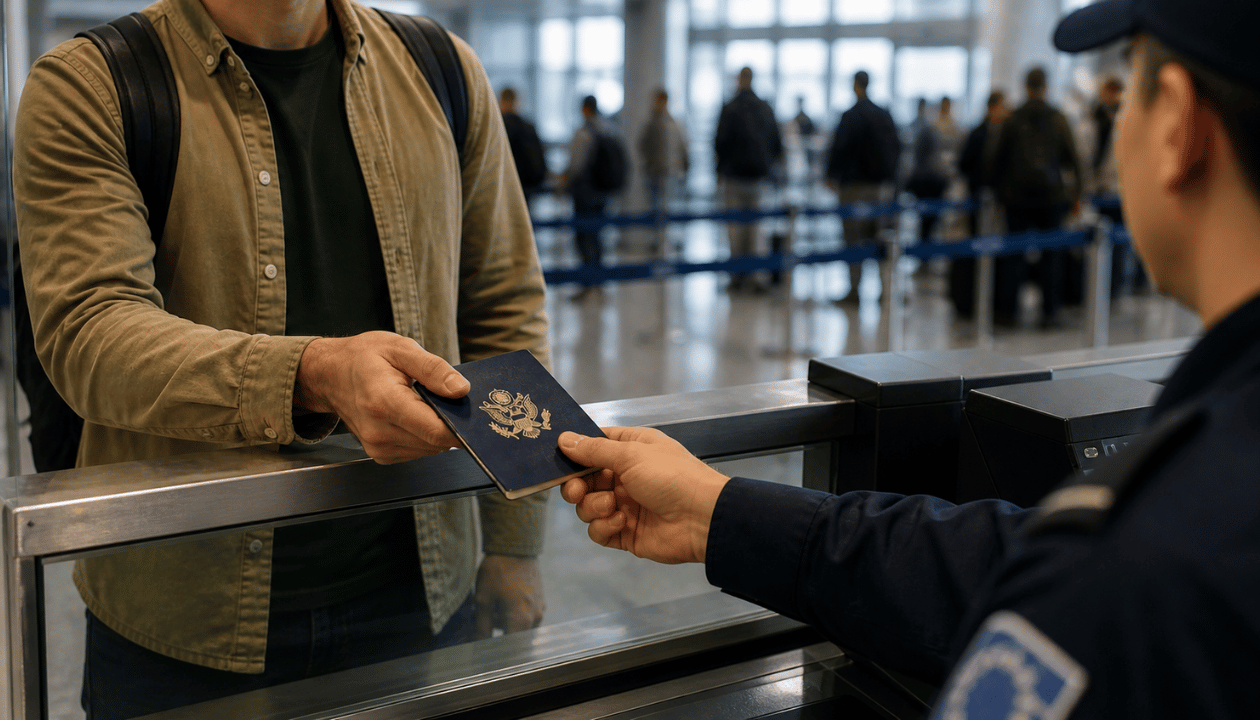
Border officers can and do refuse entry on the spot if your math doesn’t add up. With the new entry-exit system tracking every entry and exit digitally, “I lost track” is no longer a defense. The system knows exactly where you’ve been and for how long.
If a Canadian citizen wishes to stay in the Schengen Area for longer than 90 days, they must apply for a visa from the embassy or consulate of the specific Schengen country they plan to visit. There’s no Schengen long-stay visa, each country has its own process, and you apply where you’ll spend the most time.
The Entry/Exit System (EES): Already Affecting You
This is the part most Canadian travelers haven’t caught up with yet.
The new biometric registration under the EES program became fully operational in April 2026. The Entry/Exit System (EES) replaces manual passport stamps with digital registration of biometrics, facial images, and fingerprints. The first time you cross into any Schengen country after April 2026, you’ll go through a brief biometric registration: a photo, fingerprints, and your passport scanned.
This data is stored for three years. If you re-enter within that window, the process is faster, your passport is electronically linked to your existing record.
A few things have changed in practice:
- Expect longer queues at first. Madrid-Barajas, Paris CDG, Frankfurt, Amsterdam Schiphol, and all major European airport gateways are running biometric registration. Build extra time into your arrival, especially during peak summer.
- No more “stamp shopping.” Some Canadian travelers used to manage the 90/180 rule by carefully tracking stamps. The new digital system is unforgiving and accurate to the day.
- Your data is shared. EES feeds into the broader Schengen Information System and connects to the Visa Information System for travelers who hold separate visas. Schengen border control is now fully integrated across all 29 countries.
EES applies to all non-EU nationals — Americans, Brits, Australians, and Canadian travelers alike. There’s no opt-out and no fee. You just need to allow the extra time at the border.
ETIAS: The European Visa Waiver Coming for Canadians in Late 2026
Now to the part that involves an actual application.
The European Travel Information and Authorisation System (ETIAS) is the EU’s new electronic travel authorisation. It’s not a visa. It’s an electronic visa waiver, similar to Canada’s own eTA system that visitors from visa-exempt countries already use to enter Canada.
Starting in late 2026 (the EU has confirmed Q4 2026, with the exact date to be announced at least six months in advance), Canadians will need to obtain an approved ETIAS before entering Schengen Area countries for short stays of up to 90 days. There will be a 6-month transition period during which ETIAS is encouraged but not strictly enforced, meaning if it’s your first crossing after launch and you forgot to apply, you won’t be turned away. After that grace period, no ETIAS = no boarding pass.
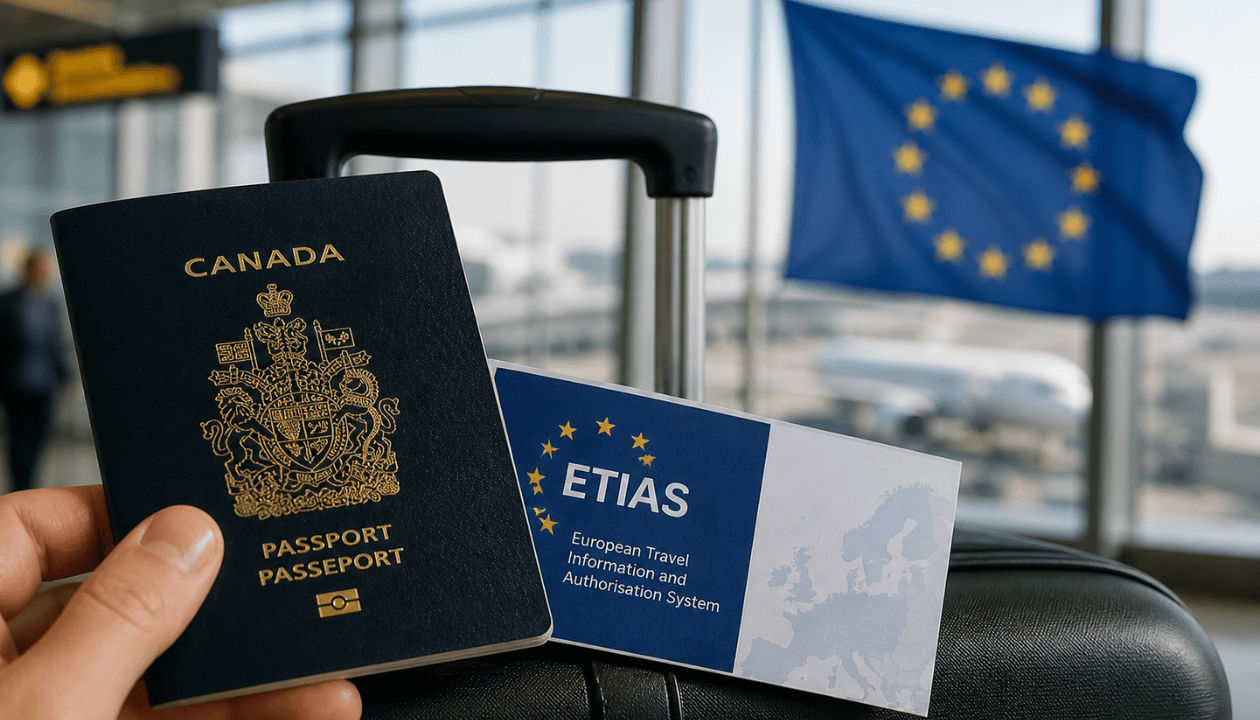
What the ETIAS application actually involves
The ETIAS application process is fully online and typically takes around 20 minutes to complete. You’ll need:
- A valid Canadian passport (with at least 3 months of validity beyond your planned departure date from the Schengen Area)
- An email address you actually check
- A valid credit card or debit card to pay the ETIAS fee
- About 20 minutes of your time
You’ll provide personal and passport information — name, date of birth, citizenship, address, occupation, your individual passport number — plus answers to a series of security questions covering criminal history, past immigration violations, and recent travel to conflict zones.
When you submit, the system runs your data against several information security databases, including the Schengen Information System, Europol, Interpol, and EU border watchlists, to screen for potential security threats. For the vast majority of Canadians planning a normal trip, approval comes through within minutes.
What does ETIAS cost?
The ETIAS fee is €20 for most adults, with exemptions for travelers under 18 or over 70 (they still need to apply, but pay nothing). That’s it, there’s no embassy appointment, no biometric appointment, no supporting documents to mail in.
A warning here: when ETIAS launches, fake third-party sites will charge $80–$150 to “process” your application. Don’t use them. Apply only through the official ETIAS website, which the EU will publish months before launch. Anything else is a markup at best, fraud at worst.
How long does an ETIAS last once approved?
Your ETIAS is valid for three years, or until your associated passport expires, whichever comes first. So if your passport expires in 18 months, your ETIAS will only last 18 months too. It’s electronically linked to that specific passport, so if you renew your passport, you’ll need to apply for a new ETIAS.
During those three years, you can enter and exit the Schengen Area as many times as you want; it functions like a multiple-entry visa for short stays, as long as you stick to the 90/180-day rule.
What ETIAS doesn’t cover
Worth being clear: ETIAS is for short stays only, tourism, business meetings, visiting family, transit, and short courses. It is not for:
- Working in Europe
- Studying long-term
- Living with a partner or spouse for extended periods
- Anything beyond 90 days is 180 days
For any of those, you need a national visa from the specific Schengen country you’ll be in. ETIAS won’t help you, and attempting to extend a stay using it can result in a ban from all EU member countries.
A Few Things Canadian Travelers Get Wrong
After reading hundreds of Canadian forum threads on this, the same misunderstandings come up again and again.
My Canadian passport works the same way it always has.
At external borders, no, biometric registration is now mandatory. Once ETIAS launches in late 2026, you’ll also need pre-approval before boarding your flight. Your same passport still works, but the process around it has changed.
ETIAS is a visa.
No. It’s an electronic travel authorization. The difference matters because a visa requires embassy appointments, supporting documents, and weeks of processing. ETIAS is an online form that takes 20 minutes and is approved in minutes. It’s the same document category as Canada’s eTA or the US ESTA.
If I have an approved ETIAS, I’m guaranteed entry.
You’re not. ETIAS clears you to board the plane. Once you land, the border officer at the European airport still has final say. They can ask for proof of accommodation, return flight, and proof of sufficient financial means to cover your stay. Canadians may need to show this — typically around €100 per day, depending on the country. Most Canadian travelers are never asked, but if you look like you might overstay, expect questions.
The UK is in Europe so my ETIAS covers it.
The UK is geographically European but politically separate. Canadians need a UK ETA (electronic travel authorisation), which is a different system entirely. The same logic applies to Ireland — visa-free but outside ETIAS.
I can apply for ETIAS now to be ready.
Not yet. The system isn’t live. Anyone telling you to apply now or pay them to “reserve” a slot is running a scam. Wait for the official launch announcement.
What Does This All Mean for a Trip You’re Planning Now
If you’re traveling to Europe in 2026, here’s the practical version:
- Right now (mid-2026): No ETIAS needed yet. EES biometric registration at the border is required. Bring your valid Canadian passport, allow extra time at airports, and follow the 90/180 rule.
- Late 2026 onward: ETIAS becomes mandatory after the transition period. Apply on the official ETIAS website at least a few weeks before your trip. Pay the €20 fee. Wait for approval.
- Always: Make sure your passport doesn’t expire within three months of your planned departure date from Europe. Carry proof of onward travel and accommodation. If border officers ask about your finances, have an answer ready.
Don’t fall for misleading or fraudulent information online. The EU has been very clear that ETIAS will only be available through one official site, and if anyone is selling it before the official launch, it’s a scam.
What Comes After the Paperwork
Here’s the thing nobody talks about in these visa articles: getting into Europe is the easy part. What you do with the 90 days you have is the part that actually matters.
Most Canadians I’ve spoken to who’ve used the visa-free window to travel to Europe come back with the same regret, they spent it skimming. Two days in Paris, three in Rome, a weekend in Barcelona. By the time they got home, they could barely remember which church was in which city.
The Canadians who came back transformed almost always did one thing differently: they spent meaningful time in one place, learning to actually communicate with the people who live there. Not in English. Not through a tour guide. In the local language, with locals, in real situations.
That’s where Spanish Express fits in.
If your trip is going to include Spain and for a lot of Canadians visiting Europe, it does, there’s a way to spend part of your 90 days that gives you something the rest of the trip can’t. You live in your teacher’s home in Spain. You speak Spanish from Day 1, in real life, at the breakfast table, at the market, on a walk through the village. By the time you leave, you’re not “a Canadian who visited Spain.” You’re someone who actually lived there, even briefly.
It’s the kind of immersion that turns a Schengen window into something more than a visa expiration date.
Ready to Use Your Time in Europe Differently?
At Spanish Express, we don’t run group classes or generic tours. Every program is one student, one teacher, in the teacher’s home in Spain — full immersion, real conversations, the kind of Spanish you’ll actually use from Day 1.
Important: Spanish Express does not provide visas, ETIAS support, or any form of travel authorization. Your entry requirements (Schengen 90/180 rules, ETIAS once it launches, EES registration at the border) are entirely your responsibility to sort out before you arrive. We help you make the time you have in Spain actually count.
If you want to talk through whether immersion is right for you and your trip, reach out directly, I answer personally:
Mónica Romero, Founder & Director, Spanish Express
📞 WhatsApp: +44 7903 867 894
📧 monicaromero@spanishexpress.co.uk
No forms. No pressure. Just a conversation about what you actually want from your time in Spain.
