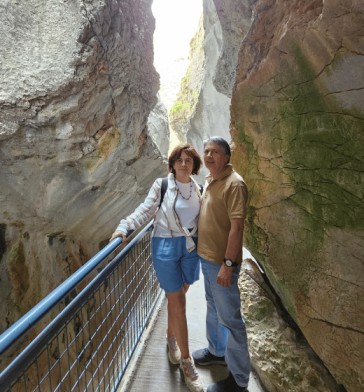
The first time I bring students to La Yecla, I ask them to stop at the entrance and stretch out both arms. In some places this narrow gorge in Burgos, Spain, squeezes to barely two meters across, with sheer rock walls, griffon vultures overhead, and a long human history carved into the landscape, so you almost feel the mountain pressing in from either side. La Yecla is one of those corners of Burgos that quietly surprises people, because it hides an entire world inside a crack in the stone.
I’m Marisol, and through the Spanish Homestay Immersion Program (SHIP), my husband Alberto and I welcome students and travelers into everyday life here in Burgos. Instead of studying only from a textbook, we learn Spanish while walking these trails, cooking together at home, and talking naturally about what we see. That is why La Yecla works so well as a living lesson: this article looks at the gorge itself, its history and wildlife, the ancient juniper forest around it, and how a visit here turns language study into a real cultural experience.

A Short History of La Yecla, Santo Domingo de Silos, and Its Land
Although most visitors come for the scenery, I always begin with a little history, because the land makes more sense that way. La Yecla sits close to Santo Domingo de Silos, in the area de Santo Domingo, where the access to the gorge lies near the town and its famous monastery, which has drawn pilgrims and monks for over a thousand years. In fact, the calm you feel near the monastery of Santo Domingo carries into the whole area.
Meanwhile, the surrounding highlands, from la Meseta de Carazo to las Peñas de Cervera, were shaped slowly by water, weather, and time. As a result, the gorge you walk today is really a chapter in a very old story, and I like my students to feel that before we take a single step inside.
Walking the Desfiladero de la Yecla
La Yecla es una short but unforgettable gorge. El Desfiladero de la Yecla stretches for a little over one kilometer, yet in some sections it narrows to less than two meters wide, while the walls rise more than one hundred meters above your head. A small stream, the Arroyo del Cauce, shaped the character of the gorge through steady erosion, and it still runs through the bottom today.
Because the path clings to the rock, the route follows hanging metal walkways and bridges, and it even crosses two tunnels along the way. The full route, there and back, usually takes only twenty to thirty minutes, so the whole route fits easily into a morning. In practice, the full route is straightforward, since visitors return by the same walkway. However, I always warn students that the walkway is not wheelchair friendly, since there are stairs and tight, narrow passages.
Getting there is simple, too. You reach La Yecla by the road BU-911, and parking is found right at the entrance of the gorge. The best times to visit are spring and autumn for ideal weather. It can be visited all year-round, but the walkway may be icy in winter. Once we leave the road behind, the noise of the world fades, and only the water and the wind remain.

Griffon Vultures and the Wildlife of La Yecla
For many of my students, birdwatching becomes the real highlight. La Yecla is home to more than one hundred pairs of griffon vultures and is one of the largest griffon vulture colonies in Burgos, with nests in the high cliffs above the walkway. If you look up at the right moment, you may see them circling slowly on the warm air—a sight nobody forgets; however, they are not the only wildlife worth noticing.
The gorge and its surroundings also shelter golden eagles, wild boar, and other quiet residents of these mountains. As the light shifts hour by hour, La Yecla is also an excellent place for photography, and I always tell students to keep their cameras close.

The Ancient Junipers of the Sabinares del Arlanza and Peñas de Cervera
The wider setting deserves its own moment, so I like to explain it as we walk. La Yecla belongs to the Espacio Natural de La Yecla y los Sabinares del Arlanza, a protected natural area with more than twenty-six thousand hectares. More importantly, los Sabinares del Arlanza hold one of the oldest and best-preserved juniper forests in Europe.
In the protected space, you find la sabina albar, a hardy tree that is one of the ancient species surviving in this environment, perfectly suited to this land, with specimens de more than two thousand years old. In fact, La Yecla is home to the oldest juniper trees, over 2,000 years old, and when I stand beside these ancient junipers near the slopes of el Monte Gayubar, I feel very small and very lucky. This is the natural heart of the region, and it teaches patience better than any classroom could.

Spanish Immersion in La Yecla Through Daily Life
This is where SHIP truly comes alive. Spanish immersion in La Yecla is not a lecture; it is a conversation that never really stops. As we drive out on the road, we name what we see. Then, at the entrance, we read the information panels together in Spanish. After that, while walking through the tunnel or over a bridge, students describe the river, the height of the walls, and the vultures overhead.
Because they are using the language to talk about something real, the words stay. Later, back home with Alberto, we cook, we laugh, and we relive the day in Spanish over dinner. That is the whole idea behind Spanish Express and SHIP: living the language instead of memorizing it.

By the End of the Trail
By the time students head home, they usually carry more than a list of new Spanish words. They remember the cool air inside the gorge, the vultures turning above the cliffs, the ancient junipers, and the confidence that grew quietly with every conversation. That is exactly why I love teaching here in Burgos. La Yecla becomes part of the lesson itself, and Spanish becomes something my students have truly walked, seen, and lived.
So, Come Walk and Learn With Us
If you want Spanish to feel this alive, then come and join us. With SHIP, you do not simply take a course; you live with a local teacher, share daily meals, and learn through real experiences in real places like La Yecla.

Alberto and I will welcome you into our home in Burgos, guide you through the gorge and the wider countryside until the parking area is reached, and help you practice Spanish in every ordinary and extraordinary moment of the day. Little by little, the language stops being a subject and becomes a natural part of your life here.
You can also explore more cultural immersion stories here:
👉 Read Stories of Our Past Visitors Here
For personalised guidance and programme details, you can contact our founder directly:
Mónica Romero
Founder & Director, Spanish Express
📞 Phone / WhatsApp: +44 7903 867 894
📧 Email: monicaromero@spanishexpress.co.uk