

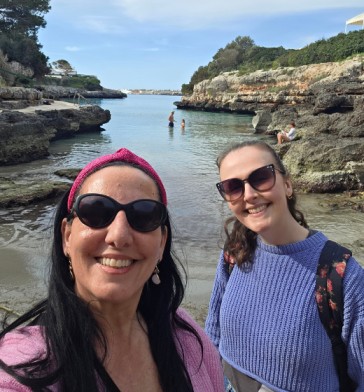
When my students ask me where the people of Ciutadella actually swim, I never point them toward the famous southern coves first. Instead, I walk them out of town along the water, past the old port, until the houses thin out and a striped tower appears above the rocks.
Sa Farola Beach, locally known as Platja de sa Farola and often searched for as Playa de sa Farola, is a small urban cove near the port of Ciutadella in Menorca, also known as Cala des Frares. People come here for calm, clear water, concrete bathing platforms, and the historic striped Sa Farola lighthouse, but the place also shows a quieter, more everyday side of the island.
This is Playa de Sa Farola, and although some visitors type it as platja de sa farola when they search online, everyone here simply calls it Sa Farola. It is small, local, and honest, and for that reason it reveals more about Menorca’s history, coastal life, and character than many of the island’s better-known postcard beaches.
I’m Mónica, and through the Spanish Homestay Immersion Program (SHIP), students come to live with me here in Ciutadella and learn Spanish through real daily life. We do not sit in a classroom all day. Instead, we shop at the market, cook together, walk the coast, and talk about what we see around us, because that is how language actually sticks. As I always tell my students, aprendes lo que vives. You learn what you live. Sa Farola is one of my favorite places to prove that Menorca is far more than beaches, especially for travelers planning a trip to Ciutadella, people looking for quieter and more authentic corners of the island, and Spanish learners who want cultural immersion, not just sightseeing.
In this guide, I will show you exactly where Sa Farola sits, how its lighthouse began, the old houses hiding inside the cove, what you can see nearby, the easiest ways to reach it on foot, by bike, by car, or by bus, and how a visit fits naturally into a deeper Spanish immersion experience in Menorca.

Where Playa de Sa Farola Sits on the Northern Side
Playa de Sa Farola is an urban cove located right at the mouth of the old port of Ciutadella, so you are never far from town. Us locals also know it as Cala des Frares, and honestly, both names are used all the time.
However, do not arrive expecting a wide stretch of sand. The beach has very little sand space for towels, and most people bathe from the concrete platforms built around the sea instead.
Because the entry of boats has been banned since 2021, the water stays calm and wonderfully clear. As a result, swimming and snorkeling in that turquoise water feels almost private, even though the town is just behind you. Besides, the views of Ciutadella’s port and the nearby cliffs are some of the best on this side of the island.
How the de Sa farola Lighthouse Began
Although most people come for the water, I always begin with the tower, because the story of the Sa Farola Lighthouse began long before anyone swam here for pleasure.
The lighthouse was inaugurated on 30 April 1863 to guide ships into the port, and it stands on the northern side of the entrance, watching over every boat that comes and goes. It is only 13 meters tall, yet its light can be seen 14 nautical miles away, which always surprises my students.
Then, on 1 March 1918, its electric light was first turned on, an early milestone for the Balearic Islands. Because the tower sits so close to sea level, storms used to send waves crashing over the rocks, so a protective wall was built facing the sea to shield the keeper’s home. Even today, the vertical black and white stripes make it one of the most recognizable landmarks in Menorca.

The Old Houses Inside the Cove
Here is a detail many visitors walk right past. Inside the cove of Sa Farola, small ancient houses sit tucked against the rock, some of them standing there for generations. In fact, these humble whitewashed buildings were used by local families and fishermen long before tourism reached the island, and they give the area its lived in character.
For this reason, I always stop with my students and let them look properly. We describe the doors, the shutters, and the worn stone in Spanish, and suddenly vocabulary about houses and history feels real. Meanwhile, the contrast between these old walls and the open sea reminds you that people have shaped this coastline for many years, not just for one summer season.

What You Can See Around the Cove
Once you have looked at the houses, turn toward the water, because the setting itself is full of stories:
- Castell de Sant Nicolau: directly across the mouth of the port, on the opposite headland, stands this 17th-century defensive tower that once guarded Ciutadella from pirates and rival fleets. Together, the castle and the lighthouse frame the entrance like two old guards who never left their posts.
- The boat channel: ferries and small boats glide in and out of the port, and watching them pass is a favorite pastime for people sitting on the rocks.
- Mallorca on the horizon: on very clear days you can even make out the outline of the neighboring island, which always earns a gasp from my students.
- Cala en Busquets: just a short stroll away, this little pier adds another quiet corner worth a photo.
How to Reach Sa Farola
Thankfully, access is easy from the town of Ciutadella, and you can reach the beach in several ways:
- On foot: I usually walk with my students along the promenade, which works like a bridge between the town and the open sea, and the whole route feels like a moving Spanish lesson.
- By bike: the path forms part of the Camí de Cavalls, the historic trail that circles the entire island, so you can continue along the coast if your legs allow.
- By car: parking is available nearby, but it can be limited during summer, so leaving the car near the port and walking the last stretch down the road is often smarter.
- By bus: the nearest bus stop is Ciutadella bus line 60, and from there it is a short, pleasant walk to the water at the end of the northern shore.
Things to Do at Sa Farola and Nearby
Although the cove is small, a whole afternoon fills up quickly here.
First, there is the water itself. The boat ban exists to protect the posidonia meadows on the seabed, and because of that, snorkeling above them feels like floating over an underwater garden. Younger visitors love jumping into the sea from the platforms, and metal ladders make climbing out easy.
Afterward, you can walk about ten minutes to the port of Ciutadella, where restaurants, ice cream parlors, little shops, and nautical activities line the harbor. Then, if you still have energy, follow the promenade in the other direction along the coast toward Cala en Blanes, a beautiful stretch of the Camí de Cavalls with the sea beside you the whole way. In fact, many of my students say this coastal walk, not the swim, becomes their favorite memory.

More Than Beaches: Experience Sa Farola Like a Local
Sa Farola is popular among locals, especially in the summer months, and that is exactly why I bring students here. At the same time, the best time to visit is during the shoulder seasons of May to June or September to October, when the platforms are quieter, and conversations come easily.
We swim, we greet neighbors, and we stay for the sunset views over the water, which turn the lighthouse gold. Afterward, many students want to share the moment, so I tell them, envíanos desde nuestro perfil de Instagram tus fotos favoritas, and tag the island that taught you Spanish.
More importantly, an ordinary evening here shows you Menorcan life itself: the history, the sea, and the people, all in one small cove.
By the time students leave, Sa Farola usually means more to them than any famous beach. They remember the striped tower, the old houses in the rock, the cool water off the platforms, and the Spanish words that arrived naturally while watching the sun go down. That is why I love teaching here in Ciutadella. The island becomes the lesson, and the language becomes something my students have genuinely lived, not merely studied.

So, Come Live Spanish in Menorca
If Sa Farola has caught your imagination, then imagine learning Spanish while actually living moments like these. Through the Spanish Homestay Immersion Program (SHIP) by Spanish Express, you stay with me, your local teacher, and we turn daily life in Ciutadella into your classroom. Together we walk the promenade, explore the lighthouse, share meals, and practice real conversation every single day. Therefore, you do not just visit Menorca. You belong to it, one Spanish word at a time.

You can also explore more cultural immersion stories here:
👉 Read Stories of Our Past Visitors Here
For personalized guidance and programme details, you can contact our founder directly:
Mónica Romero Founder & Director, Spanish Express
📞 Phone / WhatsApp: +44 7903 867 894
📧 Email: monicaromero@spanishexpress.co.uk
