

Spain’s immigration laws have shifted more in the last eighteen months than in the previous decade, and most people only hear about the dramatic headline (half a million undocumented migrants being offered legal status) without understanding the quieter changes that affect ordinary travellers far more directly. If you are planning a stay in Spain, whether for a few weeks or a few years, the rules you cross the border under are not the rules from your last trip.
Before we go further, a quick hello. I am Mónica Romero, founder, director and a host teacher with Spanish Express. We welcome language students from all over the world into our homes and classrooms, which means immigration questions land on my desk almost every week: students asking about visas, the 90-day rule, residence permits and what they are allowed to do once they arrive. That is why this blog goes deeper than a government summary. I am not writing this from a policy office. I am writing it from the practical side, where the rules meet real people getting off real flights.
So let us look at what genuinely matters this year.
The change almost nobody talks about, but everyone should: the new digital border
For decades, the 90/180 rule was enforced with an ink stamp and a fair amount of human inconsistency. A faint stamp, a missed passport page, a busy officer at Málaga airport in August, and a day or two of accidental overstay often went unnoticed.
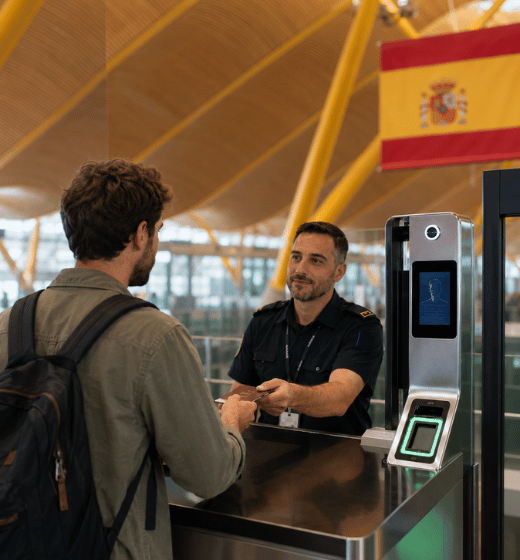
That era is over. Since 10 April 2026, the EU Entry/Exit System (EES) is fully operational at every Spanish airport, seaport and land border. Immigration officers no longer reach for an ink stamp at all. Every non-EU traveller now has their passport scanned and their biometric data (a facial image and fingerprints) recorded the first time they arrive, and the system then calculates your allowed days automatically and shares that record across all 29 European Union and Schengen countries.
Here is the real-world interpretation, because this is where I see people get caught out. The 90 days you are allowed as a visa-free visitor are not 90 days in Spain. They are 90 days across the entire Schengen Area within any rolling 180-day period. If you spent three weeks in France and Italy earlier in the year, those days are already counted against you before you even land in Madrid. The old “I will just be careful with my stamps” approach does not work anymore, because there are no stamps. The machine knows.
For most of our students this is good news, not bad. A typical immersion stay of two, three or four weeks sits comfortably inside the allowance. But if you are someone who likes to move around Europe, or who is thinking of stringing together a long stay, you now need to count properly. Overstaying is no longer a grey area. It is a flagged entry in a database, and it can affect future trips and visa applications.
One more thing worth noting: ETIAS, a separate travel authorisation for visa-exempt travellers, is expected to launch in late 2026 or early 2027. It will cost around 7 euros and last three years. It is not in force yet, but if you are planning ahead, keep it on your radar.
The “amnesty” headline: what it is, and what it is not
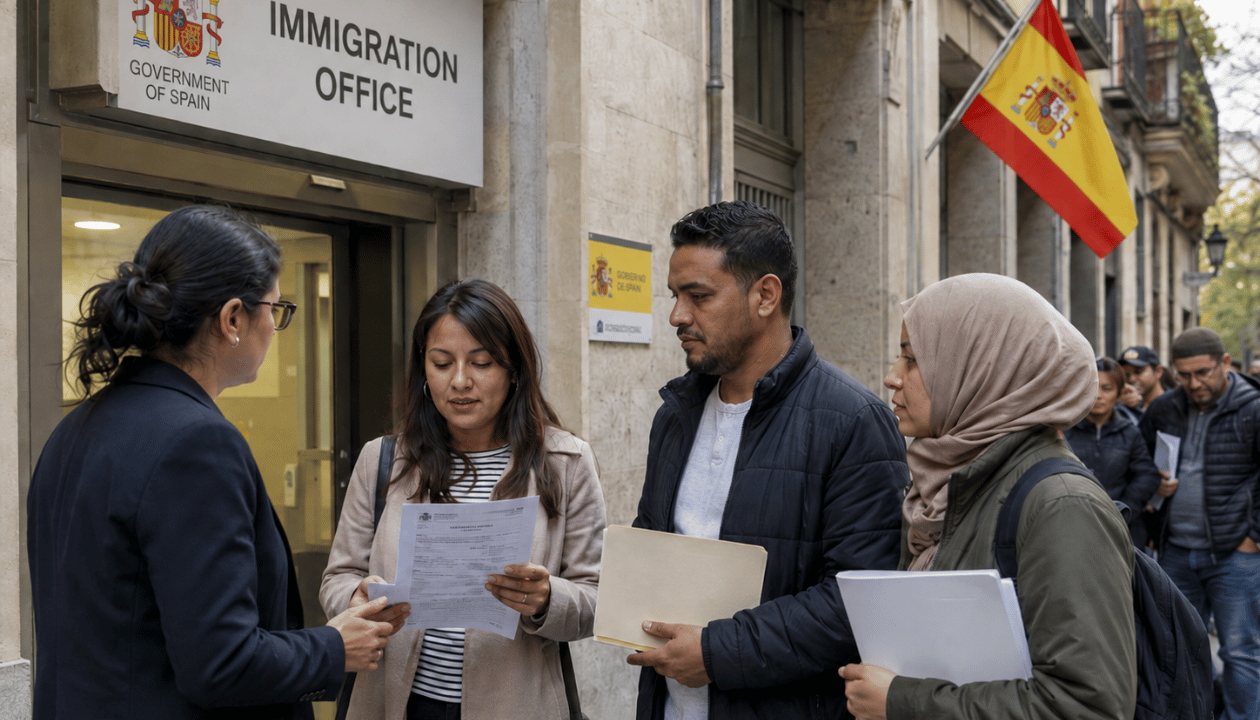
Now to the news that has been everywhere. Spain’s government, through Royal Decree 316/2026, has opened an extraordinary regularisation: a one-year residence and work permit, renewable rather than permanent, for undocumented migrants already living in the country. Because it was passed by decree, it did not need to clear parliament, where the governing coalition lacks a majority, and that decision to bypass parliament has been part of the political controversy. The idea itself did not appear from nowhere. It grew out of a popular legislative initiative backed by civil society groups who argued that legal status is the precondition for full and progressive integration into Spanish society. Without it, people cannot pay taxes properly, contribute to social security, or move out of the informal economy.
The Spanish government estimates around 500,000 people may be eligible, although official figures suggest the number of undocumented immigrants living in Spain is considerably higher, closer to 840,000. Many of them fled poverty or political instability in Latin America and North Africa and have been working here informally for years. Elma Saiz, the migration minister, called the regularisation a major milestone and defended its social, political and economic legitimacy. Prime Minister Pedro Sánchez went further at a press conference, describing the temporary measure as “an act of justice” and a necessity for a country whose ageing population and key sectors, agriculture, tourism and care work, depend heavily on foreign workers and the taxes that sustain public services. The conservative People’s Party and the far-right Vox have opposed it firmly, arguing it rewards irregular migration and could act as a pull factor for more.
This is genuinely significant. But here is the most common mistake I see in the comments and questions: people assume this is a route they can use to move to Spain. It is not.
The regularisation only applies to people who were already physically living in Spain, without legal status, before 31 December 2025, and who can prove at least five months of continuous residence here, with a clean criminal record. The same decree also created a parallel route for people who had applied for international protection (asylum) before the start of 2026. The application window runs to 30 June 2026 and, by law, cannot be extended. If you are reading this from another country and planning to come, this measure has nothing to do with you. It is a one-time correction for people already inside the system’s blind spot, not an open door.
I am spelling this out because the gap between the headline and the reality is wide, and acting on the headline alone could waste months of your time.
The pathways that actually apply if you are coming from abroad
For anyone arriving from outside Spain legally, the framework is more stable than the news cycle suggests. Beyond the headline regularisation, Spain has continued to amend its immigration laws through a broader 2025 reform that simplified residency categories and reshaped the arraigo (rootedness) routes for people who meet certain conditions after a period in the country. But the core sequence for new arrivals has not changed: you obtain the correct visa from your home country before you travel, you get an NIE (your foreigner tax identification number), and you collect a TIE card (your physical residency card) after you arrive if your stay requires one.
A few facts worth holding onto:
- Most longer-stay visa applications require a valid passport, a clean criminal record covering the last five years, and comprehensive private health insurance.
- Many residence routes ask you to prove self-sufficiency based on the IPREM index, which sits at roughly 600 euros per month in 2026. The exact multiple depends on the visa type.
- Permanent residency typically becomes available after five years of legal residence. Citizenship generally requires ten years, but this drops to just two years for nationals of Ibero-American countries, a meaningful advantage for many of our Latin American students.
- Spain has been streamlining the system: a more centralised online platform now handles residency permits and renewals, and work permit processing has genuinely been fast-tracked, including for international students who want to stay on as workers.
- Family routes have improved, too. A family member of a Spanish citizen can now apply for a five-year residence card, and the list of eligible relatives has been widened, giving families of legal residents more stability.
The honest summary is this. Spain is making legal immigration easier and faster while tightening enforcement on people who bypass the system. Those two things are happening at once, and they are not a contradiction. They are the same strategy.
Where most travellers actually go wrong
A few patterns come up again and again, and almost all of them are avoidable.
The first is treating a tourist stay as a flexible thing. It is not. You can study a language, take classes and immerse yourself fully on a short visa-free stay, but you cannot work, and you cannot quietly extend it because you are enjoying yourself. With the EES live, the date is no longer negotiable.
The second is assuming the rules of one EU country apply everywhere. Spanish residency rules, regional registration (the padrón), and access to healthcare through the social security system are specific to Spain. Advice from a friend who moved to Portugal or Germany is not reliable here.
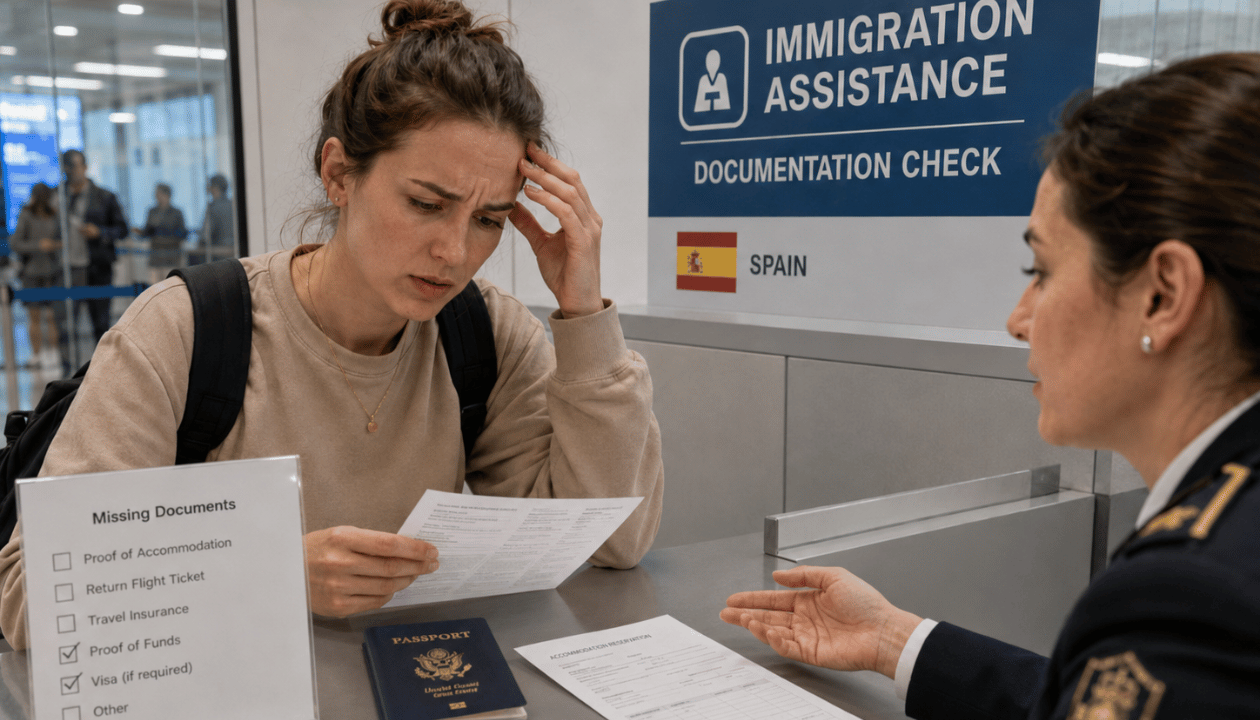
The third, and the most expensive one, is leaving documentation to the last minute. Criminal record certificates, apostilles, sworn translations and insurance policies all take longer than people expect. A correctable paperwork error is cheap if you catch it early and costly if you catch it after a deadline.
And the fourth is underestimating how much smoother everything goes when you arrive already speaking some Spanish. Every appointment, every office visit, every conversation with a landlord or an official is easier in the language. This is not a small detail. It is often the difference between a frustrating first month and a confident one.
A realistic scenario
Picture someone from Brazil who wants to spend three weeks in Spain this autumn improving their Spanish before a possible longer move. Under current rules, that is straightforward: they travel visa-free, get registered through EES at the border, and stay well within their 90 days. They cannot work during that stay, but they can study intensively, live with a local family, and use the time to genuinely test whether Spain is right for them.
If they later decide to stay long term, those weeks were not wasted. They arrive at the visa stage already comfortable in the language, already familiar with how things work, and already two years away from citizenship eligibility as an Ibero-American national. The short legal stay becomes the foundation for the long one. That is the smart way to approach Spain, and it is exactly the path the law rewards.
Where Spanish Express fits in
This is the natural next step for a lot of our students. If you are coming to Spain on a short legal stay, the most valuable thing you can do with that time is not sightseeing on autopilot. It is real immersion.
At Spanish Express, you live in the home of your teacher. You are not commuting to a classroom for two hours and then switching back to English for the rest of the day. You are speaking Spanish from day one, over breakfast, on walks, at dinner, in the unscripted moments where real fluency is actually built. For someone using a short stay to prepare for a longer life in Spain, that kind of immersion turns a tourist trip into genuine groundwork.
To be completely clear: Spanish Express does not provide visas or immigration services. We are a language immersion programme, not an immigration agency. What we do is make the time you legally spend in Spain count, so you arrive at any future step already speaking the language confidently.
If that sounds like the right next move for you, I would genuinely love to hear from you.
Mónica Romero Founder & Director, Spanish Express
WhatsApp: +44 7903 867 894
Email: monicaromero@spanishexpress.co.uk
Come and live the language, do not just study it.
This blog is for general information only and reflects Spain’s immigration framework as of May 2026. Immigration rules change frequently and individual circumstances vary, so for your specific situation we always recommend consulting a qualified Spanish immigration lawyer.
